Department of Neurology, University of Regensburg, Bezirksklinikum Regensburg, TEMPiS Telemedical Stroke Center, Regensburg, Germany.
CTS, Herdecke, Germany.
J Telemed Telecare. 2022 Aug;28(7):481-487. doi: 10.1177/1357633X20943327. Epub 2020 Aug 18.
During the COVID-19 pandemic emergency departments have noted a significant decrease in stroke patients. We performed a timely analysis of the Bavarian telestroke TEMPiS "working diagnosis" database.
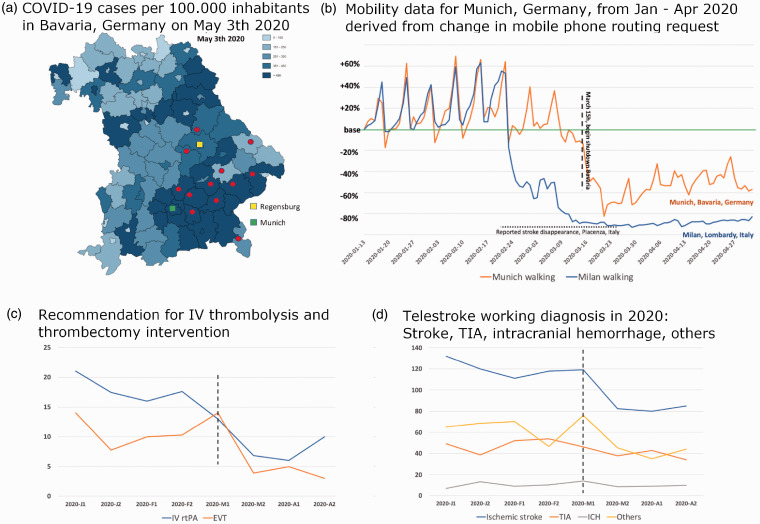
Twelve hospitals from the TEMPiS network were selected. Data collected for January through April in years 2017 through 2020 were extracted and analyzed for presumed and definite ischemic stroke (IS), amongst other disorders. In addition, recommendations for intravenous thrombolysis (rtPA) and endovascular thrombectomy (EVT) were noted and mobility data of the region analyzed. If statistically valid, group-comparison was tested with Fisher's exact test considering unpaired observations and ap-value < 0.05 was considered significant.
Upon lockdown in mid-March 2020, we observed a significant reduction in recommendations for rtPA compared to the preceding three years (14.7% [2017-2019] vs. 9.2% [2020], p = 0.0232). Recommendations for EVT were significantly higher in January to mid-March 2020 compared to 2017-2019 (5.4% [2017-2019] vs. 9.3% [2020], p = 0.0013) reflecting its increasing importance. Following the COVID-19 lockdown mid-March 2020 the number of EVT decreased back to levels in 2017-2019 (7.4% [2017-2019] vs. 7.6% [2020], p = 0.1719). Absolute numbers of IS decreased in parallel to mobility data.
The reduced stroke incidence during the COVID-19 pandemic may in part be explained by patient avoidance to seek emergency stroke care and may have an association to population mobility. Increasing mobility may induce a rebound effect and may conflict with a potential second COVID-19 wave. Telemedical networks may be ideal databases to study such effects in near-real time.
在 COVID-19 大流行期间,急诊科注意到中风患者数量显著减少。我们对巴伐利亚远程卒中 TEMPiS“工作诊断”数据库进行了及时分析。
选择 TEMPiS 网络中的 12 家医院。提取并分析了 2017 年至 2020 年 1 月至 4 月的数据,以确定疑似和明确的缺血性卒中(IS)以及其他疾病。此外,还记录了静脉溶栓(rtPA)和血管内血栓切除术(EVT)的建议,并分析了该地区的移动数据。如果具有统计学意义,则使用 Fisher 确切检验对组间比较进行检验,对于非配对观察,p 值<0.05 被认为具有统计学意义。
2020 年 3 月中旬实施封锁后,与前三年相比,rtPA 的建议显著减少(14.7%[2017-2019]与 9.2%[2020],p=0.0232)。2020 年 1 月至 3 月中旬 EVT 的建议明显高于 2017-2019 年(5.4%[2017-2019]与 9.3%[2020],p=0.0013),反映了其日益重要性。2020 年 3 月中旬 COVID-19 封锁后,EVT 的数量回落到 2017-2019 年的水平(7.4%[2017-2019]与 7.6%[2020],p=0.1719)。IS 的绝对数量与流动数据平行下降。
COVID-19 大流行期间中风发病率的降低部分可能归因于患者避免寻求急诊卒中治疗,并且可能与人口流动有关。增加流动性可能会产生反弹效应,并且可能与潜在的第二波 COVID-19 疫情相冲突。远程医疗网络可能是研究此类即时效果的理想数据库。