Department of Neurology, Second Affiliated Hospital of Chongqing Medical University, Chongqing, 400010, China.
Department of Neurology, First Affiliated Hospital of Army Medical University (Chongqing Southwest Hospital), Chongqing, 400038, China.
J Neurovirol. 2021 Feb;27(1):35-51. doi: 10.1007/s13365-021-00948-2. Epub 2021 Feb 3.
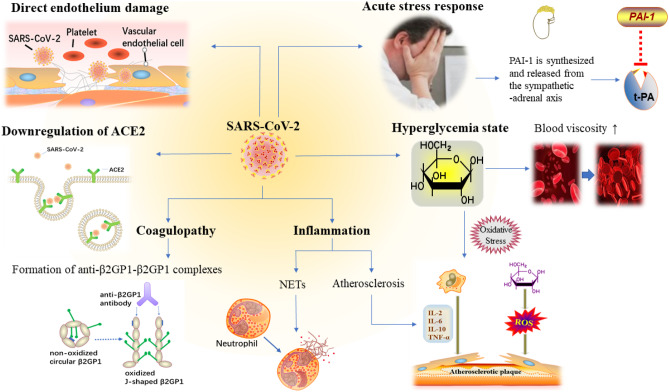
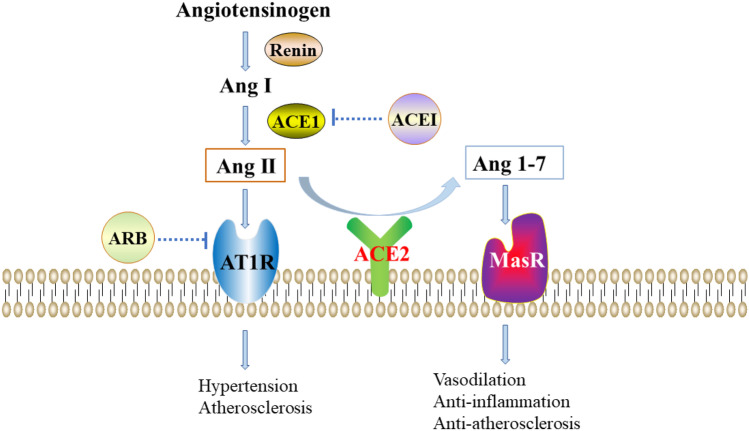
Since the outbreak of coronavirus disease 2019 (COVID-19) in 2019, it is gaining worldwide attention at the moment. Apart from respiratory manifestations, neurological dysfunction in COVID-19 patients, especially the occurrence of cerebrovascular diseases (CVD), has been intensively investigated. In this review, the effects of COVID-19 infection on CVD were summarized as follows: (I) angiotensin-converting enzyme 2 (ACE2) may be involved in the attack on vascular endothelial cells by severe acute respiratory syndrome coronavirus-2 (SARS-CoV-2), leading to endothelial damage and increased subintimal inflammation, which are followed by hemorrhage or thrombosis; (II) SARS-CoV-2 could alter the expression/activity of ACE2, consequently resulting in the disruption of renin-angiotensin system which is associated with the occurrence and progression of atherosclerosis; (III) upregulation of neutrophil extracellular traps has been detected in COVID-19 patients, which is closely associated with immunothrombosis; (IV) the inflammatory cascade induced by SARS-CoV-2 often leads to hypercoagulability and promotes the formation and progress of atherosclerosis; (V) antiphospholipid antibodies are also detected in plasma of some severe cases, which aggravate the thrombosis through the formation of immune complexes; (VI) hyperglycemia in COVID-19 patients may trigger CVD by increasing oxidative stress and blood viscosity; (VII) the COVID-19 outbreak is a global emergency and causes psychological stress, which could be a potential risk factor of CVD as coagulation, and fibrinolysis may be affected. In this review, we aimed to further our understanding of CVD-associated COVID-19 infection, which could improve the therapeutic outcomes of patients. Personalized treatments should be offered to COVID-19 patients at greater risk for stroke in future clinical practice.
自 2019 年爆发 2019 年冠状病毒病(COVID-19)以来,目前它在全球范围内受到关注。除了呼吸道表现外,COVID-19 患者的神经功能障碍,特别是脑血管疾病(CVD)的发生,已受到广泛研究。在这篇综述中,总结了 COVID-19 感染对 CVD 的影响如下:(I)血管紧张素转换酶 2(ACE2)可能参与严重急性呼吸综合征冠状病毒-2(SARS-CoV-2)对血管内皮细胞的攻击,导致内皮损伤和内膜下炎症增加,继而导致出血或血栓形成;(II)SARS-CoV-2 可改变 ACE2 的表达/活性,从而破坏肾素-血管紧张素系统,与动脉粥样硬化的发生和发展有关;(III)COVID-19 患者中检测到中性粒细胞细胞外陷阱的上调,这与免疫血栓形成密切相关;(IV)SARS-CoV-2 诱导的炎症级联反应常导致高凝状态,促进动脉粥样硬化的形成和进展;(V)一些严重病例的血浆中也检测到抗磷脂抗体,通过形成免疫复合物加重血栓形成;(VI)COVID-19 患者的高血糖可能通过增加氧化应激和血液粘度引发 CVD;(VII)COVID-19 大流行是全球紧急情况,会导致心理压力,这可能是 CVD 的潜在危险因素,因为凝血和纤溶可能会受到影响。在这篇综述中,我们旨在进一步了解 COVID-19 感染与 CVD 的关系,从而改善患者的治疗效果。在未来的临床实践中,应向有更高中风风险的 COVID-19 患者提供个性化治疗。