Department of Neurology, TEMPiS Telemedical Stroke Center, Bezirksklinikum Regensburg, University of Regensburg, Regensburg, Germany,
Department of Neurology, TEMPiS Telemedical Stroke Center, Bezirksklinikum Regensburg, University of Regensburg, Regensburg, Germany.
Cerebrovasc Dis. 2021;50(3):317-325. doi: 10.1159/000514154. Epub 2021 Feb 4.
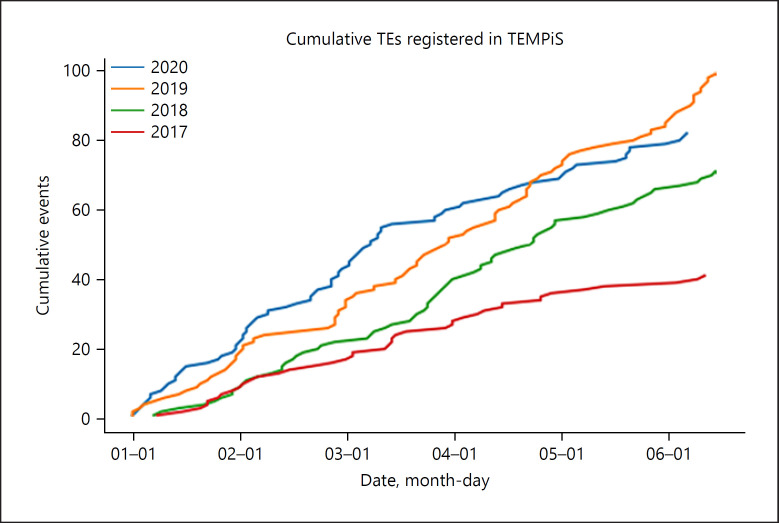
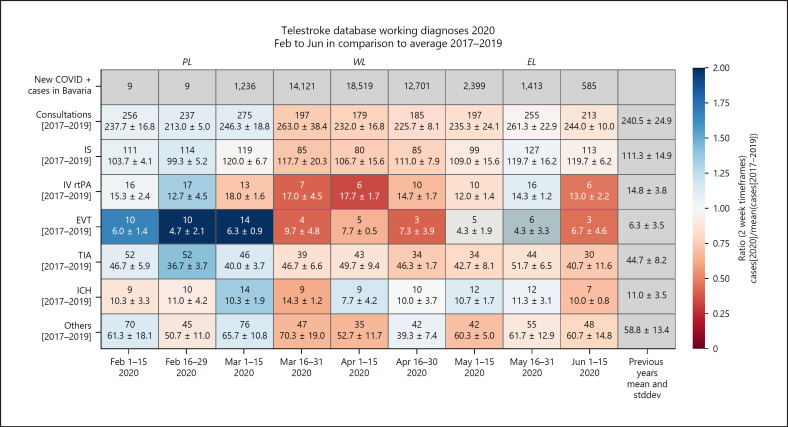
The COVID-19 pandemic lockdown (CPL) lead to a significant decrease in emergency admissions worldwide. We performed a timely analysis of ischemic stroke (IS) and related consultations using the telestroke TEMPiS "working diagnosis" database prior (PL), within (WL), and after easing (EL) of CPL.
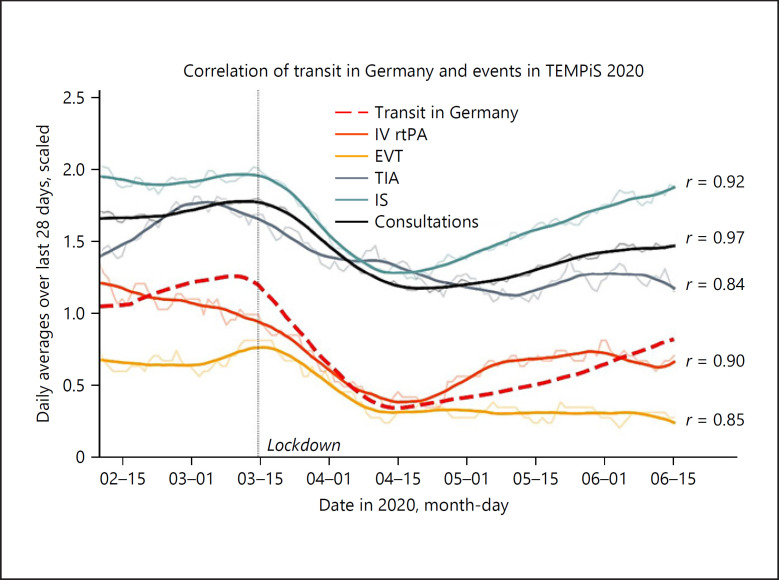
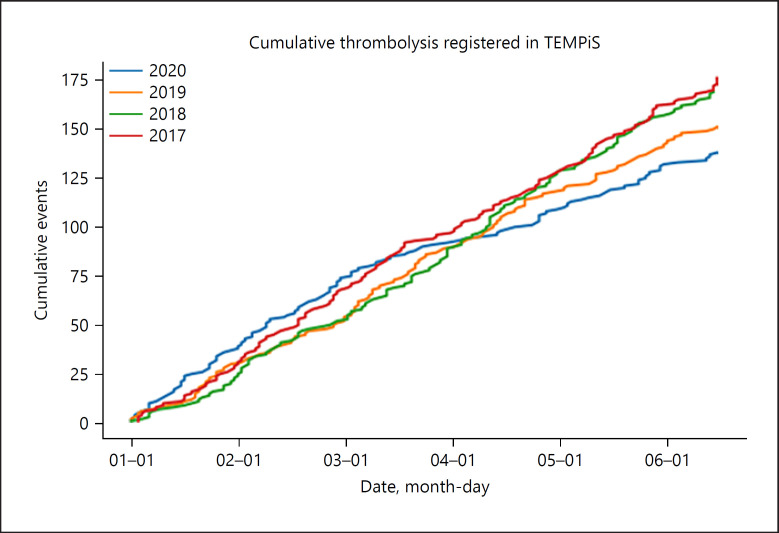
Twelve hospitals were selected and data analyzed regarding IS (including intravenous thrombolysis [intravenous recombinant tissue plasminogen; IV rtPA] and endovascular thrombectomy [EVT]) and related events from February 1 to June 15 during 2017-2020. In addition, we aimed to correlate events to various mobile phone mobility data.
Following the significant reduction of IS, IV rtPA, and EVT cases during WL compared to PL in 2020 longitudinally (p values <0.048), we observed increasing numbers of consultations, IS, recommendations for EVT, and IV rtPA with the network in EL over WL not reaching PL levels yet. Absolute numbers of all consultations paralleled best to mobility data of public transportation over walking and driving mobility.
While the decrease in emergency admissions including stroke during CPL can only be in part attributed by patients not seeking medical attention, stroke awareness in the pandemic, and direct COVID-19 triggered stroke remains of high importance. The number of consultations in TEMPiS during the lockdown parallels best with mobility of public transportation. As a consequence, exposure to common viruses, well-known triggers for acute cerebrovascular events and other diseases, are reduced and may add to the decline in stroke consultations. Further studies comparing national responses toward the course of the COVID-19 pandemic and stroke incidences are needed.
COVID-19 大流行封锁(CPL)导致全球紧急入院人数显著减少。我们利用远程卒中 TEMPiS“工作诊断”数据库,在 CPL 之前(PL)、期间(WL)和之后(EL),及时分析了缺血性卒中(IS)和相关咨询。
选择了 12 家医院,分析了 2017 年至 2020 年 2 月 1 日至 6 月 15 日期间 IS(包括静脉内重组组织纤溶酶原激活物 [IV rtPA]和血管内血栓切除术 [EVT])和相关事件的数据。此外,我们旨在将事件与各种移动电话移动数据相关联。
与 2020 年 PL 相比,WL 期间 IS、IV rtPA 和 EVT 病例明显减少(p 值<0.048),我们观察到咨询、IS、EVT 建议和 IV rtPA 的数量增加,EL 期间的网络与 WL 相比,但尚未达到 PL 水平。所有咨询的绝对数量与公共交通的移动性数据最相符,而步行和驾驶的移动性。
虽然 CPL 期间包括卒中在内的急诊入院人数减少只能部分归因于患者未寻求医疗救治,但大流行期间的卒中意识和直接 COVID-19 引发的卒中仍然非常重要。TEMPiS 在封锁期间的咨询数量与公共交通的流动性最相符。因此,接触常见病毒(急性脑血管事件和其他疾病的已知触发因素)减少,可能导致卒中咨询减少。需要进一步研究比较各国对 COVID-19 大流行过程和卒中发病率的反应。