Department of Neurology, Henry Ford Hospital, Detroit, MI, United States.
Department of Neurology, Henry Ford Hospital, Detroit, MI, United States; Department of Neurology, University of Minnesota, Minneapolis, MN, United States.
J Stroke Cerebrovasc Dis. 2021 Jun;30(6):105746. doi: 10.1016/j.jstrokecerebrovasdis.2021.105746. Epub 2021 Mar 26.
COVID-19 has impacted acute stroke care with several reports showing worldwide drops in stroke caseload during the pandemic. We studied the impact of COVID-19 on acute stroke care in our health system serving Southeast Michigan as we rolled out a policy to limit admissions and transfers.
in this retrospective study conducted at two stroke centers, we included consecutive patients presenting to the ED for whom a stroke alert was activated during the period extending from 3/20/20 to 5/20/20 and a similar period in 2019. We compared demographics, time metrics, and discharge outcomes between the two groups.
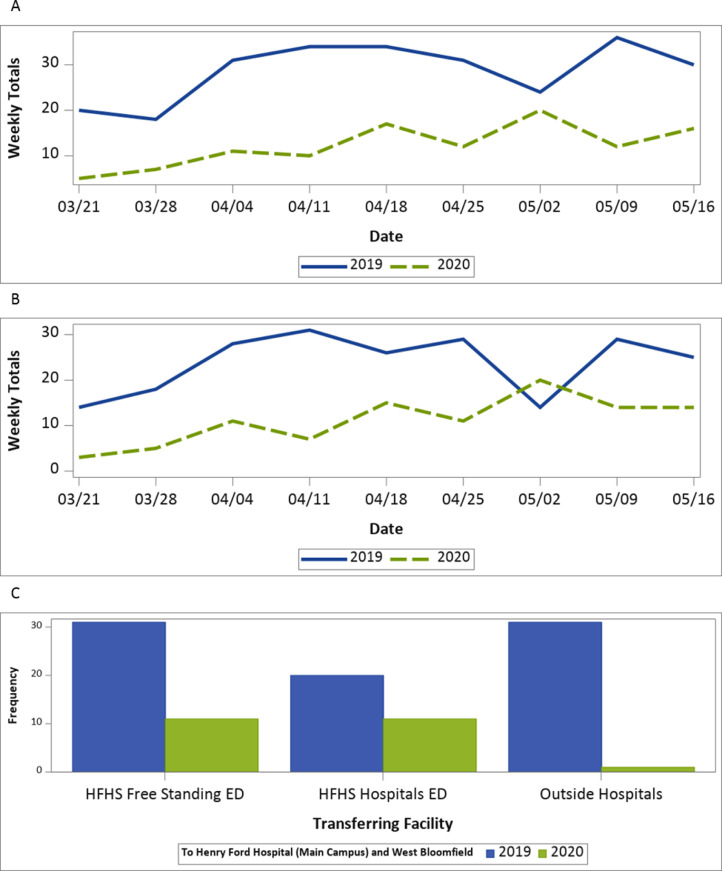
of 385 patients presented to the ED during the two time periods, 58% were African American. There was a significant decrease in the number of stroke patients presenting to the ED and admitted to the hospital between the two periods (p <0.001). In 2020, patients had higher presenting NIHSS (median: 2 vs 5, p = 0.012), discharge NIHSS (median: 2 vs 3, p = 0.004), and longer times from LKW to ED arrival (4.8 vs 9.4 h, p = 0.031) and stroke team activation (median: 10 vs 15 min, p = 0.006). In 2020, stroke mimics rates were lower among African Americans. There were fewer hospitalizations (p <0.001), and transfers from outside facilities (p = 0.015).
a trend toward faster stroke care in the ED was observed during the pandemic along with dramatically reduced numbers of ED visits, hospitalizations and stroke mimics. Delayed ED presentations and higher stroke severity characterized the African American population, highlighting deepening of racial disparities during the pandemic.
COVID-19 对急性脑卒中治疗产生了影响,有多项报道显示,大流行期间全球脑卒中患者数量有所下降。我们研究了在我们为服务东南部密歇根州而推出限制收治和转院政策的过程中,COVID-19 对我们的卫生系统急性脑卒中治疗的影响。
在这两所脑卒中中心进行的回顾性研究中,我们纳入了连续就诊于急诊科且脑卒中预警激活的患者,纳入时间为 2020 年 3 月 20 日至 5 月 20 日和 2019 年同期的类似时间段。我们比较了两组患者的人口统计学、时间指标和出院结局。
在两个时间段内,共有 385 名患者就诊于急诊科,其中 58%为非裔美国人。与两个时间段相比,就诊于急诊科并收入院的脑卒中患者数量显著减少(p<0.001)。2020 年,患者入院时 NIHSS 评分更高(中位数:2 分比 5 分,p=0.012)、出院时 NIHSS 评分更高(中位数:2 分比 3 分,p=0.004)、从 LKW 至急诊科到达的时间更长(中位数:4.8 小时比 9.4 小时,p=0.031)、脑卒中团队激活时间更长(中位数:10 分钟比 15 分钟,p=0.006)。2020 年,非裔美国人的脑卒中模拟疾病比例较低。住院人数(p<0.001)和从外部医疗机构转院的人数(p=0.015)均减少。
大流行期间,急诊科脑卒中治疗的速度呈加快趋势,同时就诊人数、住院人数和脑卒中模拟疾病数量显著减少。ED 就诊时间延迟和更高的脑卒中严重程度是非洲裔美国人的特征,突显了大流行期间种族差异的加深。