Faculty of Natural Sciences and Mathematics, Institute of Biology, "Sts, Cyril and Methodius" University, Skopje, Macedonia.
Department of Premedical Courses-Biology, Faculty of Medicine, University of Prishtina, St. Martyrs' Boulevard n.n., Prishtina, Kosovo, Serbia.
Physiol Rep. 2020 Aug;8(16):e14555. doi: 10.14814/phy2.14555.
This study was undertaken to test the hypothesis that the newly synthesized curcuminoids B2BrBC and C66 supplementation will overcome hyperoxia-induced tracheal hyperreactivity and impairment of relaxation of tracheal smooth muscle (TSM).
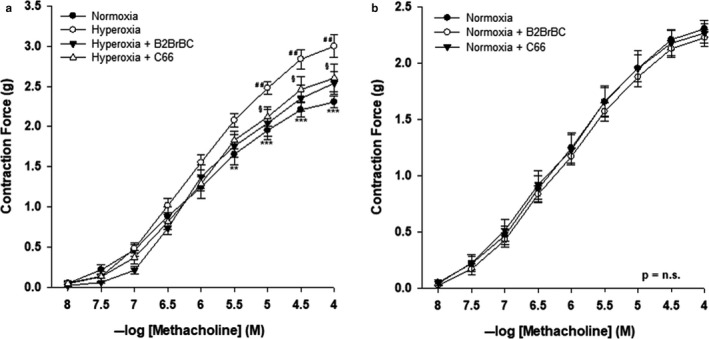
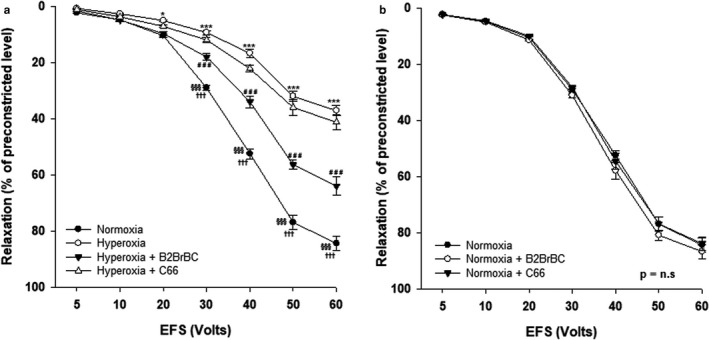
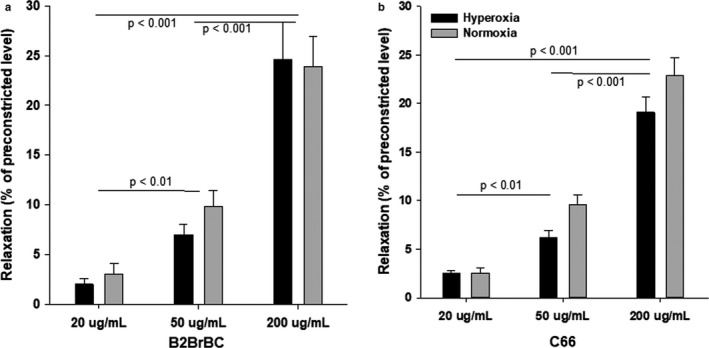
Rat pups (P5) were exposed to hyperoxia (>95% O ) or normoxia for 7 days. At P12, tracheal cylinders were used to study in vitro contractile responses induced by methacholine (10 -10 M) or relaxation induced by electrical field stimulation (5-60 V) in the presence/absence of B2BrBC or C66, or to study the direct relaxant effects elicited by both analogs.
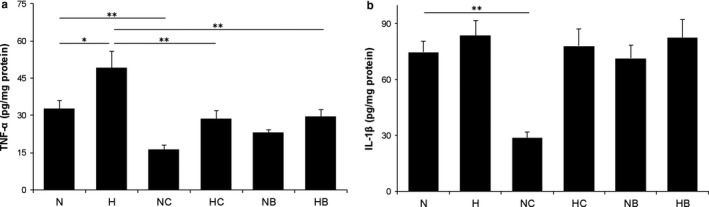
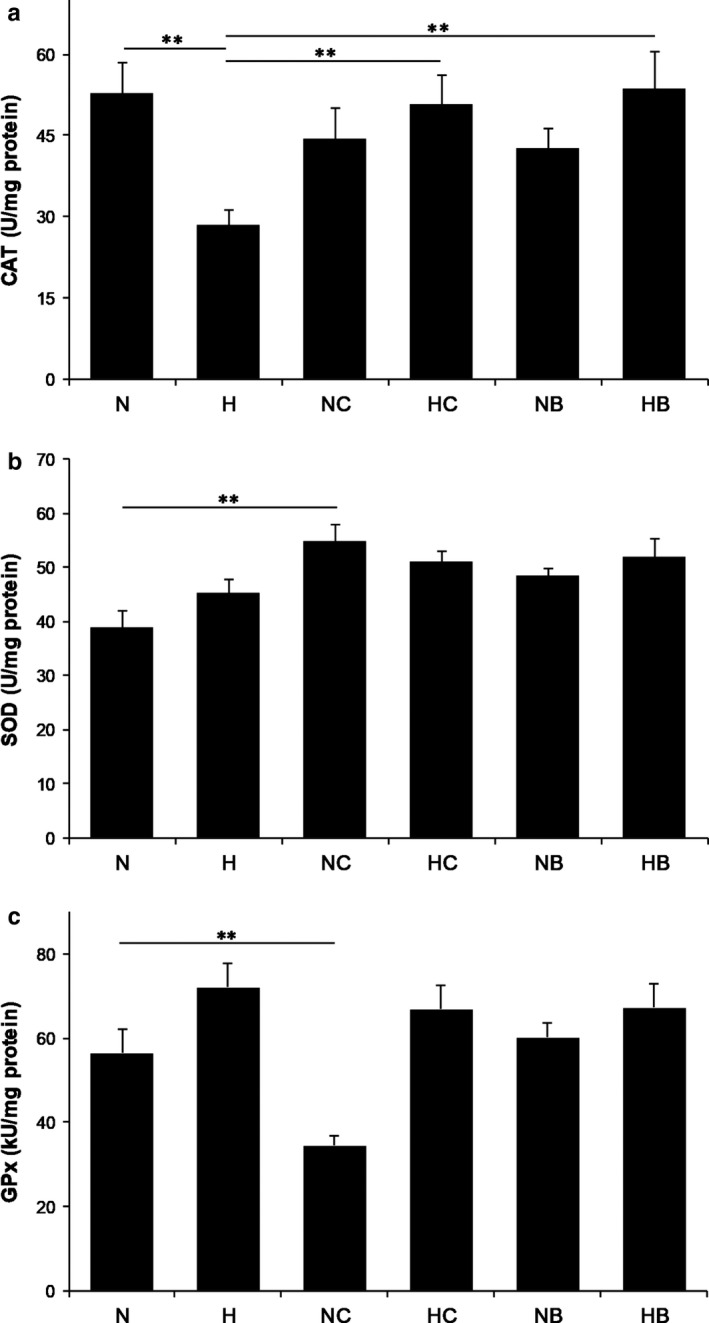
Hyperoxia significantly increased contraction and decreased relaxation of TSM compared to normoxia controls. Presence of B2BrBC or C66 normalized both contractile and relaxant responses altered by hyperoxia. Both, curcuminoids directly induced dose-dependent relaxation of preconstricted TSM. Supplementation of hyperoxic animals with B2BrBC or C66, significantly increased catalase activity. Lung TNF-α was significantly increased in hyperoxia-exposed animals. Both curcumin analogs attenuated increases in TNF-α in hyperoxic animals.
We show that B2BrBC and C66 provide protection against adverse contractility and relaxant effect of hyperoxia on TSM, and whole lung inflammation. Both analogs induced direct relaxation of TSM. Through restoration of catalase activity in hyperoxia, we speculate that analogs are protective against hyperoxia-induced tracheal hyperreactivity by augmenting H O catabolism. Neonatal hyperoxia induces increased tracheal contractility, attenuates tracheal relaxation, diminishes lung antioxidant capacity, and increases lung inflammation, while monocarbonyl CUR analogs were protective of these adverse effects of hyperoxia. Analogs may be promising new therapies for neonatal hyperoxic airway and lung disease.
本研究旨在验证以下假设,即新合成的姜黄素 B2BrBC 和 C66 补充剂将克服高氧诱导的气管高反应性和气管平滑肌松弛受损。
将大鼠幼仔(P5)暴露于高氧(>95% O2)或常氧下 7 天。在 P12 时,使用气管圆柱研究在存在/不存在 B2BrBC 或 C66 的情况下,由乙酰甲胆碱(10-10 M)诱导的体外收缩反应或由电场刺激(5-60 V)诱导的松弛反应,或研究两种类似物引起的直接松弛作用。
与常氧对照组相比,高氧显著增加了 TSM 的收缩并降低了其松弛。B2BrBC 或 C66 的存在使高氧引起的收缩和松弛反应均恢复正常。两种姜黄素类似物均直接诱导预收缩 TSM 的剂量依赖性松弛。高氧动物补充 B2BrBC 或 C66 显著增加了过氧化氢酶的活性。高氧暴露动物的肺 TNF-α显著增加。两种姜黄素类似物均减轻了高氧动物 TNF-α 的增加。
我们表明 B2BrBC 和 C66 可防止高氧对 TSM 和全肺炎症的不利收缩性和松弛作用。两种类似物均直接诱导 TSM 松弛。通过在高氧中恢复过氧化氢酶的活性,我们推测类似物通过增加 H2O2 的代谢来防止高氧诱导的气管高反应性。新生鼠高氧导致气管收缩性增加,松弛性降低,肺抗氧化能力降低,肺炎症增加,而单羰基 CUR 类似物对高氧的这些不利影响具有保护作用。类似物可能是新生儿高氧性气道和肺部疾病的有前途的新疗法。