University of Hawaii Cancer Center, 701 Ilalo Street, Honolulu, HI, 96813, USA.
Department of Molecular Biosciences and Bioengineering, University of Hawaii at Manoa, Honolulu, HI, USA.
Sci Rep. 2020 Aug 20;10(1):14059. doi: 10.1038/s41598-020-70703-w.
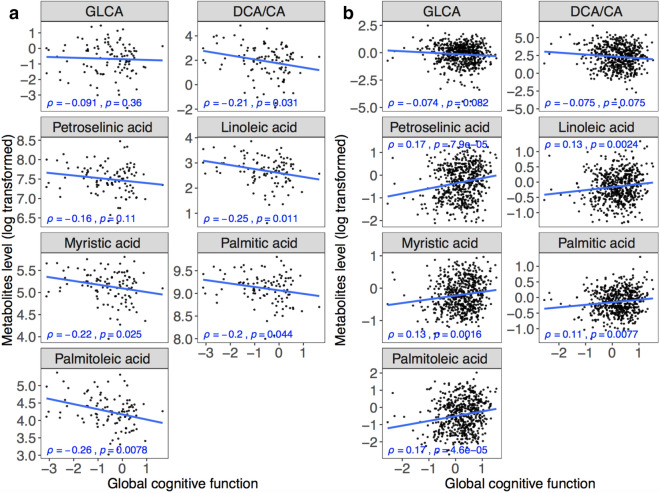
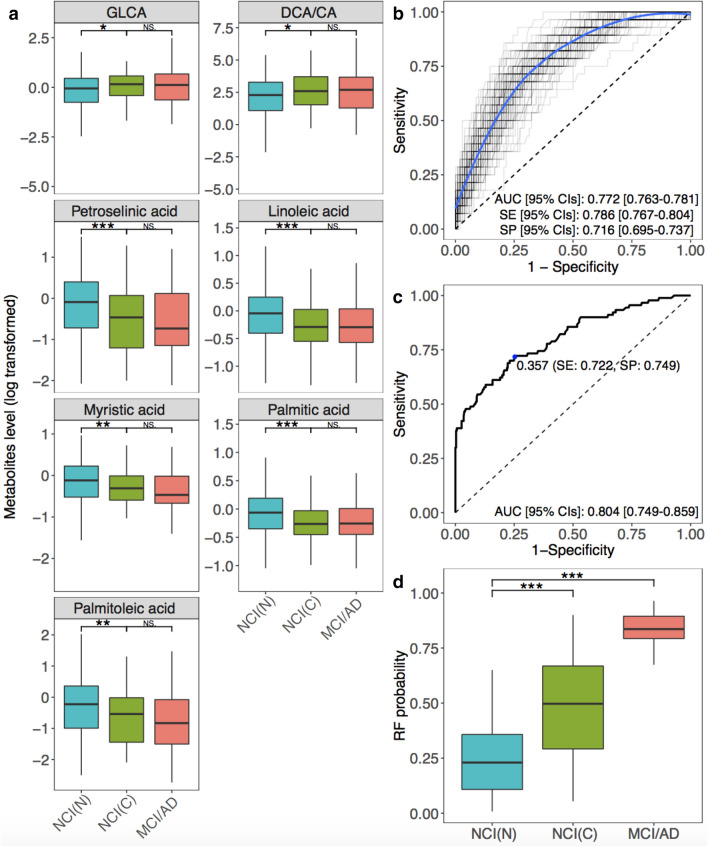
The incidence of Alzheimer's disease (AD) increases with age and is becoming a significant cause of worldwide morbidity and mortality. However, the metabolic perturbation behind the onset of AD remains unclear. In this study, we performed metabolite profiling in both brain (n = 109) and matching serum samples (n = 566) to identify differentially expressed metabolites and metabolic pathways associated with neuropathology and cognitive performance and to identify individuals at high risk of developing cognitive impairment. The abundances of 6 metabolites, glycolithocholate (GLCA), petroselinic acid, linoleic acid, myristic acid, palmitic acid, palmitoleic acid and the deoxycholate/cholate (DCA/CA) ratio, along with the dysregulation scores of 3 metabolic pathways, primary bile acid biosynthesis, fatty acid biosynthesis, and biosynthesis of unsaturated fatty acids showed significant differences across both brain and serum diagnostic groups (P-value < 0.05). Significant associations were observed between the levels of differential metabolites/pathways and cognitive performance, neurofibrillary tangles, and neuritic plaque burden. Metabolites abundances and personalized metabolic pathways scores were used to derive machine learning models, respectively, that could be used to differentiate cognitively impaired persons from those without cognitive impairment (median area under the receiver operating characteristic curve (AUC) = 0.772 for the metabolite level model; median AUC = 0.731 for the pathway level model). Utilizing these two models on the entire baseline control group, we identified those who experienced cognitive decline in the later years (AUC = 0.804, sensitivity = 0.722, specificity = 0.749 for the metabolite level model; AUC = 0.778, sensitivity = 0.633, specificity = 0.825 for the pathway level model) and demonstrated their pre-AD onset prediction potentials. Our study provides a proof-of-concept that it is possible to discriminate antecedent cognitive impairment in older adults before the onset of overt clinical symptoms using metabolomics. Our findings, if validated in future studies, could enable the earlier detection and intervention of cognitive impairment that may halt its progression.
阿尔茨海默病(AD)的发病率随着年龄的增长而增加,正在成为全球发病率和死亡率的重要原因。然而,AD 发病背后的代谢紊乱仍不清楚。在这项研究中,我们对大脑(n=109)和匹配的血清样本(n=566)进行了代谢物谱分析,以鉴定与神经病理学和认知表现相关的差异表达代谢物和代谢途径,并鉴定出有发生认知障碍高风险的个体。6 种代谢物(甘氨胆酸(GLCA)、芹菜甲素、亚油酸、肉豆蔻酸、棕榈酸、棕榈油酸)的丰度和脱氧胆酸/胆酸(DCA/CA)比值以及 3 种代谢途径(初级胆汁酸生物合成、脂肪酸生物合成和不饱和脂肪酸生物合成)的失调评分在大脑和血清诊断组中均有显著差异(P 值<0.05)。差异代谢物/途径的水平与认知表现、神经原纤维缠结和神经纤维斑块负担之间存在显著相关性。代谢物丰度和个性化代谢途径评分分别用于推导机器学习模型,可用于区分认知障碍者和无认知障碍者(基于代谢物水平模型的中位数受试者工作特征曲线(ROC)下面积(AUC)=0.772;基于途径水平模型的中位数 AUC=0.731)。利用这两个模型对整个基线对照组进行分析,我们确定了那些在随后几年经历认知能力下降的人(基于代谢物水平模型的 AUC=0.804,敏感性=0.722,特异性=0.749;基于途径水平模型的 AUC=0.778,敏感性=0.633,特异性=0.825),并证明了它们在 AD 发作前的预测潜力。我们的研究提供了一个概念验证,即使用代谢组学可以区分老年人在明显临床症状出现之前的认知障碍前兆。如果在未来的研究中得到验证,我们的发现可能会更早地发现和干预认知障碍,从而阻止其进展。