Department of English Language and Literature, Hanyang University, Seoul, Korea.
Hanyang Institute for Phonetics and Cognitive Sciences of Language, Hanyang University, Seoul, Korea.
Hum Brain Mapp. 2020 Dec;41(17):4935-4951. doi: 10.1002/hbm.25171. Epub 2020 Aug 21.
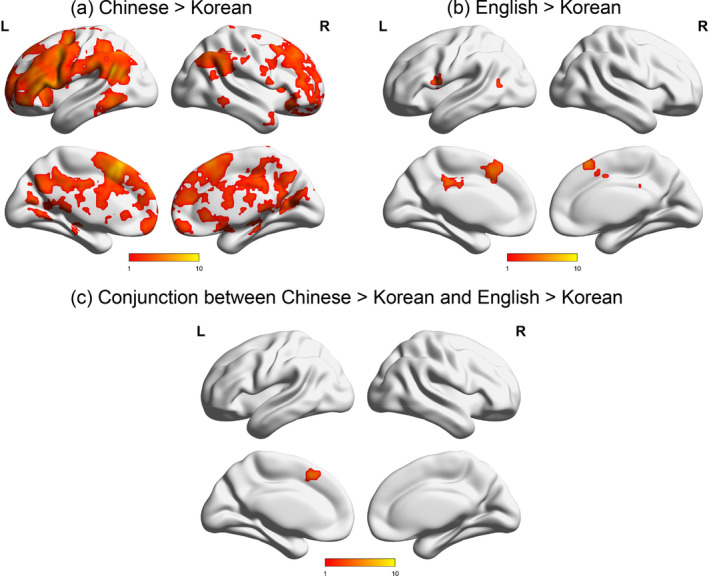
Despite substantial research on the brain mechanisms of L1 and L2 processing in bilinguals, it is still unknown whether language modality (i.e., visual vs. auditory) plays a role in determining whether L1 and L2 are processed similarly. Therefore, we examined the neural representational similarity in neural networks between L1 and L2 in spoken and written word processing in Korean-English-Chinese trilinguals. Participants performed both visual and auditory rhyming judgments in the three languages: Korean, English, and Chinese. The results showed greater similarity among the three languages in the auditory modality than in the visual modality, suggesting more differentiated networks for written word processing in the three languages than spoken word processing. In addition, there was less similarity between spoken and written word processing in L1 than the L2s, suggesting a more specialized network for each modality in L1 than L2s. Finally, the similarity between the two L2s (i.e., Chinese and English) was greater than that between each L2 and L1 after task performance was regressed out, especially in the visual modality, suggesting that L2s are processed similarly. These findings provide important insights about spoken and written language processing in the bilingual brain.
尽管人们对双语者的 L1 和 L2 加工的大脑机制进行了大量研究,但语言模态(即视觉与听觉)是否在决定 L1 和 L2 是否以相似方式加工方面起作用仍不得而知。因此,我们在韩语-英语-汉语三语者中检查了口语和书面语加工过程中 L1 和 L2 的神经网络的神经表示相似性。参与者在三种语言(韩语、英语和汉语)中执行视觉和听觉押韵判断。结果表明,听觉模态中三种语言之间的相似性大于视觉模态,表明三种语言的书面语处理比口语处理具有更分化的网络。此外,L1 的口语和书面语处理之间的相似性小于 L2s,表明 L1 中每种模态的网络比 L2s 更专业化。最后,在任务表现被回归后,两个 L2(即中文和英文)之间的相似性大于每个 L2 和 L1 之间的相似性,尤其是在视觉模态中,表明 L2 以相似的方式被处理。这些发现为双语者大脑中的口语和书面语处理提供了重要的见解。