Mpilla Gabriel Benyomo, Philip Philip Agop, El-Rayes Bassel, Azmi Asfar Sohail
Department of Oncology, Wayne State University School of Medicine, Detroit, MI 48201, United States.
Department of Hematology Oncology, Emory Winship Institute, Atlanta, GA 30322, United States.
World J Gastroenterol. 2020 Jul 28;26(28):4036-4054. doi: 10.3748/wjg.v26.i28.4036.
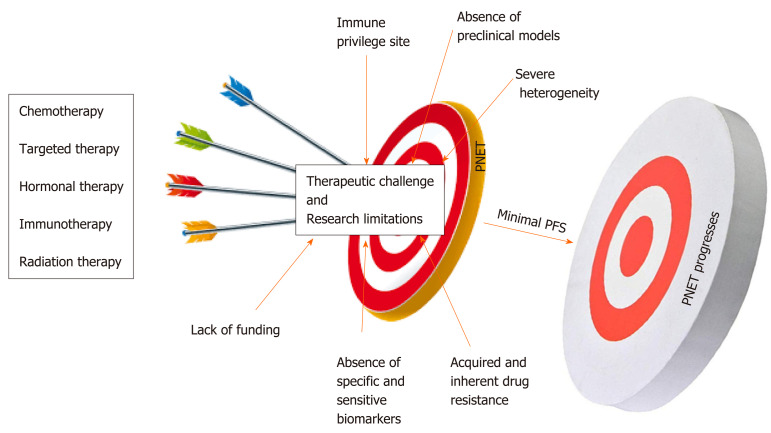
Pancreatic neuroendocrine tumors (PNETs) are known to be the second most common epithelial malignancy of the pancreas. PNETs can be listed among the slowest growing as well as the fastest growing human cancers. The prevalence of PNETs is deceptively low; however, its incidence has significantly increased over the past decades. According to the American Cancer Society's estimate, about 4032 (> 7% of all pancreatic malignancies) individuals will be diagnosed with PNETs in 2020. PNETs often cause severe morbidity due to excessive secretion of hormones (such as serotonin) and/or overall tumor mass. Patients can live for many years (except for those patients with poorly differentiated G3 neuroendocrine tumors); thus, the prevalence of the tumors that is the number of patients actually dealing with the disease at any given time is fairly high because the survival is much longer than pancreatic ductal adenocarcinoma. Due to significant heterogeneity, the management of PNETs is very complex and remains an unmet clinical challenge. In terms of research studies, modest improvements have been made over the past decades in the identification of potential oncogenic drivers in order to enhance the quality of life and increase survival for this growing population of patients. Unfortunately, the majority of systematic therapies approved for the management of advanced stage PNETs lack objective response or at most result in modest benefits in survival. In this review, we aim to discuss the broad challenges associated with the management and the study of PNETs.
胰腺神经内分泌肿瘤(PNETs)是胰腺第二常见的上皮性恶性肿瘤。PNETs可列为生长最慢以及生长最快的人类癌症之一。PNETs的患病率看似较低;然而,在过去几十年中其发病率显著上升。根据美国癌症协会的估计,2020年约有4032人(占所有胰腺恶性肿瘤的7%以上)将被诊断为PNETs。PNETs常因激素(如血清素)过度分泌和/或肿瘤总体积而导致严重发病。患者可以存活多年(分化差的G3神经内分泌肿瘤患者除外);因此,肿瘤的患病率,即在任何给定时间实际患有该疾病的患者数量相当高,因为其生存期比胰腺导管腺癌长得多。由于显著的异质性,PNETs的治疗非常复杂,仍然是一个未满足的临床挑战。在研究方面,过去几十年在识别潜在致癌驱动因素方面取得了适度进展,以提高这一不断增长的患者群体的生活质量并延长生存期。不幸的是,大多数被批准用于治疗晚期PNETs的系统疗法缺乏客观反应,或者最多只能在生存期方面带来适度益处。在这篇综述中,我们旨在讨论与PNETs治疗和研究相关的广泛挑战。