Alkasaby Mona Khyri, Abd El-Fattah Abeer Ibrahim, Ibrahim Iman Hassan, Abd El-Samie Hesham Samir
Department of Biochemistry and Molecular Biology, Faculty of Pharmacy (Girls), Al-Azhar University, Nasr City, Cairo, Egypt.
Department of Clinical Pathology, Faculty of Medicine (New Damietta), Al-Azhar University, New Damietta, Damietta, Egypt.
Pharmgenomics Pers Med. 2020 Aug 6;13:273-282. doi: 10.2147/PGPM.S260682. eCollection 2020.
Polymorphisms of DNA repair genes may contribute to variations in DNA repair capacity and subsequent genetic susceptibility to different cancers. In Egypt, breast cancer is the most common cancer among women, representing 18.9% of the total cancer cases. The present study assesses the correlation between X-ray repair cross-complementing group 3 () polymorphism with breast cancer and treatment response in Egyptian female breast cancer patients.
This pilot case-control study was conducted on 66 female breast cancer patients and 20 apparently healthy females as a control group. Tumor grading, immunohistostaining of hormone (progesterone and estrogen) receptors and human epidermal growth factor receptor 2 (HER2), and RFLP-PCR for (rs861539) polymorphism were performed. All breast cancer patients received a treatment protocol (after surgery) which was either chemotherapy (anthracyclines followed by paclitaxel or anthracyclines + fluorouracil) or radiotherapy, or both. Disease-free survival (DFS) and overall survival (OS) were recorded.
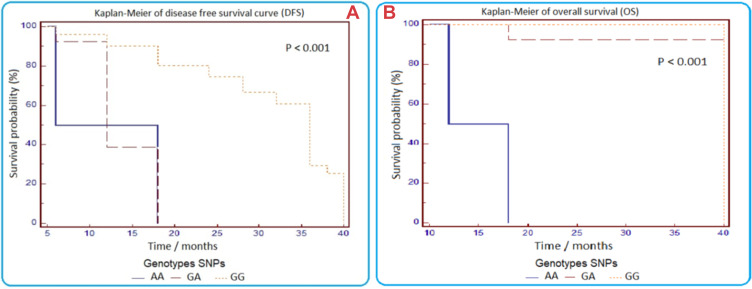
The number of patients with a heterozygous allele (GA) was significantly higher in cases of tumor size >20 mm. The A allele was correlated with younger age at diagnosis in both chemotherapy and radiotherapy groups. Poor treatment response and higher mortality rates were significantly associated with AA and GA compared with GG alleles (normal allele). In the chemotherapy group, out of eight patients with the A allele, six showed a poor response to treatment containing fluorouracil.
XRCC3 rs861539 polymorphism could be associated with lower DFS and OS and poor treatment response. So, we recommend carrying out genotyping before starting treatment to choose the most effective treatment strategy according to polymorphism.
DNA修复基因的多态性可能导致DNA修复能力的差异以及随后对不同癌症的遗传易感性。在埃及,乳腺癌是女性中最常见的癌症,占所有癌症病例的18.9%。本研究评估埃及女性乳腺癌患者中X射线修复交叉互补基因3(XRCC3)多态性与乳腺癌及治疗反应之间的相关性。
本前瞻性病例对照研究对66例女性乳腺癌患者和20例明显健康的女性作为对照组进行。进行了肿瘤分级、激素(孕激素和雌激素)受体及人表皮生长因子受体2(HER2)的免疫组化染色,以及XRCC3(rs861539)多态性的限制性片段长度多态性聚合酶链反应(RFLP-PCR)。所有乳腺癌患者在手术后接受了治疗方案,包括化疗(蒽环类药物后接紫杉醇或蒽环类药物+氟尿嘧啶)或放疗,或两者皆有。记录无病生存期(DFS)和总生存期(OS)。
肿瘤大小>20mm的病例中,杂合等位基因(GA)患者数量显著更高。在化疗和放疗组中,A等位基因与诊断时较年轻的年龄相关。与GG等位基因(正常等位基因)相比,AA和GA与较差的治疗反应和更高的死亡率显著相关。在化疗组中,8例携带A等位基因的患者中,有6例对含氟尿嘧啶的治疗反应不佳。
XRCC3 rs861539多态性可能与较低的DFS和OS以及较差的治疗反应相关。因此,我们建议在开始治疗前进行XRCC3基因分型,以便根据多态性选择最有效的治疗策略。