Noble Robert, Burley John T, Le Sueur Cécile, Hochberg Michael E
Department of Biosystems Science and Engineering ETH Zurich Basel Switzerland.
SIB Swiss Institute of Bioinformatics Basel Switzerland.
Evol Appl. 2020 Jul 18;13(7):1558-1568. doi: 10.1111/eva.13057. eCollection 2020 Aug.
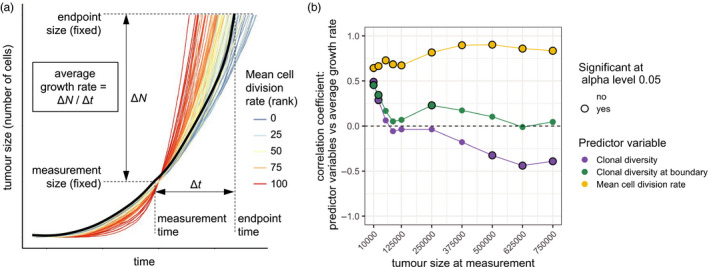
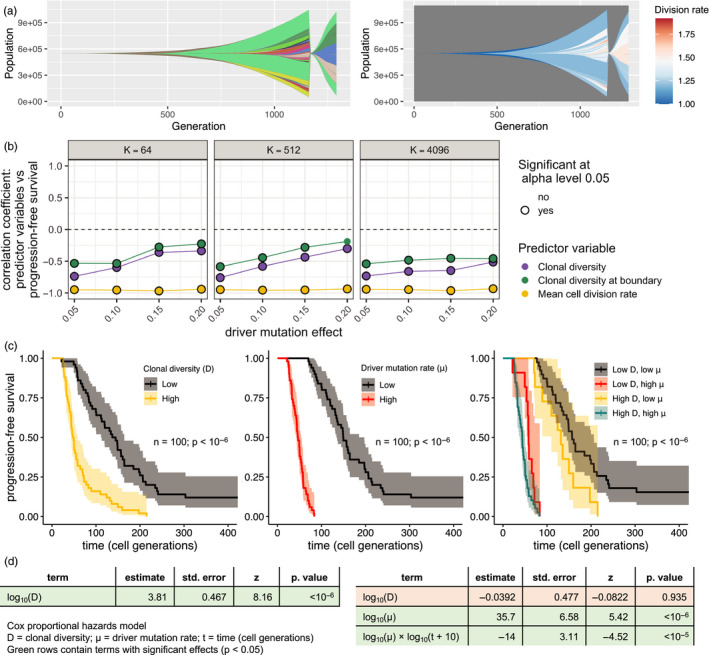
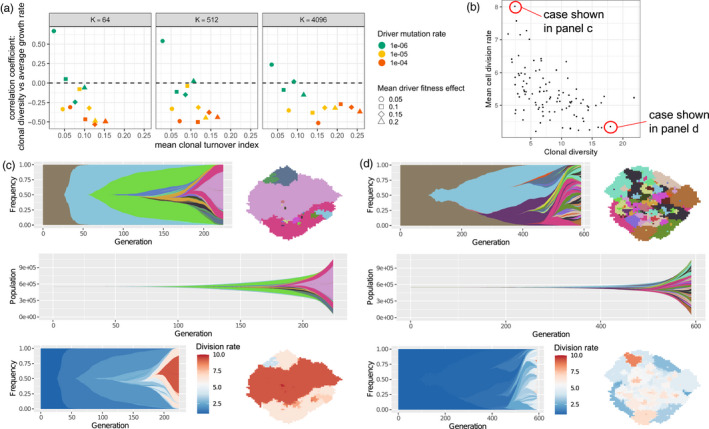
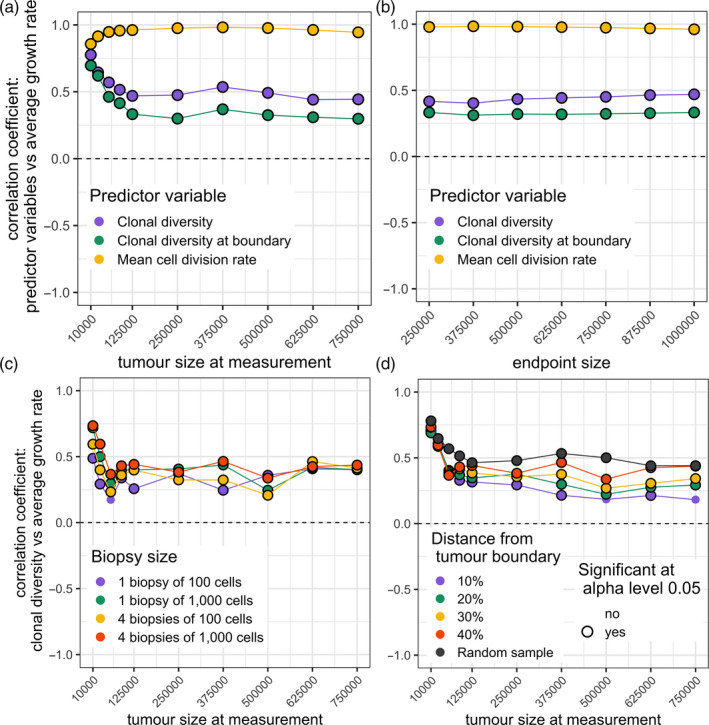
The utility of intratumour heterogeneity as a prognostic biomarker is the subject of ongoing clinical investigation. However, the relationship between this marker and its clinical impact is mediated by an evolutionary process that is not well understood. Here, we employ a spatial computational model of tumour evolution to assess when, why and how intratumour heterogeneity can be used to forecast tumour growth rate and progression-free survival. We identify three conditions that can lead to a positive correlation between clonal diversity and subsequent growth rate: diversity is measured early in tumour development; selective sweeps are rare; and/or tumours vary in the rate at which they acquire driver mutations. Opposite conditions typically lead to negative correlation. In cohorts of tumours with diverse evolutionary parameters, we find that clonal diversity is a reliable predictor of both growth rate and progression-free survival. We thus offer explanations-grounded in evolutionary theory-for empirical findings in various cancers, including survival analyses reported in the recent TRACERx Renal study of clear-cell renal cell carcinoma. Our work informs the search for new prognostic biomarkers and contributes to the development of predictive oncology.
肿瘤内异质性作为一种预后生物标志物的效用是正在进行的临床研究的主题。然而,这种标志物与其临床影响之间的关系是由一个尚未完全理解的进化过程介导的。在这里,我们采用肿瘤进化的空间计算模型来评估何时、为何以及如何利用肿瘤内异质性来预测肿瘤生长速率和无进展生存期。我们确定了三种可导致克隆多样性与后续生长速率呈正相关的情况:在肿瘤发展早期测量多样性;选择性清除很少见;和/或肿瘤获得驱动突变的速率不同。相反的情况通常导致负相关。在具有不同进化参数的肿瘤队列中,我们发现克隆多样性是生长速率和无进展生存期的可靠预测指标。因此,我们基于进化理论为各种癌症的实证研究结果提供了解释,包括最近TRACERx肾透明细胞肾细胞癌研究中报告的生存分析。我们的工作为寻找新的预后生物标志物提供了信息,并有助于预测肿瘤学的发展。