China CDC Key Laboratory of Environment and Population Health, National Institute of Environmental Health, Chinese Center for Disease Control and Prevention, Beijing 100021, China; Center for Global Health, School of Public Health, Nanjing Medical University, Nanjing, Jiangsu 211166, China.
China CDC Key Laboratory of Environment and Population Health, National Institute of Environmental Health, Chinese Center for Disease Control and Prevention, Beijing 100021, China.
Environ Int. 2020 Nov;144:106039. doi: 10.1016/j.envint.2020.106039. Epub 2020 Aug 7.
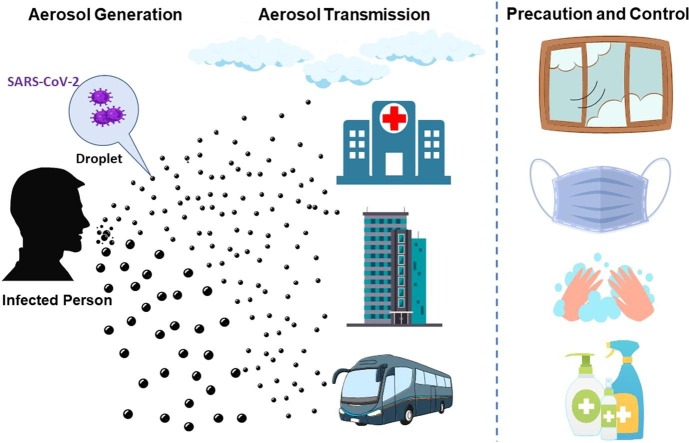
As public health teams respond to the pandemic of coronavirus disease 2019 (COVID-19), containment and understanding of the modes of severe acute respiratory syndrome coronavirus 2 (SARS-CoV-2) transmission is of utmost importance for policy making. During this time, governmental agencies have been instructing the community on handwashing and physical distancing measures. However, there is no agreement on the role of aerosol transmission for SARS-CoV-2. To this end, we aimed to review the evidence of aerosol transmission of SARS-CoV-2. Several studies support that aerosol transmission of SARS-CoV-2 is plausible, and the plausibility score (weight of combined evidence) is 8 out of 9. Precautionary control strategies should consider aerosol transmission for effective mitigation of SARS-CoV-2.
当公共卫生团队应对 2019 年冠状病毒病(COVID-19)大流行时,遏制和理解严重急性呼吸系统综合征冠状病毒 2(SARS-CoV-2)的传播模式对于制定政策至关重要。在此期间,政府机构一直在指导社区采取洗手和保持身体距离的措施。然而,对于 SARS-CoV-2 的气溶胶传播作用尚无定论。为此,我们旨在审查 SARS-CoV-2 气溶胶传播的证据。有几项研究支持 SARS-CoV-2 的气溶胶传播是合理的,其合理性得分(综合证据权重)为 9 分中的 8 分。预防控制策略应考虑气溶胶传播,以有效减轻 SARS-CoV-2 的传播。