Kang Seo Young, Kim Ye-Jee, Park Hye Soon
International Healthcare Center, Asan Medical Center, Seoul 05505, Korea.
Department of Clinical Epidemiology and Biostatistics, Asan Medical Center, Seoul 05505, Korea.
J Clin Med. 2020 Aug 13;9(8):2626. doi: 10.3390/jcm9082626.
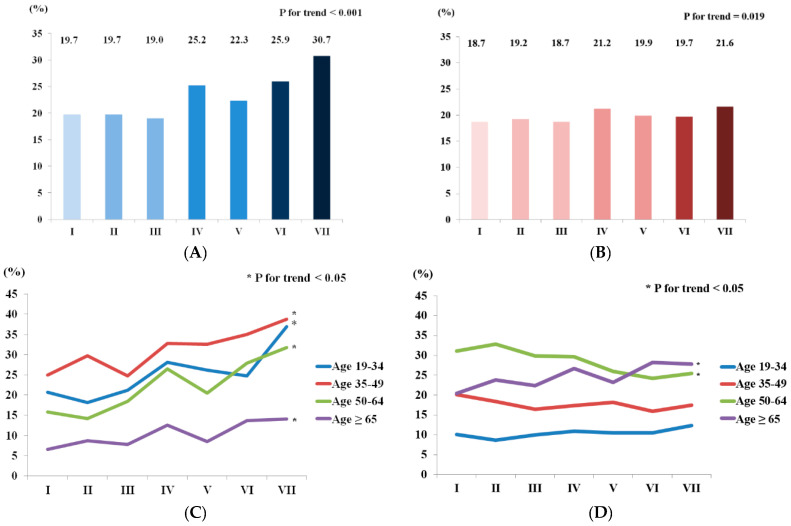
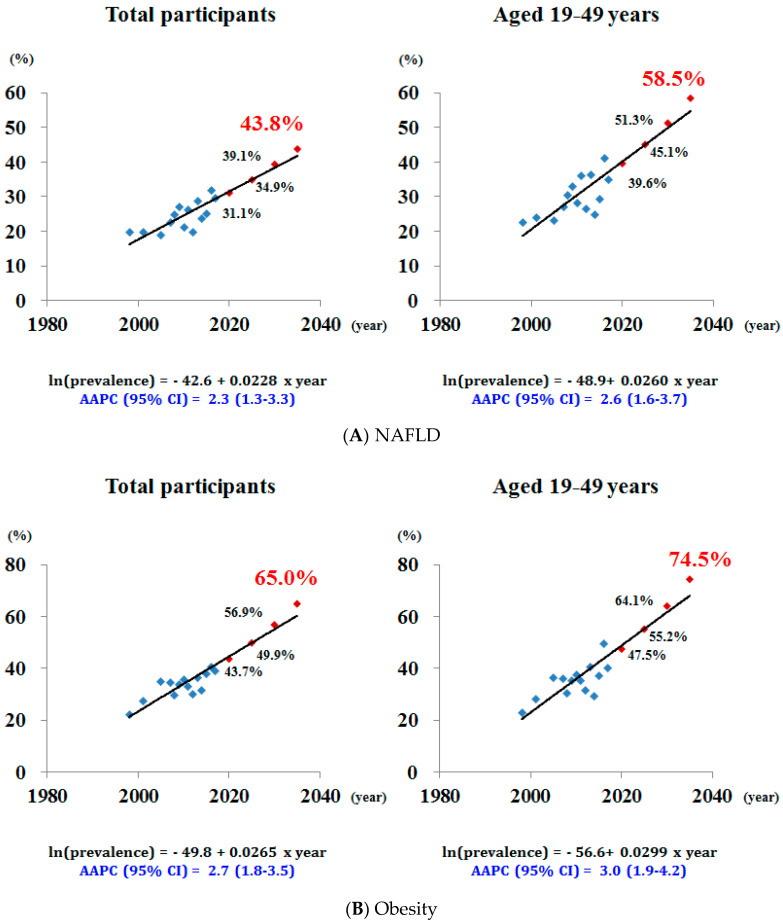
Non-alcoholic fatty liver disease (NAFLD) is a serious health concern as it can progress to liver cirrhosis and hepatoma. We investigated past trends in the prevalence of NAFLD and related factors among Korean men and women from 1998 to 2017 and predicted their future prevalence among Korean men. We used data from the Korea National Health and Nutrition Examination Survey I-VII (KNHANES). NAFLD was defined as a hepatic steatosis index of >36. Subjects with viral hepatitis, liver cirrhosis, cancer, pregnancy, and a habit of drinking ≥30 g alcohol per occasion were excluded. We evaluated the prevalence trends of NAFLD, obesity, abdominal obesity, high fat intake, and low physical activity in each KNHANES wave. For future prevalence predictions, average annual percentage changes (AAPCs) were estimated from the joinpoint model. In men, NAFLD prevalence has increased by approximately 11 percentage points in the past 19 years, reaching 30.7% in wave VII. Prevalence of obesity, abdominal obesity, high fat intake, and low physical activity also increased. The AAPC of NAFLD prevalence was 2.3% per year, and the estimated NAFLD prevalence in 2030 and 2035 was 39.1% and 43.8%, respectively. The forecasted prevalence of obesity, abdominal obesity, and high fat intake among Korean men in 2035 was 65.0%, 52.2%, and 23.5%, respectively. The estimated future prevalence of NAFLD and related factors was considerably high in the younger age group (19-45 year). In women, NAFLD prevalence has increased by approximately three percentage points in the past 19 years; however, this increase was not significant in the multivariate analysis. Public strategies to manage obesity, abdominal obesity, and unhealthy lifestyles are needed to prevent NAFLD.
非酒精性脂肪性肝病(NAFLD)是一个严重的健康问题,因为它可能发展为肝硬化和肝癌。我们调查了1998年至2017年韩国男性和女性中NAFLD患病率及相关因素的过去趋势,并预测了其在韩国男性中的未来患病率。我们使用了韩国国家健康与营养检查调查I - VII(KNHANES)的数据。NAFLD被定义为肝脏脂肪变性指数>36。排除患有病毒性肝炎、肝硬化、癌症、妊娠以及每次饮酒≥30克酒精习惯的受试者。我们评估了每次KNHANES调查周期中NAFLD、肥胖、腹型肥胖、高脂肪摄入和低体力活动的患病率趋势。对于未来患病率预测,从连接点模型估计平均年度百分比变化(AAPC)。在男性中,NAFLD患病率在过去19年中增加了约11个百分点,在第七轮调查中达到30.7%。肥胖、腹型肥胖、高脂肪摄入和低体力活动的患病率也有所增加。NAFLD患病率的AAPC为每年2.3%,预计2030年和2035年的NAFLD患病率分别为39.1%和43.8%。预计2035年韩国男性中肥胖、腹型肥胖和高脂肪摄入的患病率分别为65.0%、52.2%和23.5%。在较年轻年龄组(19 - 45岁)中,NAFLD及相关因素的预计未来患病率相当高。在女性中,NAFLD患病率在过去19年中增加了约3个百分点;然而,在多变量分析中这种增加并不显著。需要采取公共策略来管理肥胖、腹型肥胖和不健康的生活方式以预防NAFLD。