Jang Dong Kee, Lee Jung Soo, Lee Jun Kyu, Kim Yeo Hyung
Department of Internal Medicine, Dongguk University College of Medicine, Dongguk University Ilsan Hospital, Goyang 10326, Korea.
Department of Rehabilitation Medicine, College of Medicine, The Catholic University of Korea, Seoul 06591, Korea.
J Clin Med. 2019 Jul 10;8(7):1013. doi: 10.3390/jcm8071013.
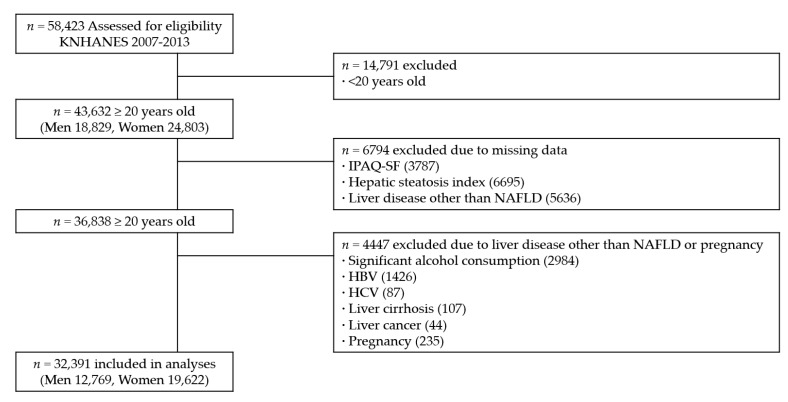
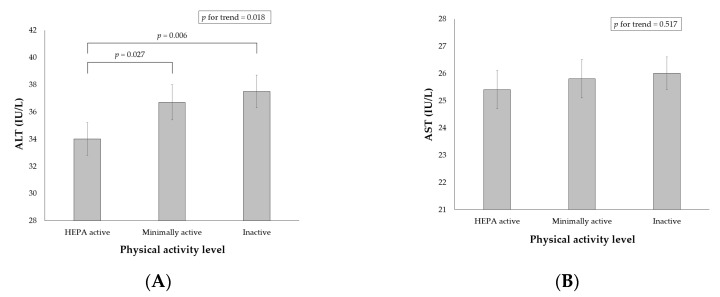
The aim of the current study was to examine the independent association of physical activity with nonalcoholic fatty liver disease (NAFLD) and aminotransferases while adjusting for obesity and diet. Cross-sectional data from 32,391 participants aged ≥ 20 years in the Korea National Health and Nutrition Examination Surveys (KNHANES) was analyzed by logistic regression models and general linear models. Physical activity was assessed from the questionnaire by health-enhancing physical activity (HEPA). The physical activity was negatively associated with NAFLD and lean NAFLD after adjustment for multiple factors with an odds ratio of 0.7 (95% CI, 0.6-0.8) and 0.5 (95% CI, 0.4-0.7) comparing the most active (HEPA active) and the least active (inactive) participants. Among the participants with NAFLD, physical activity also showed an independent negative association with alanine aminotransferase (ALT) levels but not with aspartate aminotransferase levels. These independent associations were not observed when comparing the minimally active and inactive participants except for the risk of lean NAFLD. Physical activity is independently associated with the degree of hepatocellular injury in patients with NAFLD as well as the risk of NAFLD and lean NAFLD in the general population. Sufficiently active physical activity greater than a minimally active level may be needed to lower the risk of NAFLD and ALT levels.
本研究的目的是在调整肥胖和饮食因素的同时,检验体力活动与非酒精性脂肪性肝病(NAFLD)及转氨酶之间的独立关联。通过逻辑回归模型和一般线性模型分析了韩国国家健康与营养检查调查(KNHANES)中32391名年龄≥20岁参与者的横断面数据。通过健康增强体力活动(HEPA)问卷评估体力活动情况。在对多个因素进行调整后,将最活跃(HEPA活跃)和最不活跃(不活跃)的参与者进行比较,体力活动与NAFLD和瘦型NAFLD呈负相关,比值比分别为0.7(95%CI,0.6 - 0.8)和0.5(95%CI,0.4 - 0.7)。在患有NAFLD的参与者中,体力活动与丙氨酸转氨酶(ALT)水平也呈独立负相关,但与天冬氨酸转氨酶水平无关。除了瘦型NAFLD的风险外,在比较最低限度活跃和不活跃的参与者时未观察到这些独立关联。体力活动与NAFLD患者的肝细胞损伤程度以及一般人群中NAFLD和瘦型NAFLD的风险独立相关。可能需要进行足够活跃的体力活动(大于最低限度活跃水平)来降低NAFLD风险和ALT水平。