Agashe Ruchi, Kurzrock Razelle
Center for Personalized Cancer Therapy, University of California San Diego, Moores Cancer Center, La Jolla, CA 92130, USA.
Cancers (Basel). 2020 Aug 21;12(9):2361. doi: 10.3390/cancers12092361.
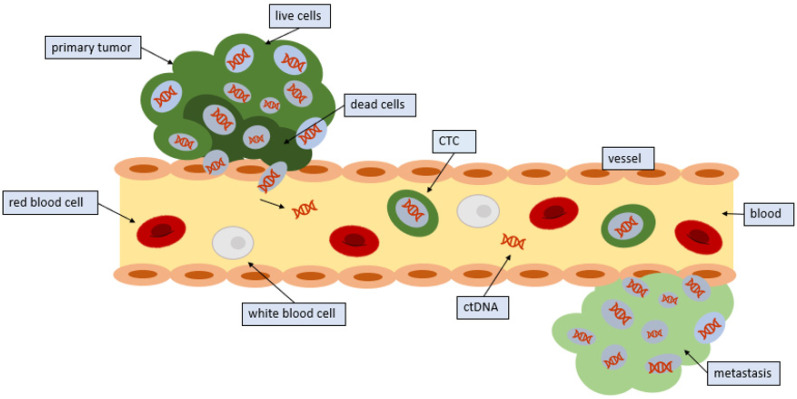
Circulating tumor cells (CTCs) are cells that are shed from tumors into the bloodstream. Cell enrichment and isolation technology as well as molecular profiling via next-generation sequencing have allowed for a greater understanding of tumor cancer biology via the interrogation of CTCs. CTC detection can be used to predict cancer relapse, progression, and survival; evaluate treatment effectiveness; and explore the ex vivo functional impact of agents. Detection methods can be by either immunoaffinity (positive or negative enrichment strategies) or biophysical strategies. CTC characterization, which is performed by DNA, RNA, and/or protein techniques, can predict metastatic potential. Currently, CTC-derived explant models may mimic patient response to chemotherapy and help with studying druggable targets and testing treatments. The Food and Drug Administration has cleared a CTC blood test to enumerate CTCs derived from breast, prostate, and colorectal cancers. In conclusion, liquid biopsies via CTCs provide a non-invasive way to obtain important diagnostic, prognostic, and predictive information in patients with cancer.
循环肿瘤细胞(CTCs)是从肿瘤脱落进入血液循环的细胞。细胞富集和分离技术以及通过下一代测序进行的分子分析,使得通过对循环肿瘤细胞的研究能够更深入地了解肿瘤生物学。循环肿瘤细胞检测可用于预测癌症复发、进展和生存情况;评估治疗效果;以及探索药物的体外功能影响。检测方法可以是免疫亲和法(阳性或阴性富集策略)或生物物理策略。通过DNA、RNA和/或蛋白质技术进行的循环肿瘤细胞表征可以预测转移潜力。目前,源自循环肿瘤细胞的外植体模型可以模拟患者对化疗的反应,并有助于研究可成药靶点和测试治疗方法。美国食品药品监督管理局已批准一项循环肿瘤细胞血液检测,用于计数源自乳腺癌、前列腺癌和结直肠癌的循环肿瘤细胞。总之,通过循环肿瘤细胞进行液体活检为获取癌症患者重要的诊断、预后和预测信息提供了一种非侵入性方法。