Li Ge-Zi, Li Han-Xiao, Xu Meng-Jun, Wang Peng-Fei, Xiao Xiang-Hong, Kang Guo-Zhang
National Engineering Research Centre for Wheat, Henan Agricultural University, #15 Longzihu College District, Zhengzhou, 450046, Henan Province, People's Republic of China.
National Key Laboratory of Wheat and Maize Crop Science, Henan Agricultural University, #15 Longzihu College District, Zhengzhou, 450046, Henan Province, People's Republic of China.
BMC Genomics. 2020 Aug 24;21(1):577. doi: 10.1186/s12864-020-06985-1.
Drought is one of the most adverse environmental factors limiting crop productions and it is important to identify key genetic determinants for food safety. Calcium-dependent protein kinases (CPKs) are known to be involved in plant growth, development, and environmental stresses. However, biological functions and regulatory mechanisms of many plant CPKs have not been explored. In our previous study, abundance of the wheat CPK34 (TaCPK34) protein was remarkably upregulated in wheat plants suffering from drought stress, inferring that it could be involved in this stress. Therefore, here we further detected its function and mechanism in response to drought stress.
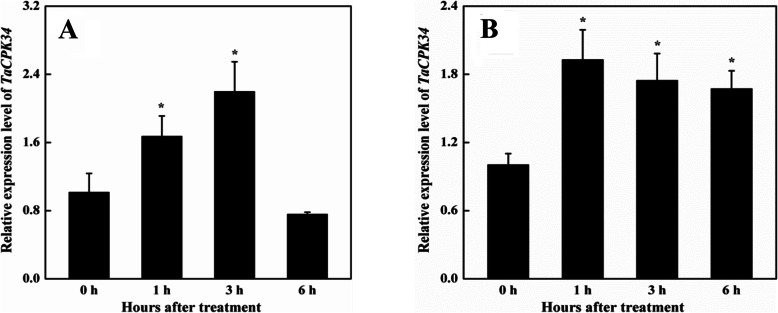
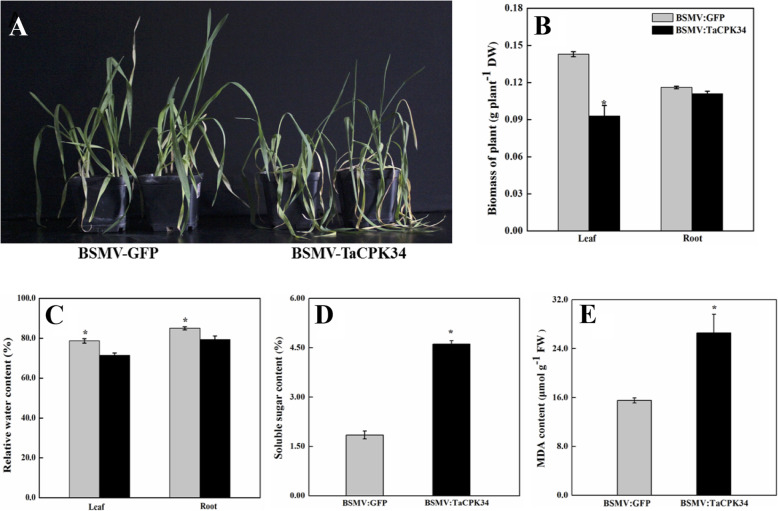
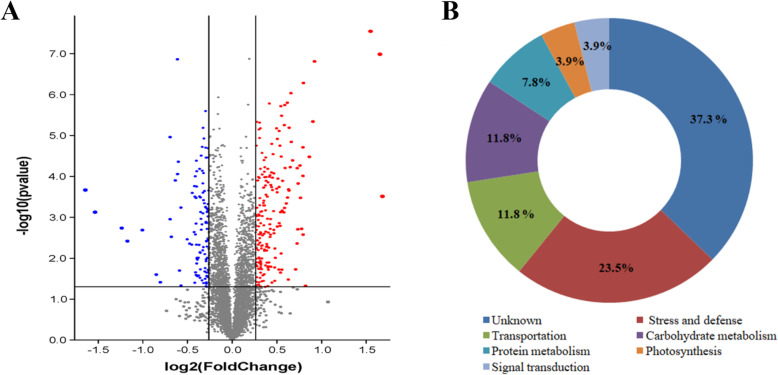
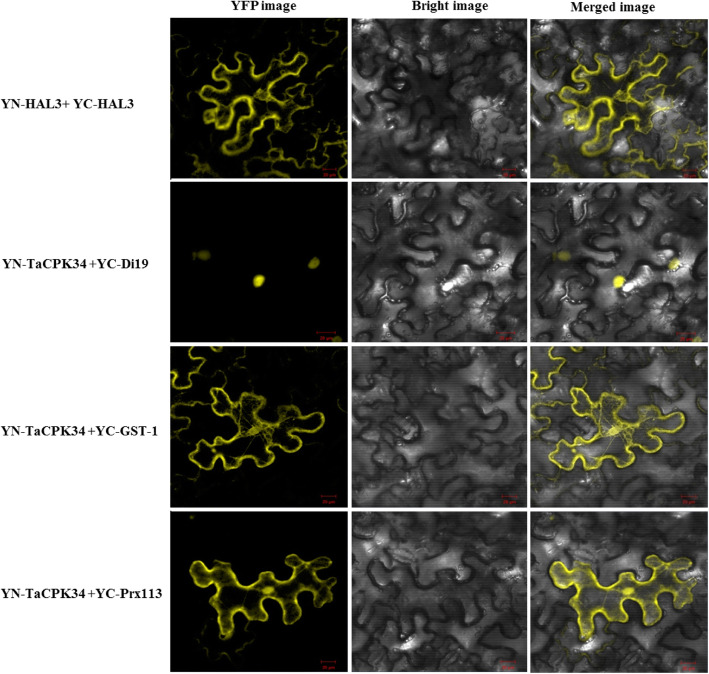
Transcripts of the TaCPK34 gene were significantly induced after PEG-stimulated water deficiency (20% PEG6000) or 100 μM abscisic acid (ABA) treatments. The TaCPK34 gene was transiently silenced in wheat genome by using barley stripe mosaic virus-induced silencing (BSMV-VIGS) method. After 14 days of drought stress, the transiently TaCPK34-silenced wheat seedlings showed more sensitivity compared with control, and the plant biomasses and relative water contents significantly decreased, whereas soluble sugar and MDA contents increased. The iTRAQ-based quantitative proteomics was employed to measure the protein expression profiles in leaves of the transiently TaCPK34-silenced wheat plants after drought stress. There were 6103 proteins identified, of these, 51 proteins exhibited significantly altered abundance, they were involved in diverse function. And sequence analysis on the promoters of genes, which encoded the above identified proteins, indicated that some promoters harbored some ABA-responsive elements. We determined the interactions between TaCPK34 and three identified proteins by using bimolecular fluorescent complementation (BiFC) method and our data indicated that TaCPK34directly interacted with the glutathione S-transferase 1 and prx113, respectively.
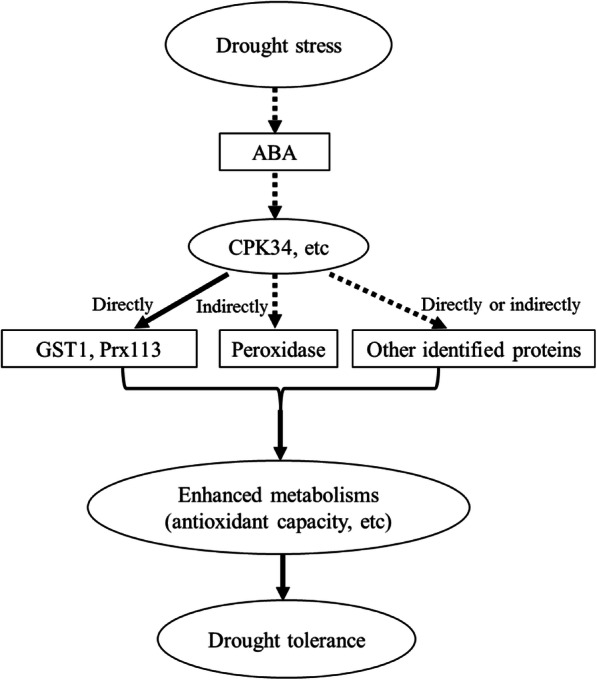
Our study suggested that the TaCPK34 gene played positive roles in wheat response to drought stress through directly or indirectly regulating the expression of ABA-dependent manner genes, which were encoding identified proteins from iTRAQ-based quantitative proteomics. And it could be used as one potential gene to develop crop cultivars with improved drought tolerance.
干旱是限制作物产量的最不利环境因素之一,识别食品安全的关键遗传决定因素很重要。已知钙依赖蛋白激酶(CPK)参与植物生长、发育和环境胁迫。然而,许多植物CPK的生物学功能和调控机制尚未被探索。在我们之前的研究中,小麦CPK34(TaCPK34)蛋白的丰度在遭受干旱胁迫的小麦植株中显著上调,推测它可能参与这种胁迫。因此,我们在此进一步检测其在响应干旱胁迫中的功能和机制。
在聚乙二醇(PEG)模拟缺水(20% PEG6000)或100 μM脱落酸(ABA)处理后,TaCPK34基因的转录本被显著诱导。通过大麦条纹花叶病毒诱导的基因沉默(BSMV-VIGS)方法,TaCPK34基因在小麦基因组中被瞬时沉默。干旱胁迫14天后,与对照相比,瞬时TaCPK34沉默的小麦幼苗表现出更高的敏感性,植株生物量和相对含水量显著降低,而可溶性糖和丙二醛含量增加。基于iTRAQ的定量蛋白质组学被用于测量干旱胁迫后瞬时TaCPK34沉默的小麦植株叶片中的蛋白质表达谱。共鉴定出6103种蛋白质,其中51种蛋白质的丰度有显著变化,它们参与多种功能。对编码上述鉴定蛋白质的基因启动子的序列分析表明,一些启动子含有一些ABA响应元件。我们使用双分子荧光互补(BiFC)方法确定了TaCPK34与三种鉴定出的蛋白质之间的相互作用,我们的数据表明TaCPK34分别与谷胱甘肽S-转移酶1和prx113直接相互作用。
我们的研究表明,TaCPK34基因通过直接或间接调控依赖ABA方式的基因表达,在小麦对干旱胁迫的响应中发挥积极作用,这些基因编码基于iTRAQ的定量蛋白质组学鉴定出的蛋白质。它可作为一个潜在基因用于培育耐旱性提高的作物品种。