Walker Brian W, Lara Roberto Portillo, Mogadam Emad, Yu Chu Hsiang, Kimball William, Annabi Nasim
Department of Chemical and Biomolecular Engineering, University of California-Los Angeles, Los Angeles, CA, 90095, USA.
Department of Chemical Engineering, Northeastern University, Boston, MA, 02115, USA.
Prog Polym Sci. 2019 May;92:135-157. doi: 10.1016/j.progpolymsci.2019.02.007. Epub 2019 Feb 20.
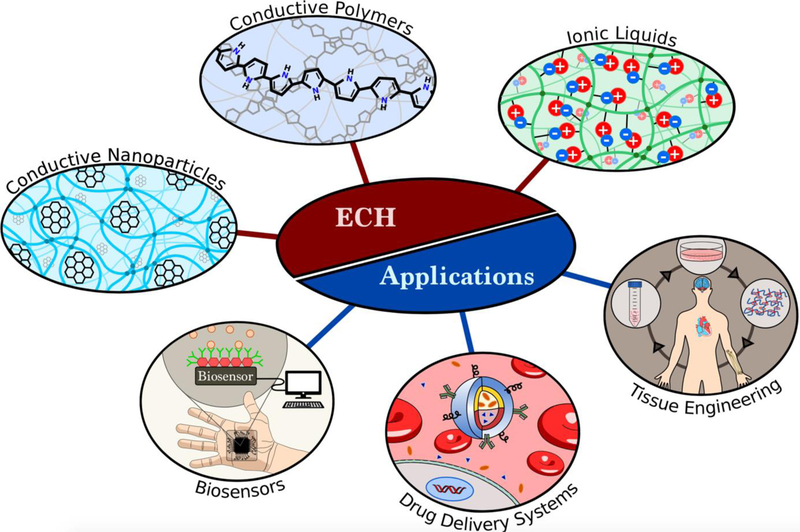
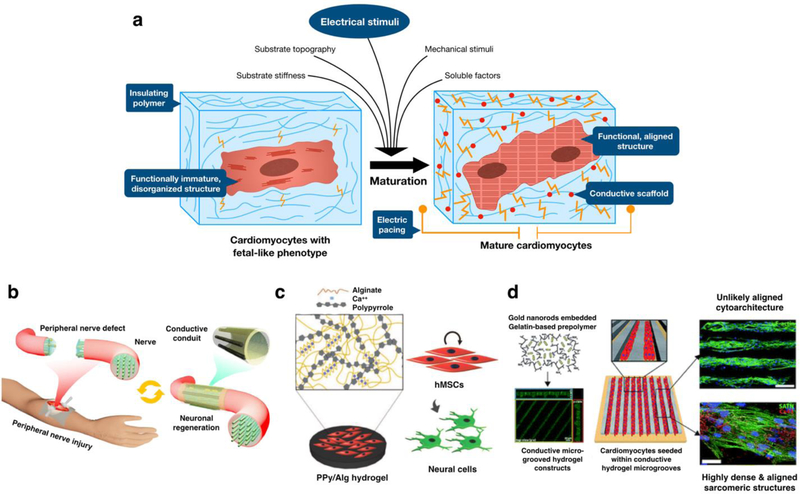
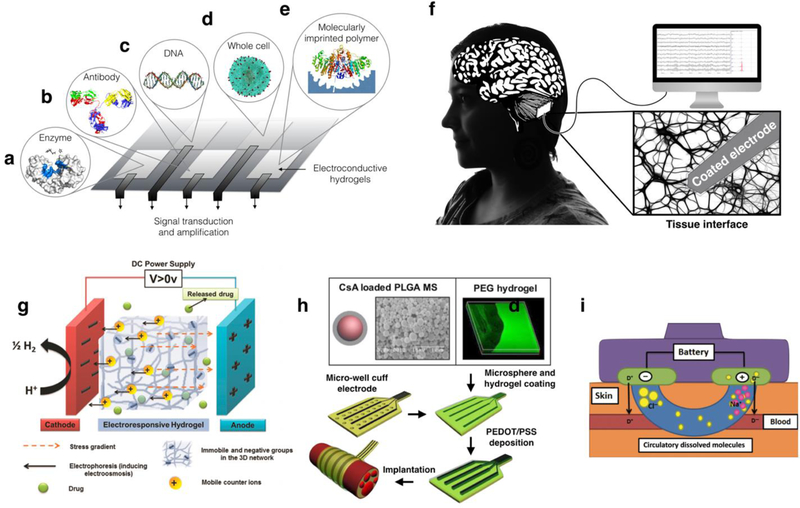
Electroconductive hydrogels (ECHs) are highly hydrated 3D networks generated through the incorporation of conductive polymers, nanoparticles, and other conductive materials into polymeric hydrogels. ECHs combine several advantageous properties of inherently conductive materials with the highly tunable physical and biochemical properties of hydrogels. Recently, the development of biocompatible ECHs has been investigated for various biomedical applications, such as tissue engineering, drug delivery, biosensors, flexible electronics, and other implantable medical devices. Several methods for the synthesis of ECHs have been reported, which include the incorporation of electrically conductive materials such as gold and silver nanoparticles, graphene, and carbon nanotubes, as well as various conductive polymers (CPs), such as polyaniline, polypyrrole, and poly(3,4-ethylenedioxyythiophene) into hydrogel networks. Theses electroconductive composite hydrogels can be used as scaffolds with high swellability, tunable mechanical properties, and the capability to support cell growth both and . Furthermore, recent advancements in microfabrication techniques such as three dimensional (3D) bioprinting, micropatterning, and electrospinning have led to the development of ECHs with biomimetic microarchitectures that reproduce the characteristics of the native extracellular matrix (ECM). In addition, smart ECHs with controlled structures and healing properties have also been engineered into devices with prolonged half-lives and increased durability. The combination of sophisticated synthesis chemistries and modern microfabrication techniques have led to engineer smart ECHs with advanced architectures, geometries, and functionalities that are being increasingly used in drug delivery systems, biosensors, tissue engineering, and soft electronics. In this review, we will summarize different strategies to synthesize conductive biomaterials. We will also discuss the advanced microfabrication techniques used to fabricate ECHs with complex 3D architectures, as well as various biomedical applications of microfabricated ECHs.
导电水凝胶(ECHs)是通过将导电聚合物、纳米颗粒和其他导电材料掺入聚合物水凝胶中而形成的高度水合三维网络。ECHs将固有导电材料的几种有利特性与水凝胶高度可调的物理和生化特性结合在一起。最近,人们对生物相容性ECHs在各种生物医学应用中的开发进行了研究,如组织工程、药物递送、生物传感器、柔性电子器件和其他可植入医疗设备。已经报道了几种合成ECHs的方法,包括将金和银纳米颗粒、石墨烯和碳纳米管等导电材料以及各种导电聚合物(CPs),如聚苯胺、聚吡咯和聚(3,4-乙撑二氧噻吩)掺入水凝胶网络中。这些导电复合水凝胶可以用作具有高膨胀性、可调机械性能以及支持细胞生长能力的支架。此外,微制造技术的最新进展,如三维(3D)生物打印、微图案化和静电纺丝,已导致开发出具有仿生微结构的ECHs,该微结构再现了天然细胞外基质(ECM)的特征。此外,具有可控结构和愈合特性的智能ECHs也已被设计成具有延长半衰期和增加耐久性的装置。复杂合成化学与现代微制造技术的结合导致设计出具有先进结构、几何形状和功能的智能ECHs,这些ECHs越来越多地用于药物递送系统、生物传感器、组织工程和柔性电子器件。在这篇综述中,我们将总结合成导电生物材料的不同策略。我们还将讨论用于制造具有复杂3D结构的ECHs的先进微制造技术,以及微制造ECHs的各种生物医学应用。