Samarehfekri Atena, Dehghan Mahlagha, Arab Mansoor, Ebadzadeh Mohammad Reza
Nursing Research Center, Razi Faculty of Nursing and Midwifery, Kerman University of Medical Sciences, Kerman, Iran.
Department of Critical Care Nursing, Razi Faculty of Nursing and Midwifery, Kerman University of Medical Sciences, Kerman, Iran.
Evid Based Complement Alternat Med. 2020 Aug 1;2020:5095071. doi: 10.1155/2020/5095071. eCollection 2020.
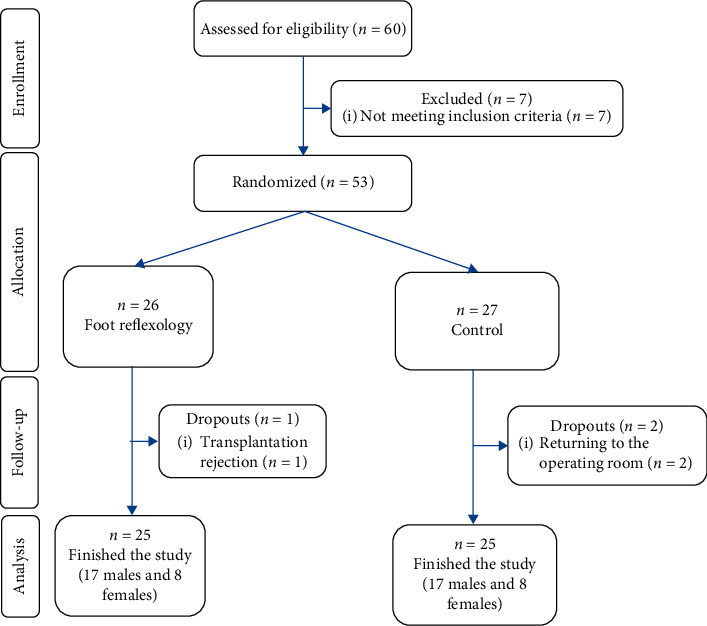
The study was a parallel randomized controlled trial. Patients admitted to the transplantation ward participated in the study. Fifty-three eligible patients were allocated into the foot reflexology group ( = 26) and the control group ( = 27) by using the stratified randomization method. Finally, 25 participants in each group finished the study. The intervention group received foot reflexology for 30 minutes once a day for three consecutive days, and no reflexology was applied in the control group. The intervention started on the second day after surgery. Pain, fatigue, and quality of sleep were measured on the first, second (before intervention), third, fourth, and eleventh days after surgery. Data were collected using visual analogue scale for measuring pain and fatigue and Verran and Snyder-Halpern sleep scale for measuring quality of sleep.
In each group, 25 patients finished the study. The mean pain score in the foot reflexology and control groups decreased from 9.44 ± 0.96 and 9.36 ± 0.91 on the day of surgery to 1.32 ± 0.94 and 4.32 ± 1.68 on the eleventh day after surgery, respectively. The mean fatigue score in the reflexology and control groups decreased from 8.76 ± 1.27 and 8.6 ± 1.26 on the day of surgery to 1.24 ± 1.2 and 3.92 ± 1.63 on the eleventh day after surgery, respectively. The mean sleep score in the foot reflexology and control groups increased from 33.38 ± 11.22 and 39.59 ± 12.8 on the day of surgery to 69.43 ± 12.8 and 56.27 ± 8.03 on the eleventh day after surgery, respectively. While pain, fatigue, and sleep quality scores improved in both groups, those in the intervention group showed significantly greater improvement compared with the control group ( < 0.001). No significant difference was found between the two groups in the use of acetaminophen on the first, second, third, fourth, and eleventh days after surgery ( > 0.05).
Foot reflexology may reduce pain and fatigue and improve sleep quality of patients after kidney transplantation.
本研究为平行随机对照试验。入住移植病房的患者参与了本研究。采用分层随机化方法将53例符合条件的患者分为足部反射疗法组(n = 26)和对照组(n = 27)。最后,每组25名参与者完成了研究。干预组连续三天每天接受30分钟的足部反射疗法,对照组不进行反射疗法。干预从术后第二天开始。在术后第一天、第二天(干预前)、第三天、第四天和第十一天测量疼痛、疲劳和睡眠质量。使用视觉模拟量表测量疼痛和疲劳,使用Verran和Snyder - Halpern睡眠量表测量睡眠质量来收集数据。
每组均有25例患者完成研究。足部反射疗法组和对照组的平均疼痛评分分别从手术当天的9.44±0.96和9.36±0.91降至术后第十一天的1.32±0.94和4.32±1.68。反射疗法组和对照组的平均疲劳评分分别从手术当天的8.76±1.27和8.6±1.26降至术后第十一天的1.24±1.2和3.92±1.63。足部反射疗法组和对照组的平均睡眠评分分别从手术当天的33.38±11.22和39.59±12.8升至术后第十一天的69.43±12.8和56.27±8.03。虽然两组的疼痛、疲劳和睡眠质量评分均有所改善,但干预组的改善程度明显大于对照组(P < 0.001)。术后第一天、第二天、第三天、第四天和第十一天,两组在对乙酰氨基酚的使用上无显著差异(P > 0.05)。
足部反射疗法可能减轻肾移植术后患者的疼痛和疲劳,改善睡眠质量。