Charng Jason, Sanfilippo Paul G, Attia Mary S, Dolliver Monika, Arunachalam Sukanya, Chew Avenell L, Wong Evan N, Mackey David A, Chen Fred K
Centre of Ophthalmology and Visual Science (incorporating Lions Eye Institute), The University of Western Australia, Perth, Western Australia.
Centre for Eye Research Australia, Royal Victorian Eye and Ear Hospital, University of Melbourne, Melbourne, Victoria, Australia.
Transl Vis Sci Technol. 2020 Jun 18;9(7):19. doi: 10.1167/tvst.9.7.19. eCollection 2020 Jun.
Macular Integrity Assessment (MAIA) microperimetry is used widely in clinical trials and routine practice to assess paracentral scotoma. Current interpretation of MAIA is based on an assumed uniform 25 decibel (dB) cutoff for normal function irrespective of subject age and retinal location. We examined this convention by establishing an age- and loci-specific reference in healthy eyes and comparing this to the <25 dB cutoff.
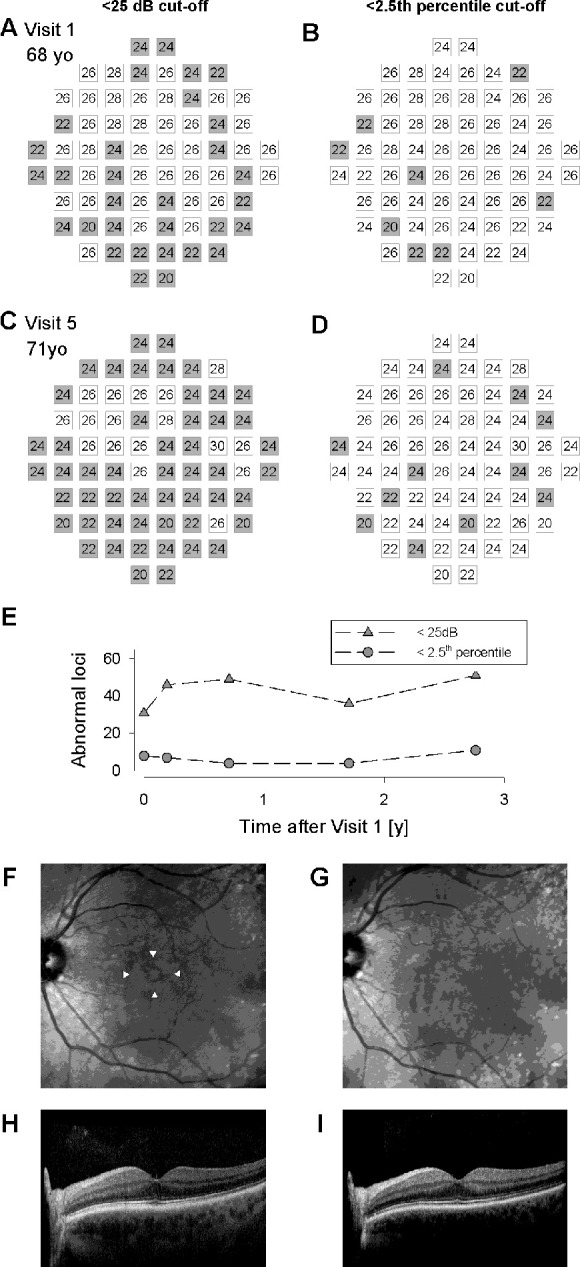
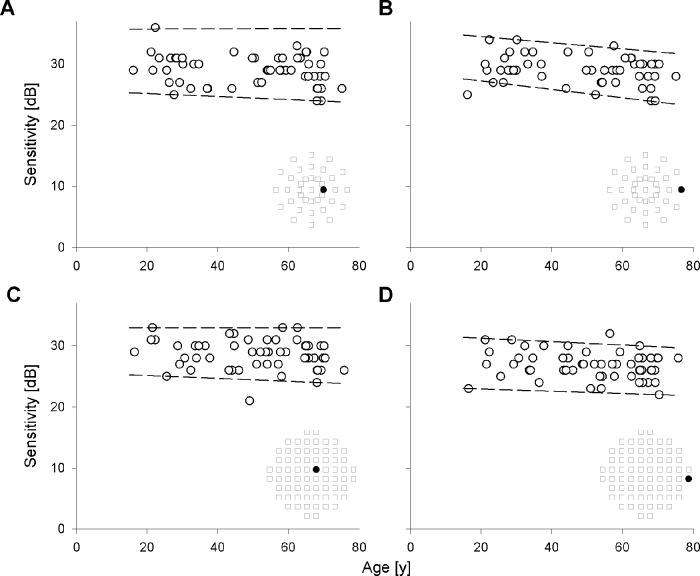
Retrospective MAIA results from healthy eyes were analyzed for prevalence of loci with <25 dB. At each locus, a new reference cutoff was derived from quantile regression of sensitivity against age at the 2.5th percentile. Two clinical cases of serial MAIA testing were analyzed using the new approach and compared to the <25 dB cutoff.
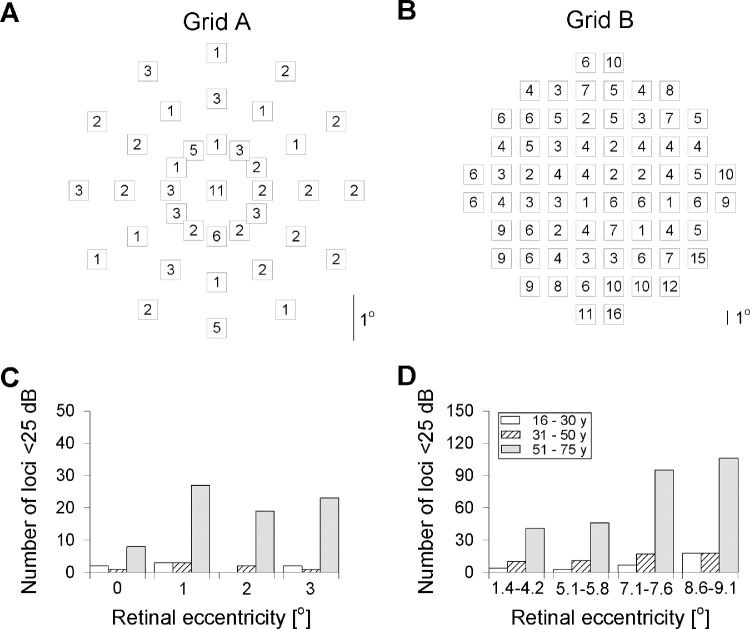
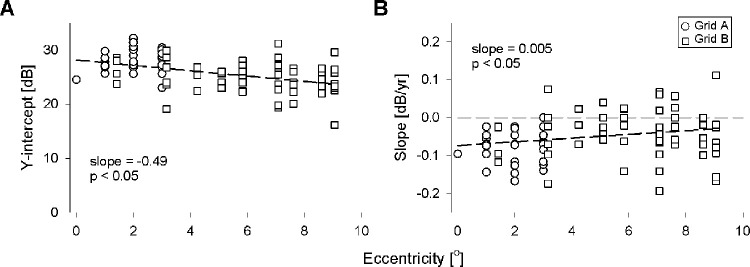
Fifty-four and 56 age-matched (range: 16-75 years) healthy eyes underwent small (37 loci) and large (68 loci) grid testing, respectively. Retinal sensitivity <25 dB was found in 5% of the small grid (1998 data points) and 10% of the large grid (3808 data points). These were found predominantly in older subjects and at the central point or in the perifoveal region. Quantile regression at each individual locus showed age-related decline with a median gradient of 0.6 dB/decade.
We caution against using <25 dB cutoff in MAIA interpretation and advocate an age- and loci-specific cutoff criterion.
Our study suggests that MAIA interpretation is influenced by the criterion used for defining abnormal pointwise measurement.
黄斑完整性评估(MAIA)微视野检查在临床试验和常规实践中被广泛用于评估旁中心暗点。目前对MAIA的解读基于一个假定的正常功能统一25分贝(dB)阈值,而不考虑受试者年龄和视网膜位置。我们通过在健康眼中建立年龄和位置特异性参考值并将其与<25 dB阈值进行比较,来检验这一惯例。
分析健康眼的回顾性MAIA结果中<25 dB位置的患病率。在每个位置,从第2.5百分位数的敏感度对年龄的分位数回归中得出一个新的参考阈值。使用新方法分析了两个连续进行MAIA检测的临床病例,并与<25 dB阈值进行比较。
分别对54只和56只年龄匹配(范围:16 - 75岁)的健康眼进行了小网格(37个位置)和大网格(68个位置)测试。在小网格(1998个数据点)的5%和大网格(3808个数据点)的10%中发现视网膜敏感度<25 dB。这些主要出现在老年受试者以及中心点或黄斑周围区域。每个单独位置的分位数回归显示与年龄相关的下降,中位数梯度为0.6 dB/十年。
我们提醒在MAIA解读中不要使用<25 dB阈值,并提倡采用年龄和位置特异性的阈值标准。
我们的研究表明,MAIA解读受到用于定义异常逐点测量的标准的影响。