Chew Avenell L, Sampson Danuta M, Chelva Enid, Khan Jane C, Chen Fred K
Centre for Ophthalmology and Visual Science (Incorporating Lions Eye Institute), The University of Western Australia, Crawley, WA, 6009, Australia.
Department of Medical Technology and Physics, Sir Charles Gairdner Hospital, Nedlands, WA, 6009, Australia.
Doc Ophthalmol. 2018 Feb;136(1):57-68. doi: 10.1007/s10633-017-9615-9. Epub 2017 Nov 9.
To characterize the ultrastructural and functional correlates of hydroxychloroquine (HCQ)-induced subclinical bull's eye lesion seen on near-infrared reflectance (NIR) imaging.
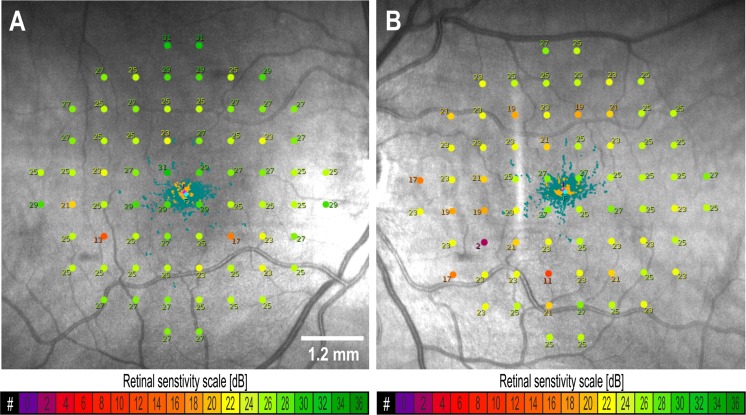
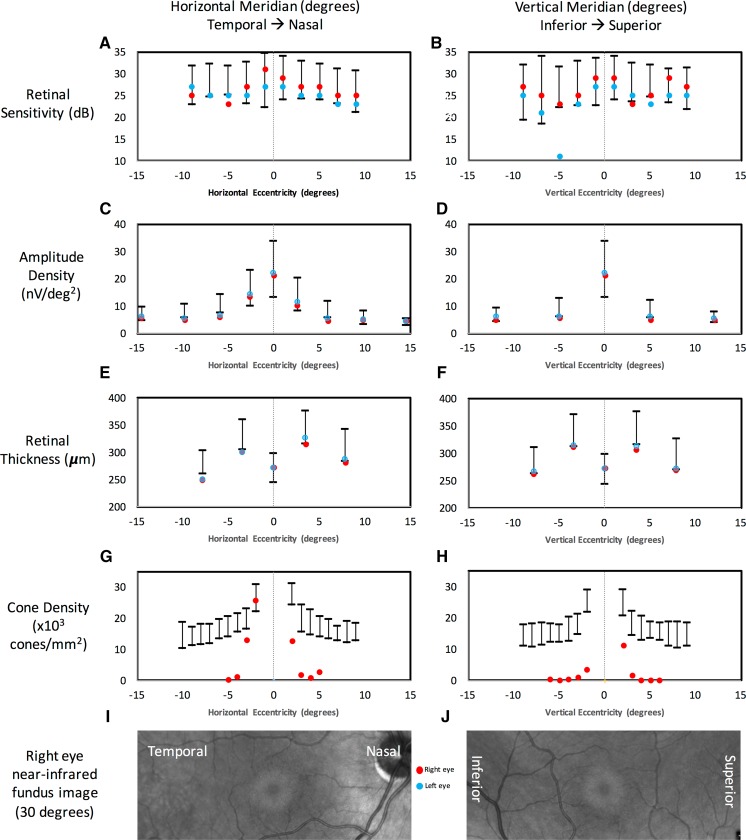
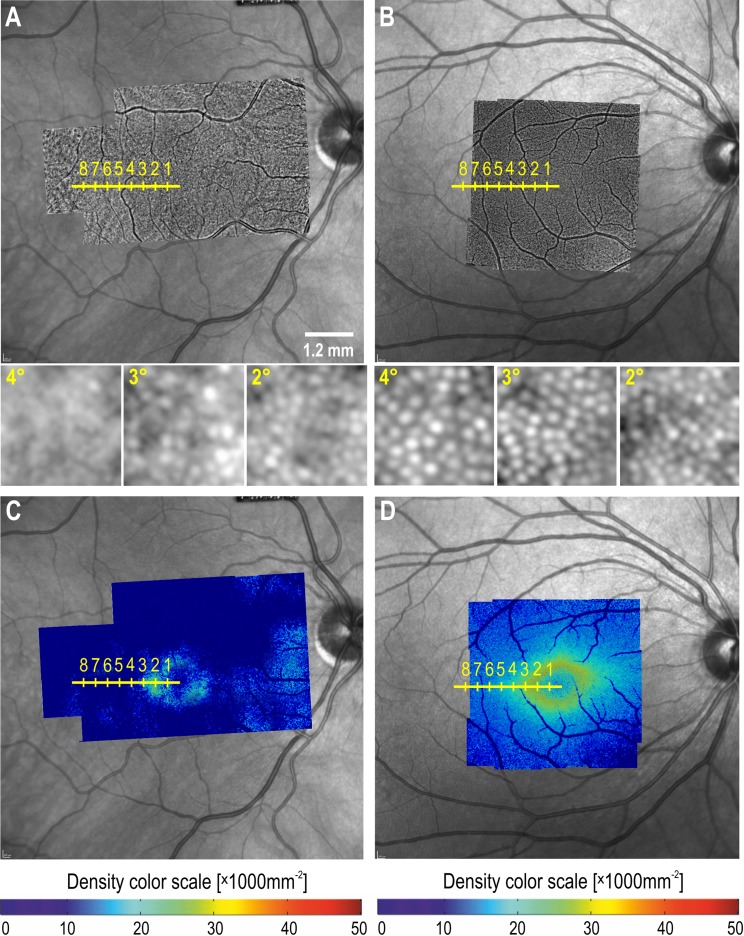
An asymptomatic 54-year-old male taking HCQ presented with paracentral ring-like scotoma, abnormal multifocal electroretinography (mfERG) and preserved ellipsoid zone on optical coherence tomography (OCT). Dense raster OCT was performed to create en face reflectivity maps of the interdigitation zone. Macular Integrity Assessment (MAIA) microperimetry and mfERG findings were compared with NIR imaging, en face OCT, retinal thickness profiles and wave-guiding cone density maps derived from flood-illumination adaptive optics (AO) retinal photography.
The bull's eye lesion is an oval annular zone of increased reflectivity on NIR with an outer diameter of 1450 µm. This region corresponds exactly to an area of preserved interdigitation zone reflectivity in en face OCT images and of normal cone density on AO imaging. Immediately surrounding the bull's eye lesion is an annular zone (3°-12° eccentricity) of depressed retinal sensitivity on MAIA and reduced amplitude density on mfERG. Wave-guiding cone density at 2° temporal was 25,400 per mm. This declined rapidly to 12,900 and 1200 per mm at 3° and 4°.
Multimodal imaging illustrated pathology in the area surrounding the NIR bull's eye, characterized by reduced reflectance, wave-guiding cone density and retinal function. Further studies are required to investigate whether the bull's eye on NIR imaging and en face OCT is prominent or consistent enough for diagnostic use.
描述在近红外反射(NIR)成像中观察到的羟氯喹(HCQ)诱导的亚临床靶心病变的超微结构和功能相关性。
一名无症状的54岁男性服用HCQ后出现旁中心环状暗点、异常多焦视网膜电图(mfERG)以及光学相干断层扫描(OCT)上的椭圆体带保存。进行密集光栅OCT以创建指状交叉区的正面反射率图。将黄斑完整性评估(MAIA)微视野检查和mfERG结果与NIR成像、正面OCT、视网膜厚度剖面图以及源自泛光照明自适应光学(AO)视网膜摄影的波导锥密度图进行比较。
靶心病变是NIR上反射率增加的椭圆形环形区域,外径为1450 µm。该区域与正面OCT图像中保存的指状交叉区反射率区域以及AO成像上的正常视锥密度区域完全对应。紧挨着靶心病变的是一个环形区域(偏心度3° - 12°),在MAIA上视网膜敏感度降低,在mfERG上振幅密度降低。颞侧2°处的波导锥密度为每毫米25,400个。在3°和4°处迅速降至每毫米12,900个和1200个。
多模态成像显示了NIR靶心周围区域的病理情况,其特征为反射率、波导锥密度和视网膜功能降低。需要进一步研究来调查NIR成像和正面OCT上的靶心是否突出或一致到足以用于诊断。