Benozzi Giovanna, Perez Cristian, Leiro Juliana, Facal Sonia, Orman Betina
Centro de Investigación Avanzada para la Presbicia, Buenos Aires, Argentina.
Pharmacology Unit, Facultad de Odontología, Universidad de Buenos Aires, Buenos Aires, Argentina.
Transl Vis Sci Technol. 2020 Jun 23;9(7):25. doi: 10.1167/tvst.9.7.25. eCollection 2020 Jun.
The purpose of this study was to evaluate the safety and efficacy across time, of patients topically treated with Benozzi's method for presbyopia.
A nonrandomized case series retrospective study was developed, including patients with emmetropia with binocular uncorrected distance visual acuity (UDVA) of 25/20 or better, and with uncorrected near visual acuity (UNVA) at least Jaeger 2 or worse. The study was set in Buenos Aires, Argentina, from January 2011 to June 2018, with at least 1-year follow-up. Patients were treated with pilocarpine and diclofenac preservative-free eye drops (Benozzi Method; US 8.524.758 B2, EP1.938.839 B1), and the main outcome measured was binocular UNVA at different follow-up times. Other parameters, as the UDVA and presence of side effects, were evaluated.
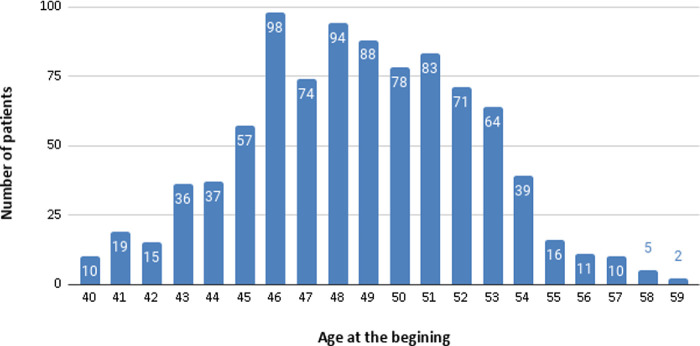
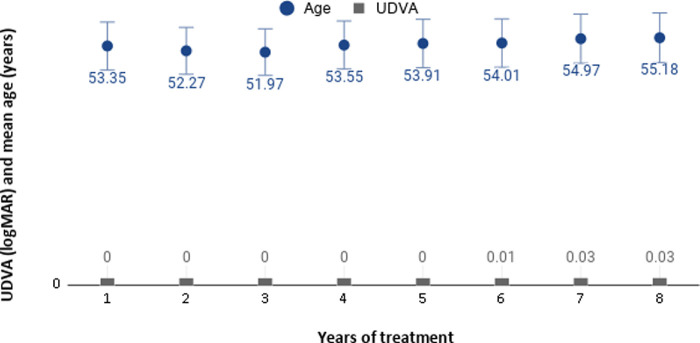
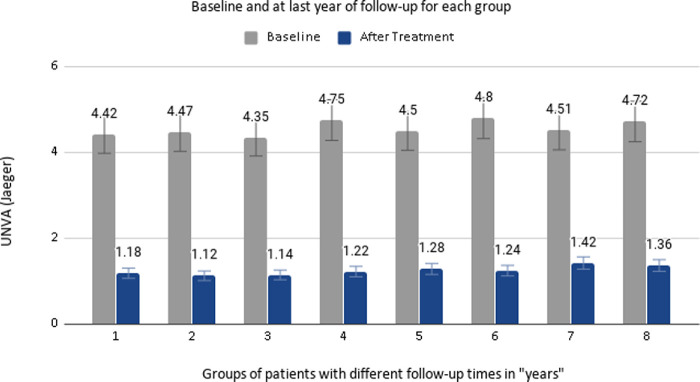
A total of 910 patients were included with a mean age at baseline of 48.67 ± 3.72 years old (range, 40-59 years). The baseline UNVA was 4.74 ± 1.53 and at 8 years of follow-up was decreased to 1.36 ± 0.48 (Jaeger scale). The mean binocular UDVA at baseline was 0.00 ± 0.01 logarithm of the minimum angle of resolution (logMAR) and after 8 years of follow-up was 0.03 ± 0.04 logMAR. All side effects reported (decrease of light perception, headaches, symptoms of ocular surface dryness, and dizziness) were spontaneously resolved in patients who continued with the treatment.
The efficacy of the pharmacological treatment of presbyopia to improve the UNVA without affecting the UDVA is shown. Side effects were well tolerated and resolved before 1 year of treatment.
This is a nonsurgical option for patients with emmetropic presbyopia who do not wish to wear glasses, which is a pharmacological treatment with eye drops.
本研究旨在评估采用贝诺齐方法局部治疗老花眼患者的安全性和不同时间的疗效。
开展一项非随机病例系列回顾性研究,纳入正视眼患者,其双眼未矫正远视力(UDVA)为25/20或更好,未矫正近视力(UNVA)至少为耶格2级或更差。该研究于2011年1月至2018年6月在阿根廷布宜诺斯艾利斯进行,随访时间至少为1年。患者使用毛果芸香碱和不含防腐剂的双氯芬酸滴眼液(贝诺齐方法;美国专利8,524,758 B2,欧洲专利1,938,839 B1)进行治疗,主要测量指标为不同随访时间的双眼UNVA。还评估了其他参数,如UDVA和副作用的发生情况。
共纳入910例患者,基线时平均年龄为48.67±3.72岁(范围40 - 59岁)。基线时UNVA为4.74±1.53,随访8年后降至1.36±0.48(耶格视力表)。基线时双眼平均UDVA为0.00±0.01最小分辨角对数(logMAR),随访8年后为0.03±0.04 logMAR。所有报告的副作用(光感下降、头痛、眼表干燥症状和头晕)在继续治疗的患者中均自发缓解。
显示了老花眼药物治疗在不影响UDVA的情况下改善UNVA的疗效。副作用耐受性良好,在治疗1年前即可缓解。
这是一种为不希望戴眼镜的正视性老花眼患者提供的非手术选择,即使用滴眼液进行药物治疗。