Xu Wen Wen, Huang Zhi-Hao, Liao Long, Zhang Qi-Hua, Li Jun-Qi, Zheng Can-Can, He Yan, Luo Ting-Ting, Wang Yang, Hu Hui-Fang, Zuo Qian, Chen Wen-You, Yang Qing-Sheng, Zhao Jian-Fu, Qin Yan-Ru, Xu Li-Yan, Li En-Min, Liao Hua-Xin, Li Bin, He Qing-Yu
MOE Key Laboratory of Tumor Molecular Biology and Guangdong Provincial Key Laboratory of Bioengineering Medicine National Engineering Research Center of Genetic Medicine Institute of Biomedicine College of Life Science and Technology Jinan University Guangzhou 510632 China.
MOE Key Laboratory of Tumor Molecular Biology and Key Laboratory of Functional Protein Research of Guangdong Higher Education Institutes Institute of Life and Health Engineering College of Life Science and Technology Jinan University Guangzhou 510632 China.
Adv Sci (Weinh). 2020 Jul 1;7(16):2000925. doi: 10.1002/advs.202000925. eCollection 2020 Aug.
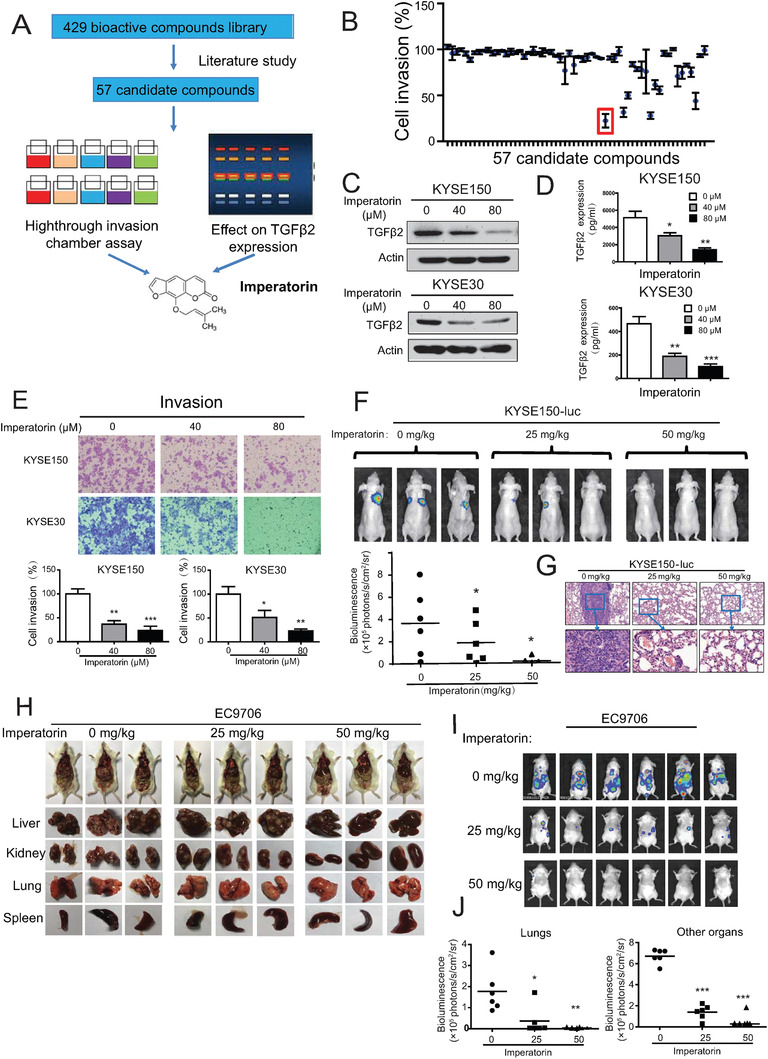
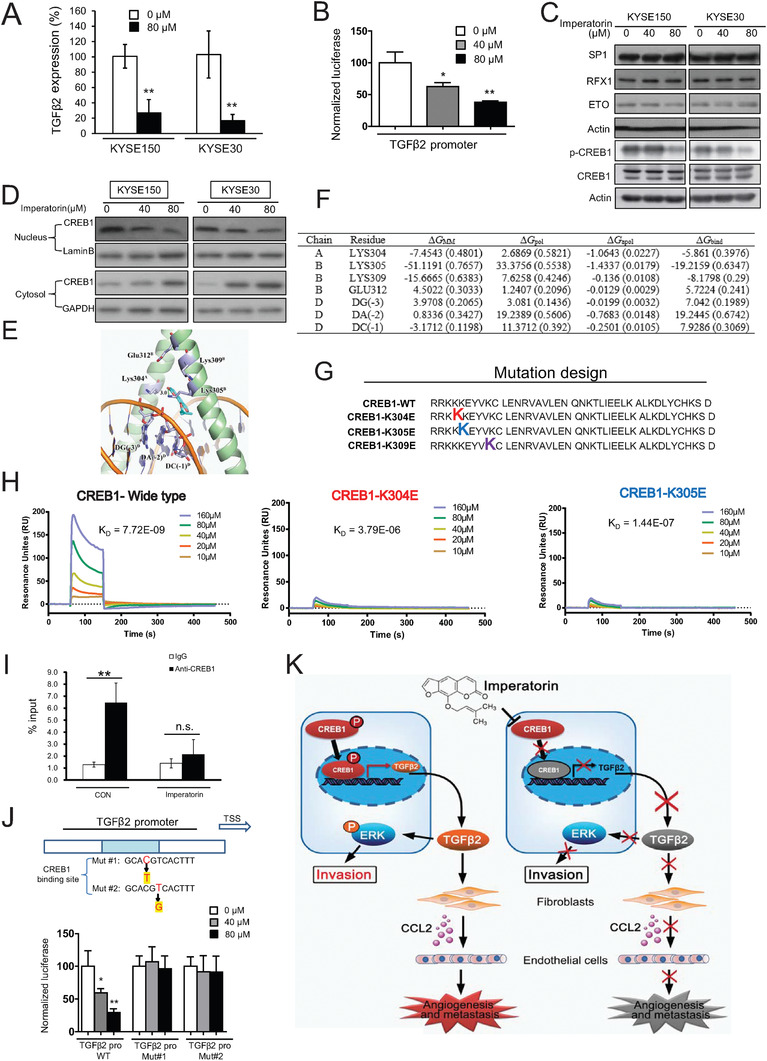
Metastasis accounts for 90% of cancer death worldwide, and effective therapeutic strategies are lacking. The aim of this work is to identify the key drivers in tumor metastasis and screen therapeutics for treatment of esophageal squamous cell carcinoma (ESCC). Gene Ontology analysis of The Cancer Genome Atlas (TCGA) gene expression datasets of ESCC patients with or without lympy metastasis identifies that TGF2 is highly enriched in the pathways essential for tumor metastasis and upregulates in the metastatic ESCC tumors. High TGF2 expression in ESCC correlates with metastasis and patient survival, and functionally contributes to tumor metastasis via activating extracellular signal-regulated kinases (ERK) signaling. By screening of a library consisting of 429 bioactive compounds, imperatorin is verified as a novel TGF2 inhibitor, with robustly suppressive effect on tumor metastasis in multiple mice models. Mechanistically, direct binding of imperatorin and CREB1 inhibits phosphorylation, nuclear translocation of CREB1, and its interaction with TGF2 promoter, represses TGF2 expression and fibroblasts-secreted CCL2, and then inactivates ERK signaling to block cancer invasion and abrogates the paracrine effects of fibroblasts on tumor angiogenesis and metastasis. Overall, the findings suggest the use of TGF2 as a diagnostic and prognostic biomarker and therapeutic target in ESCC, and supports the potential of imperatorin as a novel therapeutic strategy for cancer metastasis.
转移是全球90%癌症死亡的原因,且缺乏有效的治疗策略。这项工作的目的是确定肿瘤转移的关键驱动因素,并筛选治疗食管鳞状细胞癌(ESCC)的疗法。对有或无淋巴结转移的ESCC患者的癌症基因组图谱(TCGA)基因表达数据集进行基因本体分析,发现TGF2在肿瘤转移所必需的通路中高度富集,且在转移性ESCC肿瘤中上调。ESCC中TGF2的高表达与转移及患者生存相关,并通过激活细胞外信号调节激酶(ERK)信号在功能上促进肿瘤转移。通过筛选由429种生物活性化合物组成的文库,欧前胡素被证实为一种新型TGF2抑制剂,对多种小鼠模型中的肿瘤转移具有强大的抑制作用。机制上,欧前胡素与CREB1直接结合可抑制CREB1的磷酸化、核转位及其与TGF2启动子的相互作用,抑制TGF2表达和成纤维细胞分泌的CCL2,进而使ERK信号失活,以阻断癌症侵袭,并消除成纤维细胞对肿瘤血管生成和转移的旁分泌作用。总体而言,这些发现表明TGF2可作为ESCC的诊断和预后生物标志物及治疗靶点,并支持欧前胡素作为癌症转移新治疗策略的潜力。