Cheng Feng, Tang Yu-Fei, Cao Yang, Peng Shi-Qing, Zhu Xiao-Ren, Sun Yue, Wang Shu-Hang, Wang Bin, Lu Yi-Min
Department of Respiratory Medicine, Huzhou Central Hospital, Affiliated Central Hospital, Huzhou University, Huzhou, Zhejiang, China.
Huzhou Key Laboratory of Precision Diagnosis and Treatment in Respiratory Diseases, Huzhou Central Hospital, Huzhou, Zhejiang, China.
Cell Death Discov. 2023 Oct 19;9(1):382. doi: 10.1038/s41420-023-01679-5.
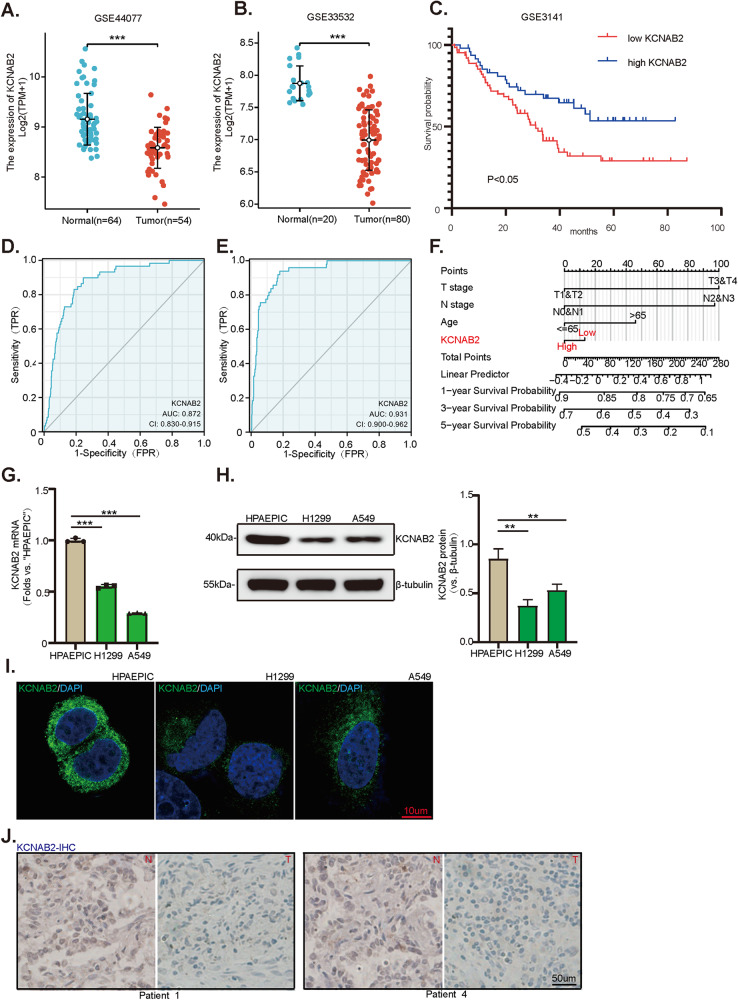
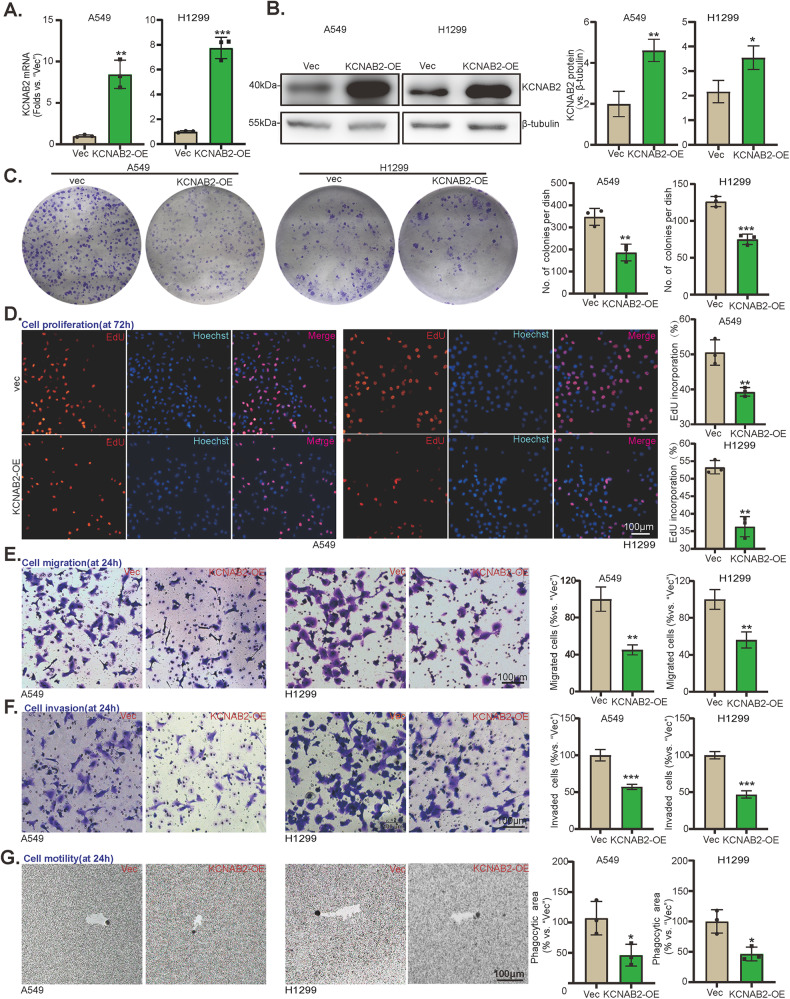
Non-small-cell lung cancer (NSCLC) accounts for approximately 85% of all lung cancer cases. NSCLC patients often have poor prognosis demanding urgent identification of novel biomarkers and potential therapeutic targets. KCNAB2 (regulatory beta subunit2 of voltage-gated potassium channel), encoding aldosterone reductase, plays a pivotal role in regulating potassium channel activity. In this research, we tested the expression of KCNAB2 as well as its potential functions in human NSCLC. Bioinformatics analysis shows that expression of KCNAB2 mRNA is significantly downregulated in human NSCLC, correlating with poor overall survival. In addition, decreased KCNAB2 expression was detected in different NSCLC cell lines and local human NSCLC tissues. Exogenous overexpression of KCNAB2 potently suppressed growth, proliferation and motility of established human NSCLC cells and promoted NSCLC cells apoptosis. In contrast, CRISPR/Cas9-induced KCNAB2 knockout further promoted the malignant biological behaviors of NSCLC cells. Protein chip analysis in the KCNAB2-overexpressed NSCLC cells revealed that KCNAB2 plays a possible role in AKT-mTOR cascade activation. Indeed, AKT-mTOR signaling activation was potently inhibited following KCNAB2 overexpression in NSCLC cells. It was however augmented by KCNAB2 knockout. In vivo, the growth of subcutaneous KCNAB2-overexpressed A549 xenografts was significantly inhibited. Collectively, KCNAB2 could be a novel effective gene for prognosis prediction of NSCLC. Targeting KCNAB2 may lead to the development of advanced therapies.
非小细胞肺癌(NSCLC)约占所有肺癌病例的85%。NSCLC患者的预后通常较差,迫切需要鉴定新的生物标志物和潜在的治疗靶点。KCNAB2(电压门控钾通道的调节β亚基2)编码醛固酮还原酶,在调节钾通道活性中起关键作用。在本研究中,我们检测了KCNAB2在人NSCLC中的表达及其潜在功能。生物信息学分析表明,KCNAB2 mRNA在人NSCLC中的表达显著下调,与总体生存率差相关。此外,在不同的NSCLC细胞系和局部人NSCLC组织中检测到KCNAB2表达降低。KCNAB2的外源性过表达有力地抑制了已建立的人NSCLC细胞的生长、增殖和运动,并促进了NSCLC细胞凋亡。相反,CRISPR/Cas9诱导的KCNAB2基因敲除进一步促进了NSCLC细胞的恶性生物学行为。对KCNAB2过表达的NSCLC细胞进行蛋白质芯片分析发现,KCNAB2可能在AKT-mTOR级联激活中发挥作用。事实上,在NSCLC细胞中过表达KCNAB2后,AKT-mTOR信号激活受到有力抑制。然而,KCNAB2基因敲除则增强了该信号。在体内,皮下过表达KCNAB2的A549异种移植瘤的生长受到显著抑制。总之,KCNAB2可能是一种用于NSCLC预后预测的新型有效基因。靶向KCNAB2可能会推动先进治疗方法的发展。