
远程医疗舱的未来?以法国学生的接受度为例。
The future of Telemedicine Cabin? The case of the French students' acceptability.
作者信息
Baudier Patricia, Kondrateva Galina, Ammi Chantal
机构信息
EM Normandie Business School, Métis Lab, 64 rue Ranelagh, 75016 Paris, France.
EDC, Paris Business School, France.
出版信息
Futures. 2020 Sep;122:102595. doi: 10.1016/j.futures.2020.102595. Epub 2020 Jun 13.
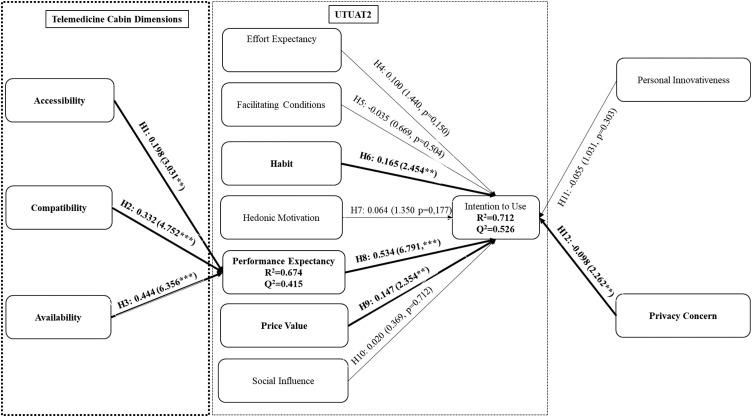
Telemedicine could solve the problem of the lack of infrastructure and insufficient number of qualified healthcare staff in many countries/regions. The aim of this research is to investigate the futures of such solution by having a better understanding of the acceptance of the Telemedicine Cabin by high-educated Millennials. To reach this goal, a survey was built using specific dimensions to measure the perception of Telemedicine Cabin, the Unified-Theory-of-Acceptance-and-Use-of-Technology 2nd version (UTAUT2) and finally the Personal Innovativeness and the Privacy Concern scales. Our sample was composed of 158 students from different Business Schools and data were analysed using a Partial Least Approach. Findings highlight the key role of all Telemedicine Cabin dimensions (Accessibility, Availability and Compatibility) on Performance Expectancy, the importance of three UTAUT2 constructs (Performance Expectancy, Price Value and Habit) and the negative impact of Privacy Concern on the Intention to Use a Telemedicine Cabin. In addition, results demonstrate that Personal Innovativeness does not affect the Intention to Use Telemedicine Cabin.
远程医疗可以解决许多国家/地区基础设施不足和合格医护人员数量不够的问题。本研究的目的是通过更好地了解受过高等教育的千禧一代对远程医疗舱的接受程度来探究这种解决方案的前景。为实现这一目标,构建了一项调查,使用特定维度来衡量对远程医疗舱的认知、技术接受与使用统一理论第二版(UTAUT2),最后是个人创新性和隐私关注量表。我们的样本由来自不同商学院的158名学生组成,并使用偏最小二乘法对数据进行了分析。研究结果突出了远程医疗舱所有维度(可及性、可用性和兼容性)对绩效期望的关键作用、UTAUT2三个构念(绩效期望、价格价值和习惯)的重要性以及隐私关注对使用远程医疗舱意愿的负面影响。此外,结果表明个人创新性并不影响使用远程医疗舱的意愿。
 Zotero 插件