Raajan N R, Lakshmi V S Ramya, Prabaharan Natarajan
Present Address: School of EEE, SASTRA Deemed University, Thanjavur, Tamil nadu India.
Natl Acad Sci Lett. 2021;44(4):347-350. doi: 10.1007/s40009-020-01009-8. Epub 2020 Jul 30.
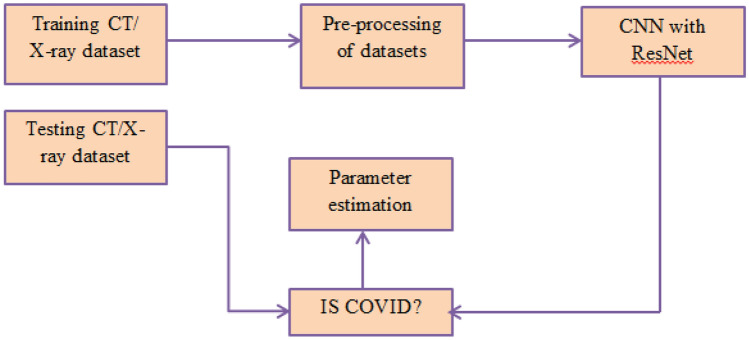
A novel human coronavirus 2 (SARS-CoV-2) is an extremely acute respiratory syndrome which was reported in Wuhan, China in the later half 2019. Most of its primary epidemiological aspects are not appropriately known, which has a direct effect on monitoring, practices and controls. The main objective of this work is to propose a high speed, accurate and highly sensitive CT scan approach for diagnosis of COVID19. The CT scan images display several small patches of shadows and interstitial shifts, particularly in the lung periphery. The proposed method utilizes the ResNet architecture Convolution Neural Network for training the images provided by the CT scan to diagnose the coronavirus-affected patients effectively. By comparing the testing images with the training images, the affected patient is identified accurately. The accuracy and specificity are obtained 95.09% and 81.89%, respectively, on the sample dataset based on CT images without the inclusion of another set of data such as geographical location, population density, etc. Also, the sensitivity is obtained 100% in this method. Based on the results, it is evident that the COVID-19 positive patients can be classified perfectly by using the proposed method.
一种新型人类冠状病毒2(严重急性呼吸综合征冠状病毒2,SARS-CoV-2)是一种极为严重的急性呼吸综合征,于2019年下半年在中国武汉被报道。其大部分主要流行病学特征尚不清楚,这对监测、防控措施产生了直接影响。这项工作的主要目标是提出一种用于诊断新型冠状病毒肺炎(COVID-19)的高速、准确且高度灵敏的CT扫描方法。CT扫描图像显示出多个小片状阴影和间质改变,尤其是在肺外周。所提出的方法利用残差网络(ResNet)架构的卷积神经网络对CT扫描提供的图像进行训练,以有效诊断感染冠状病毒的患者。通过将测试图像与训练图像进行比较,能够准确识别受感染患者。在不纳入地理位置、人口密度等其他数据集的基于CT图像的样本数据集上,准确率和特异性分别达到了95.09%和81.89%。此外,该方法的灵敏度达到了100%。基于这些结果,显然使用所提出的方法能够完美地对新型冠状病毒肺炎阳性患者进行分类。