1Department of Engineering Systems and Environment, University of Virginia, Charlottesville, Virginia.
2Department of Epidemiology, Rollins School of Public Health, Emory University, Atlanta, Georgia.
Am J Trop Med Hyg. 2020 Oct;103(4):1405-1415. doi: 10.4269/ajtmh.20-0228.
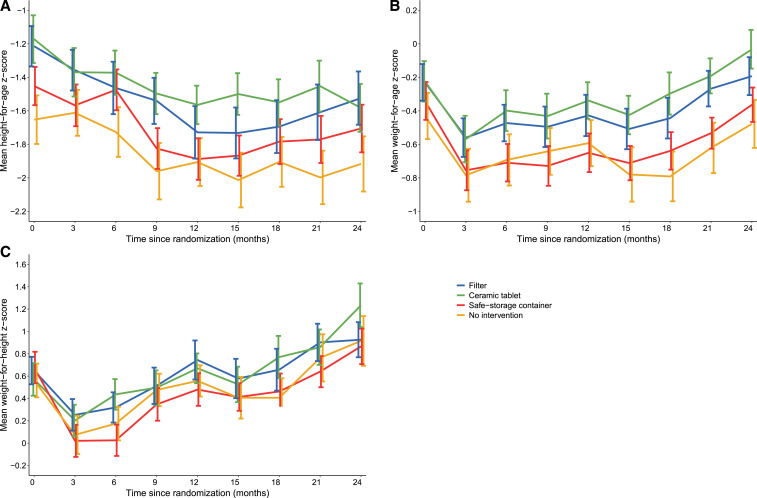
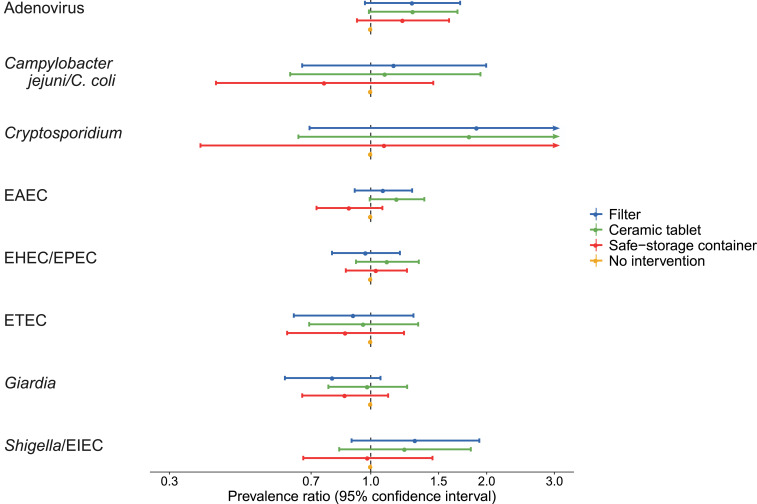
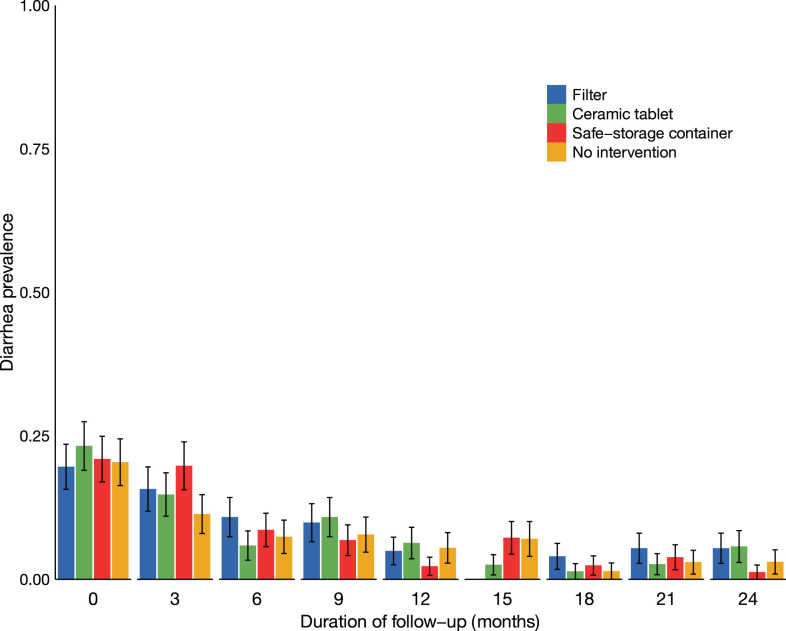
Enteric infections early in life have been associated with poor linear growth among children in low-resource settings. Point-of-use water treatment technologies provide effective and low-cost solutions to reduce exposure to enteropathogens from drinking water, but it is unknown whether the use of these technologies translates to improvements in child growth. We conducted a community-based randomized controlled trial of two water treatment technologies to estimate their effects on child growth in Limpopo, South Africa. We randomized 404 households with a child younger than 3 years to receive a silver-impregnated ceramic water filter, a silver-impregnated ceramic tablet, a safe-storage water container alone, or no intervention, and these households were followed up quarterly for 2 years. We estimated the effects of the interventions on linear and ponderal growth, enteric infections assessed by quantitative molecular diagnostics, and diarrhea prevalence. The silver-impregnated ceramic water filters and tablets consistently achieved approximately 1.2 and 3 log reductions, respectively, in total coliform bacteria in drinking water samples. However, the filters and tablets were not associated with differences in height (height-for-age -score differences compared with no intervention: 0.06, 95% CI: -0.29, 0.40, and 0.00, 95% CI: -0.35, 0.35, respectively). There were also no effects of the interventions on weight, diarrhea prevalence, or enteric infections. Despite their effectiveness in treating drinking water, the use of the silver-impregnated ceramic water filters and tablets did not reduce enteric infections or improve child growth. More transformative water, sanitation, and hygiene interventions that better prevent enteric infections are likely needed to improve long-term child growth outcomes.
生命早期的肠道感染与资源匮乏环境中儿童的线性生长不良有关。即时用水处理技术为减少饮用水中肠道病原体暴露提供了有效且低成本的解决方案,但这些技术的使用是否能改善儿童的生长状况尚不清楚。我们在南非林波波省进行了一项基于社区的随机对照试验,以评估两种水处理技术对儿童生长的影响。我们将 404 户有 3 岁以下儿童的家庭随机分为四组,分别接受载银陶瓷滤芯、载银陶瓷片、安全储水容器或不干预,并在 2 年内每季度对这些家庭进行随访。我们估计了干预措施对线性和体质量增长、定量分子诊断评估的肠道感染以及腹泻流行率的影响。载银陶瓷水过滤器和载银陶瓷片分别使饮用水中总大肠菌群的数量减少了约 1.2 和 3 个对数级。然而,过滤器和载银陶瓷片与身高增长(与无干预相比,身高年龄得分差异:0.06,95%置信区间:-0.29,0.40 和 0.00,95%置信区间:-0.35,0.35)之间没有差异。干预措施对体重、腹泻流行率或肠道感染也没有影响。尽管载银陶瓷水过滤器和载银陶瓷片在处理饮用水方面非常有效,但它们的使用并不能减少肠道感染或改善儿童的生长状况。可能需要更具变革性的水、环境卫生和个人卫生干预措施来改善长期儿童生长结局。