Lindquist Erik D, George C M, Perin Jamie, Neiswender de Calani Karen J, Norman W Ray, Davis Thomas P, Perry Henry
Am J Trop Med Hyg. 2014 Jul;91(1):190-197. doi: 10.4269/ajtmh.13-0568. Epub 2014 May 27.
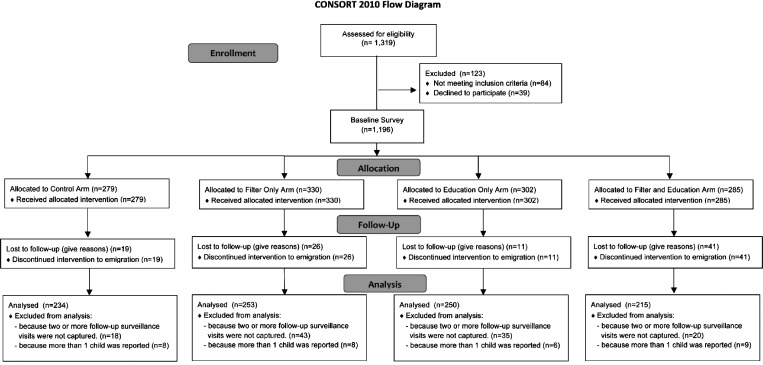
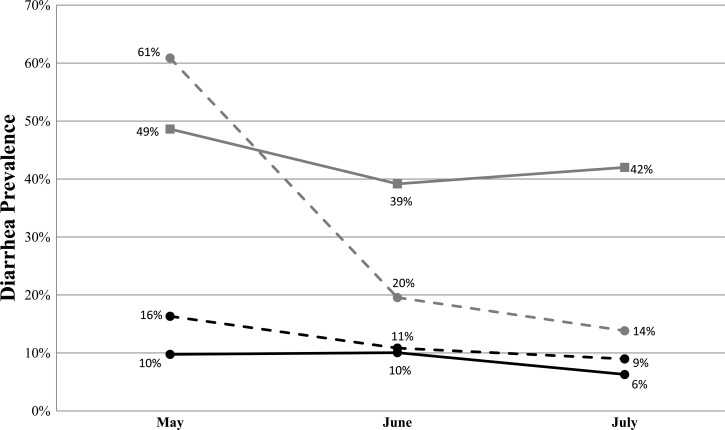
Safe domestic potable water supplies are urgently needed to reduce childhood diarrheal disease. In periurban neighborhoods in Cochabamba, Bolivia, we conducted a cluster randomized controlled trial to evaluate the efficacy of a household-level hollow fiber filter and/or behavior change communication (BCC) on water, sanitation, and hygiene (WASH) to reduce the diarrheal disease in children less than 5 years of age. In total, 952 households were followed for a period of 12 weeks post-distribution of the study interventions. Households using Sawyer PointONE filters had significantly less diarrheal disease compared with the control arm during the intervention period, which was shown by diarrheal prevalence ratios of 0.21 (95% confidence interval [95% CI] = 0.15-0.30) for the filter arm and 0.27 (95% CI = 0.22-0.34) for the filter and WASH BCC arm. A non-significant reduction in diarrhea prevalence was reported in the WASH BCC study arm households (0.71, 95% CI = 0.59-0.86).
迫切需要安全的家庭饮用水供应来减少儿童腹泻疾病。在玻利维亚科恰班巴的城郊社区,我们进行了一项整群随机对照试验,以评估家庭级中空纤维过滤器和/或行为改变沟通(BCC)对水、环境卫生和个人卫生(WASH)的效果,从而减少5岁以下儿童的腹泻疾病。在研究干预措施分发后的12周内,总共对952户家庭进行了跟踪。在干预期间,使用索耶PointONE过滤器的家庭与对照组相比,腹泻疾病明显减少,过滤器组的腹泻患病率比为0.21(95%置信区间[95%CI]=0.15-0.30),过滤器和WASH BCC组为0.27(95%CI=0.22-0.34)。WASH BCC研究组家庭的腹泻患病率有不显著的降低(0.71,95%CI=0.59-0.86)。