Steiner Bianca, Elgert Lena, Saalfeld Birgit, Wolf Klaus-Hendrik
Peter L. Reichertz Institute for Medical Informatics of TU Braunschweig and Hannover Medical School, Braunschweig, Germany.
Peter L. Reichertz Institute for Medical Informatics of TU Braunschweig and Hannover Medical School, Hannover, Germany.
JMIR Serious Games. 2020 Aug 25;8(3):e19914. doi: 10.2196/19914.
Gamification has become increasingly important both in research and in practice. Particularly in long-term care processes, such as rehabilitation, playful concepts are gaining in importance to increase motivation and adherence. In addition to neurological diseases, this also affects the treatment of patients with musculoskeletal diseases such as shoulder disorders. Although it would be important to assist patients during more than one rehabilitation phase, it is hypothesized that existing systems only support a single phase. It is also unclear which game design elements are currently used in this context and how they are combined to achieve optimal positive effects on motivation.
This scoping review aims to identify and analyze information and communication technologies that use game design elements to support the rehabilitation processes of patients with musculoskeletal diseases of the shoulder. The state of the art with regard to fields of application, game design elements, and motivation concepts will be determined.
We conducted a scoping review to identify relevant application systems. The search was performed in 3 literature databases: PubMed, IEEE Xplore, and Scopus. Following the PICO (population, intervention, comparison, outcome) framework, keywords and Medical Subject Headings for shoulder, rehabilitation, and gamification were derived to define a suitable search term. Two independent reviewers, a physical therapist and a medical informatician, completed the search as specified by the search strategy. There was no restriction on year of publication. Data synthesis was done by deductive-inductive coding based on qualitative content analysis.
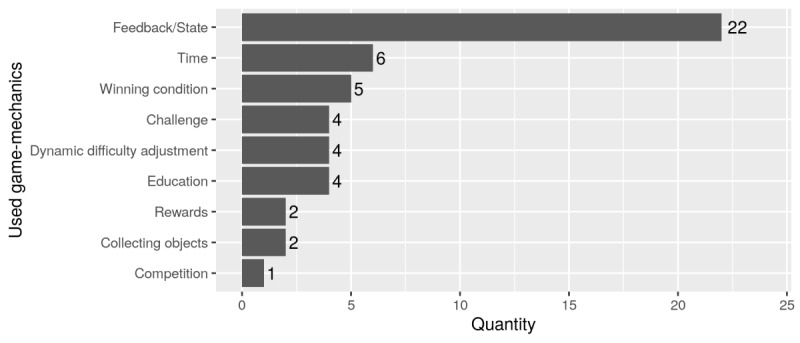
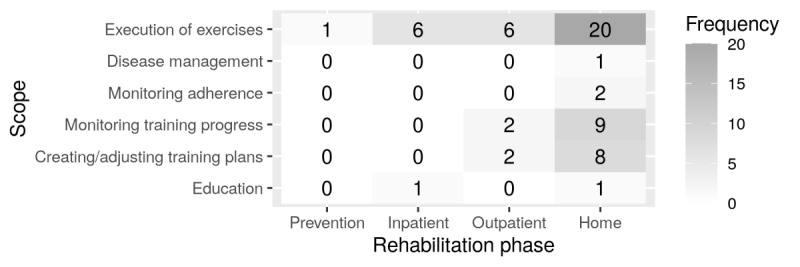
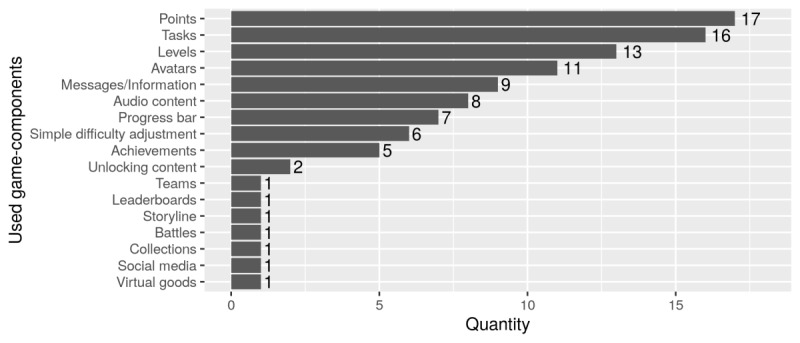
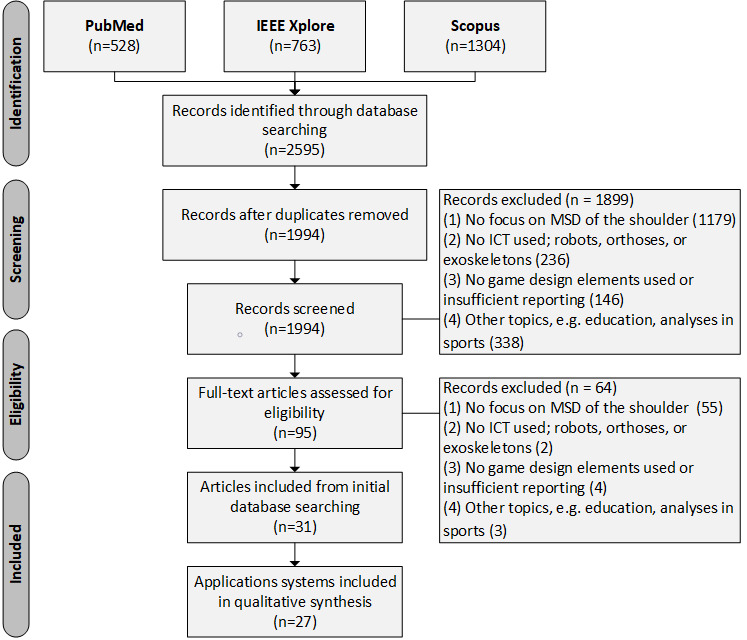
A total of 1994 articles were screened; 31 articles in English, published between 2006 and 2019, were included. Within, 27 application systems that support patients with musculoskeletal diseases of the shoulder in exercising, usually at home but also in inpatient or outpatient rehabilitation clinics, were described. Only 2 application systems carried out monitoring of adherence. Almost all were based on in-house developed software. The most frequently used game components were points, tasks, and avatars. More complex game components, such as collections and teams, were rarely used. When selecting game components, patient-specific characteristics, such as age and gender, were only considered in 2 application systems. Most were described as motivating, though an evaluation of motivational effects was usually not conducted.
There are only a few application systems supporting patients with musculoskeletal diseases of the shoulder in rehabilitation by using game design elements. Almost all application systems are exergames for supporting self-exercising. Application systems for multiple rehabilitation phases seem to be nonexistent. It is also evident that only a few complex game design elements are used. Patient-specific characteristic are generally neglected when selecting and implementing game components. Consequently, a holistic approach to enhance adherence to rehabilitation is required supporting patients during the entire rehabilitation process by providing motivational game design elements based on patient-specific characteristics.
游戏化在研究和实践中都变得越来越重要。特别是在长期护理过程中,如康复治疗,趣味性概念对于提高动机和依从性变得越发重要。除了神经系统疾病,这也影响到肌肉骨骼疾病患者的治疗,如肩部疾病。虽然在多个康复阶段协助患者很重要,但据推测现有系统仅支持单个阶段。目前在这种情况下使用了哪些游戏设计元素以及它们如何组合以实现对动机的最佳积极影响也尚不清楚。
本范围综述旨在识别和分析使用游戏设计元素来支持肩部肌肉骨骼疾病患者康复过程的信息和通信技术。将确定在应用领域、游戏设计元素和动机概念方面的当前技术水平。
我们进行了一项范围综述以识别相关应用系统。检索在3个文献数据库中进行:PubMed、IEEE Xplore和Scopus。遵循PICO(人群、干预、对照、结局)框架,推导了关于肩部、康复和游戏化的关键词和医学主题词以定义合适的检索词。两名独立评审员,一名物理治疗师和一名医学信息专家,按照检索策略完成检索。对出版年份没有限制。数据综合通过基于定性内容分析的演绎 - 归纳编码完成。
共筛选了1994篇文章;纳入了2006年至2019年期间发表的31篇英文文章。其中描述了27个应用系统,这些系统支持肩部肌肉骨骼疾病患者进行锻炼,通常是在家中,但也包括住院或门诊康复诊所。只有2个应用系统进行了依从性监测。几乎所有系统都基于内部开发的软件。最常用的游戏组件是积分、任务和化身。更复杂的游戏组件,如收集和团队,很少使用。在选择游戏组件时,仅在2个应用系统中考虑了患者特定特征,如年龄和性别。大多数系统被描述为具有激励作用,不过通常没有对激励效果进行评估。
仅有少数应用系统通过使用游戏设计元素来支持肩部肌肉骨骼疾病患者的康复。几乎所有应用系统都是用于支持自我锻炼的运动游戏。似乎不存在用于多个康复阶段的应用系统。同样明显的是,仅使用了少数复杂的游戏设计元素。在选择和实施游戏组件时,通常忽略患者特定特征。因此,需要一种整体方法来提高康复依从性,通过基于患者特定特征提供激励性游戏设计元素在整个康复过程中支持患者。