Department of Respiratory and Critical Care Medicine, Peking University First Hospital, Beijing 100034, China.
Department of Respiratory and Critical Care Medicine, Tongji Hospital, Tongji Medical College, Huazhong University of Science and Technology, Wuhan, Hubei 430030, China.
Chin Med J (Engl). 2020 Oct 20;133(20):2410-2414. doi: 10.1097/CM9.0000000000000966.
The coronavirus disease 2019 (COVID-19) outbreak occurred during the flu season around the world. This study aimed to analyze the impact of influenza A virus (IAV) exposure on COVID-19.
Seventy COVID-19 patients admitted to the hospital during January and February 2020 in Wuhan, China were included in this retrospective study. Serum tests including respiratory pathogen immunoglobulin M (IgM) and inflammation biomarkers were performed upon admission. Patients were divided into common, severe, and critical types according to disease severity. Symptoms, inflammation indices, disease severity, and fatality rate were compared between anti-IAV IgM-positive and anti-IAV IgM-negative groups. The effects of the empirical use of oseltamivir were also analyzed in both groups. For comparison between groups, t tests and the Mann-Whitney U test were used according to data distribution. The Chi-squared test was used to compare disease severity and fatality between groups.
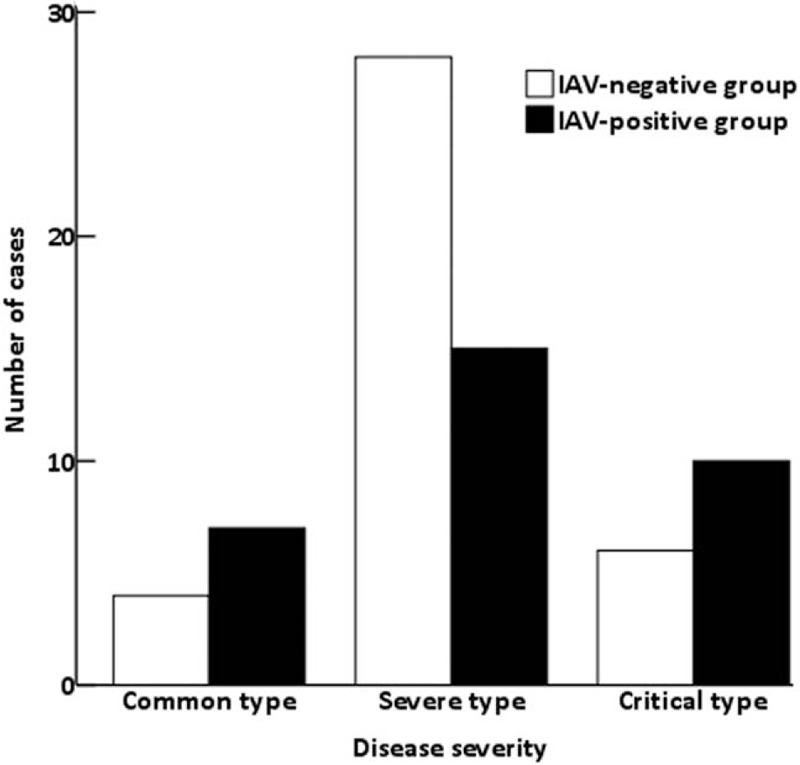
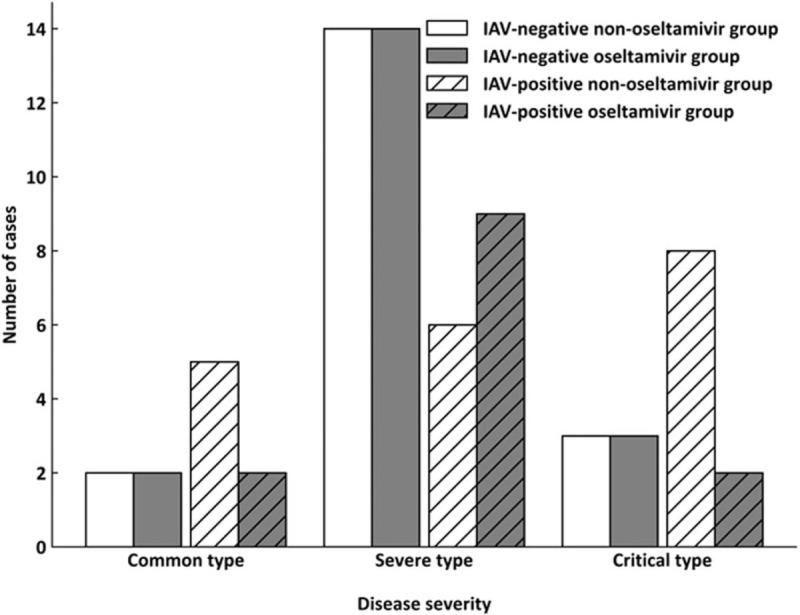
Thirty-two (45.71%) of the 70 patients had positive anti-IAV IgM. Compared with the IAV-negative group, the positive group showed significantly higher proportions of female patients (59.38% vs. 34.21%, χ = 4.43, P = 0.035) and patients with fatigue (59.38% vs. 34.21%, χ = 4.43, P = 0.035). The levels of soluble interleukin 2 receptor (median 791.00 vs. 1075.50 IU/mL, Z = -2.70, P = 0.007) and tumor necrosis factor α (median 10.75 vs. 11.50 pg/mL, Z = -2.18, P = 0.029) were significantly lower in the IAV-positive group. Furthermore, this group tended to have a higher proportion of critical patients (31.25% vs. 15.79%, P = 0.066) and a higher fatality rate (21.88% vs. 7.89%, P = 0.169). Notably, in the IAV-positive group, patients who received oseltamivir had a significantly lower fatality rate (0 vs. 36.84%, P = 0.025) compared with those not receiving oseltamivir.
The study suggests that during the flu season, close attention should be paid to the probability of IAV exposure in COVID-19 patients. Prospective studies with larger sample sizes are needed to clarify whether IAV increases the fatality rate of COVID-19 and to elucidate any benefits of empirical usage of oseltamivir.
2019 年冠状病毒病(COVID-19)疫情发生在全球流感季节。本研究旨在分析甲型流感病毒(IAV)暴露对 COVID-19 的影响。
本回顾性研究纳入了 2020 年 1 月至 2 月期间在中国武汉住院的 70 例 COVID-19 患者。入院时进行了呼吸道病原体免疫球蛋白 M(IgM)和炎症生物标志物等血清检测。根据疾病严重程度,患者被分为普通型、重型和危重型。比较了抗 IAV IgM 阳性和抗 IAV IgM 阴性组之间的症状、炎症指标、疾病严重程度和死亡率。还分析了两组中奥司他韦经验性使用的效果。根据数据分布,组间比较采用 t 检验和曼-惠特尼 U 检验。用卡方检验比较组间疾病严重程度和死亡率。
70 例患者中,32 例(45.71%)抗 IAV IgM 阳性。与 IAV 阴性组相比,阳性组女性患者比例明显较高(59.38% vs. 34.21%,χ²=4.43,P=0.035),乏力症状患者比例也较高(59.38% vs. 34.21%,χ²=4.43,P=0.035)。可溶性白细胞介素 2 受体(中位数 791.00 vs. 1075.50 IU/mL,Z=-2.70,P=0.007)和肿瘤坏死因子-α(中位数 10.75 vs. 11.50 pg/mL,Z=-2.18,P=0.029)水平在 IAV 阳性组明显较低。此外,该组倾向于有更高比例的危重症患者(31.25% vs. 15.79%,P=0.066)和更高的死亡率(21.88% vs. 7.89%,P=0.169)。值得注意的是,在 IAV 阳性组中,接受奥司他韦治疗的患者死亡率明显低于未接受奥司他韦治疗的患者(0% vs. 36.84%,P=0.025)。
本研究提示,在流感季节,应密切关注 COVID-19 患者发生 IAV 暴露的概率。需要更大样本量的前瞻性研究来阐明 IAV 是否会增加 COVID-19 的死亡率,并阐明奥司他韦经验性使用的任何益处。