Department of Pulmonary and Critical Care Medicine, Beijing Hospital, National Center of Gerontology, the Institute of Geriatric Medicine, Chinese Academy of Medical Sciences, Beijing, People's Republic of China.
First Department of Hepatobiliary & Pancreas Surgery, The First Hospital, Jilin University, Jilin, 130021, Changchun, China.
BMC Infect Dis. 2021 Apr 12;21(1):341. doi: 10.1186/s12879-021-05975-2.
Coronavirus disease 2019 (COVID-19) is an emerging infectious disease that rapidly spreads worldwide and co-infection of COVID-19 and influenza may occur in some cases. We aimed to describe clinical features and outcomes of severe COVID-19 patients with co-infection of influenza virus.
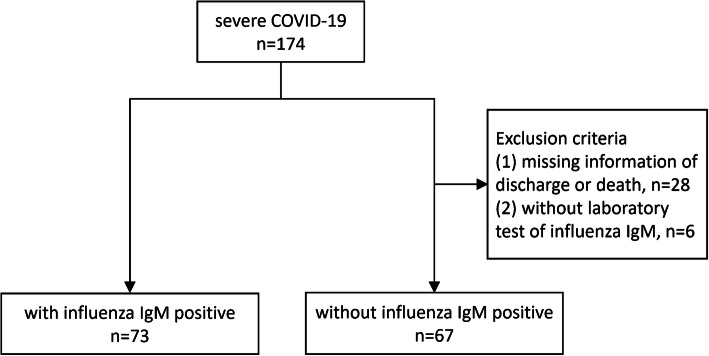
Retrospective cohort study was performed and a total of 140 patients with severe COVID-19 were enrolled in designated wards of Sino-French New City Branch of Tongji Hospital between Feb 8th and March 15th in Wuhan city, Hubei province, China. The demographic, clinical features, laboratory indices, treatment and outcomes of these patients were collected.
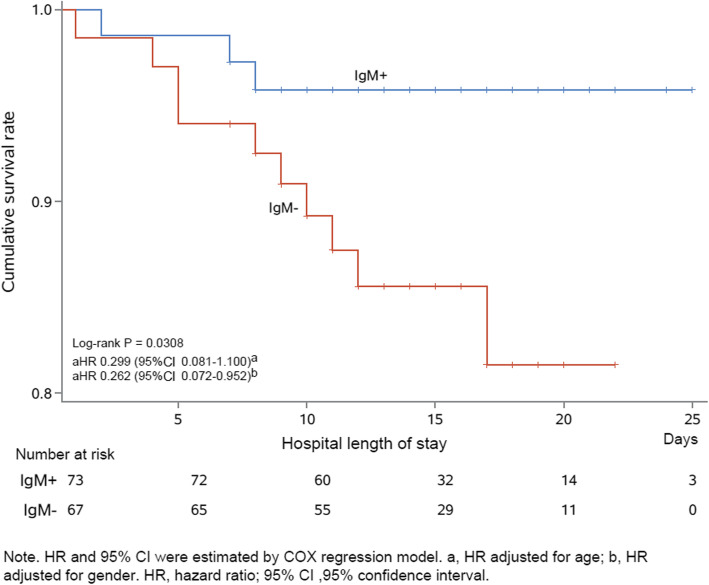
Of 140 severe COVID-19 hospitalized patients, including 73 patients (52.14%) with median age 62 years were influenza virus IgM-positive and 67 patients (47.86%) with median age 66 years were influenza virus IgM-negative. 76 (54.4%) of severe COVID-19 patients were males. Chronic comorbidities consisting mainly of hypertension (45.3%), diabetes (15.8%), chronic respiratory disease (7.2%), cardiovascular disease (5.8%), malignancy (4.3%) and chronic kidney disease (2.2%). Clinical features, including fever (≥38 °C), chill, cough, chest pain, dyspnea, diarrhea and fatigue or myalgia were collected. Fatigue or myalgia was less found in COVID-19 patients with IgM-positive (33.3% vs 50/7%, P = 0.0375). Higher proportion of prolonged activated partial thromboplastin time (APTT) > 42 s was observed in COVID-19 patients with influenza virus IgM-negative (43.8% vs 23.6%, P = 0.0127). Severe COVID-19 Patients with influenza virus IgM positive have a higher cumulative survivor rate than that of patients with influenza virus IgM negative (Log-rank P = 0.0308). Considering age is a potential confounding variable, difference in age was adjusted between different influenza virus IgM status groups, the HR was 0.29 (95% CI, 0.081-1.100). Similarly, difference in gender was adjusted as above, the HR was 0.262 (95% CI, 0.072-0.952) in the COX regression model.
Influenza virus IgM positive may be associated with decreasing in-hospital death.
2019 年冠状病毒病(COVID-19)是一种新兴的传染病,在全球范围内迅速传播,在某些情况下可能会发生 COVID-19 和流感的合并感染。我们旨在描述合并感染流感病毒的严重 COVID-19 患者的临床特征和结局。
进行了回顾性队列研究,共纳入 140 例于 2020 年 2 月 8 日至 3 月 15 日在湖北省武汉市同济医院中法新城院区指定病房住院的严重 COVID-19 患者。收集这些患者的人口统计学、临床特征、实验室指标、治疗和结局。
在 140 例严重 COVID-19 住院患者中,73 例(52.14%)的流感病毒 IgM 阳性,中位年龄为 62 岁,67 例(47.86%)的流感病毒 IgM 阴性,中位年龄为 66 岁。76 例(54.4%)严重 COVID-19 患者为男性。慢性合并症主要包括高血压(45.3%)、糖尿病(15.8%)、慢性呼吸系统疾病(7.2%)、心血管疾病(5.8%)、恶性肿瘤(4.3%)和慢性肾脏病(2.2%)。收集了发热(≥38°C)、寒战、咳嗽、胸痛、呼吸困难、腹泻和疲劳或肌痛等临床特征。在 IgM 阳性的 COVID-19 患者中,疲劳或肌痛的发生率较低(33.3% vs 50/7%,P=0.0375)。流感病毒 IgM 阴性的 COVID-19 患者中,延长的部分凝血活酶时间(APTT)>42s 的比例较高(43.8% vs 23.6%,P=0.0127)。流感病毒 IgM 阳性的严重 COVID-19 患者的累积生存率高于流感病毒 IgM 阴性的患者(Log-rank P=0.0308)。考虑到年龄是一个潜在的混杂变量,在不同的流感病毒 IgM 状态组之间调整了年龄差异,HR 为 0.29(95%CI,0.081-1.100)。同样,在以上调整性别差异后,COX 回归模型中的 HR 为 0.262(95%CI,0.072-0.952)。
流感病毒 IgM 阳性可能与住院死亡率降低有关。