National Institute for Viral Disease Control and Prevention, China CDC, Beijing, China.
PLoS One. 2012;7(6):e38638. doi: 10.1371/journal.pone.0038638. Epub 2012 Jun 15.
In addition to SARS associated coronaviruses, 4 non-SARS related human coronaviruses (HCoVs) are recognized as common respiratory pathogens. The etiology and clinical impact of HCoVs in Chinese adults with acute upper respiratory tract infection (URTI) needs to be characterized systematically by molecular detection with excellent sensitivity.
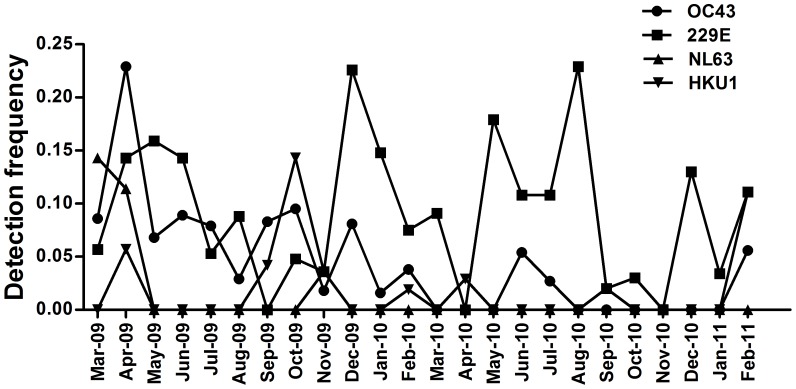
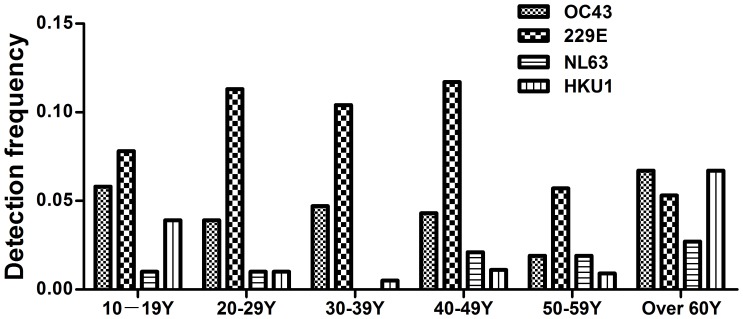
METHODOLOGY/PRINCIPAL FINDINGS: In this study, we detected 4 non-SARS related HCoV species by real-time RT-PCR in 981 nasopharyngeal swabs collected from March 2009 to February 2011. All specimens were also tested for the presence of other common respiratory viruses and newly identified viruses, human metapneumovirus (hMPV) and human bocavirus (HBoV). 157 of the 981 (16.0%) nasopharyngeal swabs were positive for HCoVs. The species detected were 229E (96 cases, 9.8%), OC43 (42 cases, 4.3%), HKU1 (16 cases, 1.6%) and NL63 (11 cases, 1.1%). HCoV-229E was circulated in 21 of the 24 months of surveillance. The detection rates for both OC43 and NL63 were showed significantly year-to-year variation between 2009/10 and 2010/11, respectively (P<0.001 and P = 0.003), and there was a higher detection frequency of HKU1 in patients aged over 60 years (P = 0.03). 48 of 157(30.57%) HCoV positive patients were co-infected. Undifferentiated human rhinoviruses and influenza (Flu) A were the most common viruses detected (more than 35%) in HCoV co-infections. Respiratory syncytial virus (RSV), human parainfluenza virus (PIV) and HBoV were detected in very low rate (less than 1%) among adult patients with URTI.
CONCLUSIONS/SIGNIFICANCE: All 4 non-SARS-associated HCoVs were more frequently detected by real-time RT-PCR assay in adults with URTI in Beijing and HCoV-229E led to the most prevalent infection. Our study also suggested that all non-SARS-associated HCoVs contribute significantly to URTI in adult patients in China.
除 SARS 相关冠状病毒外,4 种非 SARS 相关人类冠状病毒(HCoV)也被认为是常见的呼吸道病原体。需要通过具有优异灵敏度的分子检测系统地描述中国急性上呼吸道感染(URTI)成人中 HCoV 的病因和临床影响。
方法/主要发现:在这项研究中,我们通过实时 RT-PCR 检测了 2009 年 3 月至 2011 年 2 月采集的 981 份鼻咽拭子中的 4 种非 SARS 相关 HCoV 种。所有标本还检测了其他常见呼吸道病毒和新鉴定的病毒,即人类偏肺病毒(hMPV)和人类博卡病毒(HBoV)。981 份鼻咽拭子中有 157 份(16.0%)为 HCoV 阳性。检测到的物种为 229E(96 例,9.8%)、OC43(42 例,4.3%)、HKU1(16 例,1.6%)和 NL63(11 例,1.1%)。HCoV-229E 在 24 个月监测的 21 个月中均有传播。2009/10 年和 2010/11 年之间,OC43 和 NL63 的检测率均呈明显的逐年变化(P<0.001 和 P=0.003),60 岁以上患者 HKU1 的检出频率较高(P=0.03)。157 例 HCoV 阳性患者中有 48 例(30.57%)合并感染。未分化的人类鼻病毒和流感(Flu)A 是 HCoV 合并感染中最常见的病毒(超过 35%)。呼吸道合胞病毒(RSV)、人副流感病毒(PIV)和 HBoV 在成人 URTI 中检出率非常低(低于 1%)。
结论/意义:实时 RT-PCR 检测法在北京急性 URTI 成人中更频繁地检测到 4 种非 SARS 相关 HCoV,其中 HCoV-229E 导致最常见的感染。我们的研究还表明,所有非 SARS 相关 HCoV 均对中国成人 URTI 有重要贡献。