• 文献检索
  • 文档翻译
  • 深度研究
  • 学术资讯
  • Suppr Zotero 插件Zotero 插件
  • 邀请有礼
  • 套餐&价格
  • 历史记录
应用&插件
Suppr Zotero 插件Zotero 插件浏览器插件Mac 客户端Windows 客户端微信小程序
定价
高级版会员购买积分包购买API积分包
服务
文献检索文档翻译深度研究API 文档MCP 服务
关于我们
关于 Suppr公司介绍联系我们用户协议隐私条款
关注我们

Suppr 超能文献

核心技术专利:CN118964589B侵权必究
粤ICP备2023148730 号-1Suppr @ 2026

文献检索

告别复杂PubMed语法,用中文像聊天一样搜索,搜遍4000万医学文献。AI智能推荐,让科研检索更轻松。

立即免费搜索

文件翻译

保留排版,准确专业,支持PDF/Word/PPT等文件格式,支持 12+语言互译。

免费翻译文档

深度研究

AI帮你快速写综述,25分钟生成高质量综述,智能提取关键信息,辅助科研写作。

立即免费体验

与年轻成年人中的过度游戏使用者和非游戏玩家相比,休闲游戏玩家的自我效能感和临床特征

Self-Efficacy and Clinical Characteristics in Casual Gamers Compared to Excessive Gaming Users and Non-Gamers in Young Adults.

作者信息

Chung Sun Ju, Jang Joon Hwan, Lee Ji Yoon, Choi Aruem, Kim Bo Mi, Park Min Kyung, Jung Myung Hun, Choi Jung-Seok

机构信息

Department of Psychiatry, SMG-SNU Boramae Medical Center, Seoul 07061, Korea.

Department of Psychiatry, Seoul National University Health Service Center, Seoul 08826, Korea.

出版信息

J Clin Med. 2020 Aug 22;9(9):2720. doi: 10.3390/jcm9092720.

DOI:10.3390/jcm9092720
PMID:32842707
原文链接:https://pmc.ncbi.nlm.nih.gov/articles/PMC7564646/
Abstract

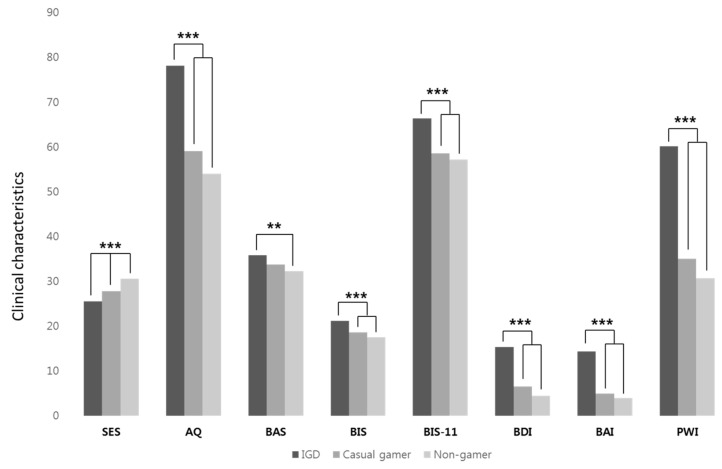
This study investigated differences in the self-efficacy and clinical characteristics which were found relevant to addictive behaviors in young adults according to time spent gaming. To our knowledge, this is the first study to explore self-efficacy in casual gamers relative to patients with internet gaming disorder (IGD) and non-gamers. In total, 158 young adults participated in this study and were divided into three groups: excessive gamers, who were diagnosed with IGD based on the Diagnostic and Statistical Manual of Mental Disorder-fifth edition (DSM-5, = 71); casual gamers, who played games regularly but did not meet the criteria for IGD ( = 37); and non-gamers/controls, who did not engage in gaming ( = 50). All participants completed self-administered questionnaires, including measures of self-efficacy and clinical features such as the Barratt Impulsiveness Scale, Beck Depression Inventory, Beck Anxiety Inventory, Behavioral Activation/Inhibition Systems, aggression, and psychosocial well-being. There were significant differences in the self-efficacy according to the extent of gaming (excessive gamers < casual gamers < non-gamers). In addition, aggression, impulsivity, depression, anxiety, level of stress, and behavioral inhibition system scores were significantly higher in excessive gamers than in casual gamers and non-gamers. These findings showed that individuals who spend more time playing games tend to have lower self-efficacy. Our study suggests that self-efficacy may protect against or constitute a risk of excessive gaming, particularly among casual gamers. It is necessary to pay attention to enhancing psychological well-being through self-efficacy to prevent addiction in young adult gamers.

摘要

本研究调查了根据游戏时长划分的年轻成年人中,与成瘾行为相关的自我效能感和临床特征的差异。据我们所知,这是第一项探索休闲游戏玩家相对于患有网络游戏障碍(IGD)的患者和非游戏玩家的自我效能感的研究。共有158名年轻成年人参与了本研究,并被分为三组:过度游戏玩家,根据《精神疾病诊断与统计手册》第五版(DSM-5)被诊断为患有IGD(n = 71);休闲游戏玩家,定期玩游戏但不符合IGD标准(n = 37);以及非游戏玩家/对照组,不参与游戏(n = 50)。所有参与者都完成了自我管理的问卷,包括自我效能感测量以及临床特征测量,如巴拉特冲动性量表、贝克抑郁量表、贝克焦虑量表、行为激活/抑制系统、攻击性和心理社会幸福感。根据游戏程度不同,自我效能感存在显著差异(过度游戏玩家<休闲游戏玩家<非游戏玩家)。此外,过度游戏玩家的攻击性、冲动性、抑郁、焦虑、压力水平和行为抑制系统得分显著高于休闲游戏玩家和非游戏玩家。这些发现表明,花更多时间玩游戏的个体往往自我效能感较低。我们的研究表明,自我效能感可能预防过度游戏或构成过度游戏的风险,特别是在休闲游戏玩家中。有必要通过自我效能感来关注增强心理健康,以防止年轻成年游戏玩家成瘾。
https://cdn.ncbi.nlm.nih.gov/pmc/blobs/dcba/7564646/3a37c0c887db/jcm-09-02720-g001.jpg

相似文献

1
Self-Efficacy and Clinical Characteristics in Casual Gamers Compared to Excessive Gaming Users and Non-Gamers in Young Adults.与年轻成年人中的过度游戏使用者和非游戏玩家相比,休闲游戏玩家的自我效能感和临床特征
J Clin Med. 2020 Aug 22;9(9):2720. doi: 10.3390/jcm9092720.
2
Established risk factors for addiction fail to discriminate between healthy gamers and gamers endorsing DSM-5 Internet gaming disorder.成瘾的既定风险因素无法区分健康玩家和认可《精神疾病诊断与统计手册》第五版(DSM-5)中网络游戏障碍的玩家。
J Behav Addict. 2017 Dec 1;6(4):516-524. doi: 10.1556/2006.6.2017.074. Epub 2017 Nov 13.
3
Internet Gaming Disorder in adolescence: investigating profiles and associated risk factors.青少年网络成瘾障碍:探索其特征及相关风险因素。
BMC Public Health. 2021 Aug 12;21(1):1547. doi: 10.1186/s12889-021-11394-4.
4
A latent profile approach for classifying internet gamers based on motives for online gaming.基于在线游戏动机的网络玩家分类的潜在剖面分析方法。
J Behav Addict. 2023 Feb 10;12(1):148-158. doi: 10.1556/2006.2022.00092. Print 2023 Mar 30.
5
Association of General Cognitive Functions with Gaming Use in Young Adults: A Comparison among Excessive Gamers, Regular Gamers and Non-Gamers.年轻人一般认知功能与游戏使用的关联:过度游戏者、经常游戏者和非游戏者的比较
J Clin Med. 2021 May 25;10(11):2293. doi: 10.3390/jcm10112293.
6
Internet gaming disorder in Lebanon: Relationships with age, sleep habits, and academic achievement.黎巴嫩的网络成瘾障碍:与年龄、睡眠习惯和学业成绩的关系。
J Behav Addict. 2018 Mar 1;7(1):70-78. doi: 10.1556/2006.7.2018.16. Epub 2018 Feb 28.
7
Time Spent Gaming, Device Type, Addiction Scores, and Well-being of Adolescent English Gamers in the 2021 OxWell Survey: Latent Profile Analysis.2021年OxWell调查中青少年英国游戏玩家的游戏时长、设备类型、成瘾得分与幸福感:潜在剖面分析
JMIR Pediatr Parent. 2022 Nov 18;5(4):e41480. doi: 10.2196/41480.
8
Internet gaming disorder in male and female young adults: The role of alexithymia, depression, anxiety and gaming type.男性和女性青年人群中的网络(电子)游戏障碍:述情障碍、抑郁、焦虑和游戏类型的作用。
Psychiatry Res. 2019 Feb;272:521-530. doi: 10.1016/j.psychres.2018.12.158. Epub 2018 Dec 29.
9
Problematic Video Gaming in a Young Spanish Population: Association with Psychosocial Health.年轻西班牙人群中的问题性电子游戏行为:与心理健康的关联。
Cyberpsychol Behav Soc Netw. 2018 Jun;21(6):388-394. doi: 10.1089/cyber.2017.0599. Epub 2018 May 24.
10
Massively multiplayer online role-playing games: comparing characteristics of addict vs non-addict online recruited gamers in a French adult population.大型多人在线角色扮演游戏:在法国成年人群中比较成瘾者和非成瘾者在线招募游戏玩家的特征。
BMC Psychiatry. 2011 Aug 26;11:144. doi: 10.1186/1471-244X-11-144.

引用本文的文献

1
Correlation Between Phase Angle and Body Composition, Strength and Nutritional Habits in Male Gamers.男性游戏玩家的相位角与身体成分、力量及营养习惯之间的相关性
Sports (Basel). 2025 Aug 6;13(8):257. doi: 10.3390/sports13080257.
2
Cognitive Mechanisms Between Psychosocial Resources and the Behavioral Intention of Professional Help-Seeking for Internet Gaming Disorder Among Chinese Adolescent Gamers: Cross-Sectional Mediation Study.认知机制在心理社会资源与中国青少年网络游戏障碍者专业求助行为意向之间的作用:横断面中介研究。
JMIR Public Health Surveill. 2024 Nov 14;10:e52478. doi: 10.2196/52478.
3
The Social Processes of Excessive Online Gaming Homophily: Peer Selection or Influence?

本文引用的文献

1
The Role of Resilience in Internet Addiction among Adolescents between Sexes: A Moderated Mediation Model.复原力在青少年网络成瘾中性别差异间的作用:一个有调节的中介模型
J Clin Med. 2018 Aug 19;7(8):222. doi: 10.3390/jcm7080222.
2
Neural Correlates of Distorted Self-concept in Individuals With Internet Gaming Disorder: A Functional MRI Study.网络成瘾障碍个体自我概念扭曲的神经关联:一项功能磁共振成像研究
Front Psychiatry. 2018 Jul 25;9:330. doi: 10.3389/fpsyt.2018.00330. eCollection 2018.
3
The Comorbidity Between Internet Gaming Disorder and Depression: Interrelationship and Neural Mechanisms.
过度网络游戏同好的社会过程:同伴选择还是影响?
J Youth Adolesc. 2024 Oct;53(10):2393-2406. doi: 10.1007/s10964-024-02032-4. Epub 2024 Jun 12.
4
Explicit and implicit effects of gaming content on social media on the behavior of young adults.社交媒体上游戏内容对年轻人行为的显性和隐性影响。
Front Psychol. 2024 Jan 24;15:1332462. doi: 10.3389/fpsyg.2024.1332462. eCollection 2024.
5
A Network Analysis of the Relationships Between Behavioral Inhibition/Activation Systems and Problematic Mobile Phone Use.行为抑制/激活系统与问题手机使用之间关系的网络分析
Front Psychiatry. 2022 Apr 1;13:832933. doi: 10.3389/fpsyt.2022.832933. eCollection 2022.
6
The Influence of Parenting Style and Time Management Tendency on Internet Gaming Disorder among Adolescents.教养方式和时间管理倾向对青少年网络成瘾的影响。
Int J Environ Res Public Health. 2020 Dec 6;17(23):9120. doi: 10.3390/ijerph17239120.
网络游戏障碍与抑郁症的共病:相互关系及神经机制
Front Psychiatry. 2018 Apr 23;9:154. doi: 10.3389/fpsyt.2018.00154. eCollection 2018.
4
Risk Factors for Internet Gaming Disorder: Psychological Factors and Internet Gaming Characteristics.网络成瘾障碍的危险因素:心理因素和网络游戏特征。
Int J Environ Res Public Health. 2017 Dec 27;15(1):40. doi: 10.3390/ijerph15010040.
5
Changes of quality of life and cognitive function in individuals with Internet gaming disorder: A 6-month follow-up.患有网络游戏障碍的个体的生活质量和认知功能变化:一项为期6个月的随访研究。
Medicine (Baltimore). 2016 Dec;95(50):e5695. doi: 10.1097/MD.0000000000005695.
6
Correlations among Social Anxiety, Self-Esteem, Impulsivity, and Game Genre in Patients with Problematic Online Game Playing.网络游戏成瘾患者的社交焦虑、自尊、冲动性与游戏类型之间的相关性
Psychiatry Investig. 2016 May;13(3):297-304. doi: 10.4306/pi.2016.13.3.297. Epub 2016 May 18.
7
Association between Internet gaming disorder and adult attention deficit and hyperactivity disorder and their correlates: Impulsivity and hostility.网络游戏障碍与成人注意力缺陷多动障碍及其相关因素之间的关联:冲动性与敌意。
Addict Behav. 2017 Jan;64:308-313. doi: 10.1016/j.addbeh.2016.04.024. Epub 2016 Apr 29.
8
The association of Internet addiction symptoms with anxiety, depression and self-esteem among adolescents with attention-deficit/hyperactivity disorder.注意缺陷多动障碍青少年中网络成瘾症状与焦虑、抑郁及自尊的关联。
Compr Psychiatry. 2014 Oct;55(7):1601-8. doi: 10.1016/j.comppsych.2014.05.025. Epub 2014 Jun 12.
9
Internet gaming addiction, problematic use of the internet, and sleep problems: a systematic review.网络成瘾、互联网问题使用与睡眠问题:系统综述。
Curr Psychiatry Rep. 2014 Apr;16(4):444. doi: 10.1007/s11920-014-0444-1.
10
Evaluation of the diagnostic criteria of Internet gaming disorder in the DSM-5 among young adults in Taiwan.评估 DSM-5 中网络游戏障碍诊断标准在台湾青年中的适用性。
J Psychiatr Res. 2014 Jun;53:103-10. doi: 10.1016/j.jpsychires.2014.02.008. Epub 2014 Feb 19.