Immunology of Infectious Diseases Unit, Institut Pasteur de Madagascar, Antananarivo, Madagascar.
Functional Genetics of Infectious Diseases Unit, Institut Pasteur, Paris, France.
Parasit Vectors. 2020 Aug 26;13(1):430. doi: 10.1186/s13071-020-04282-0.
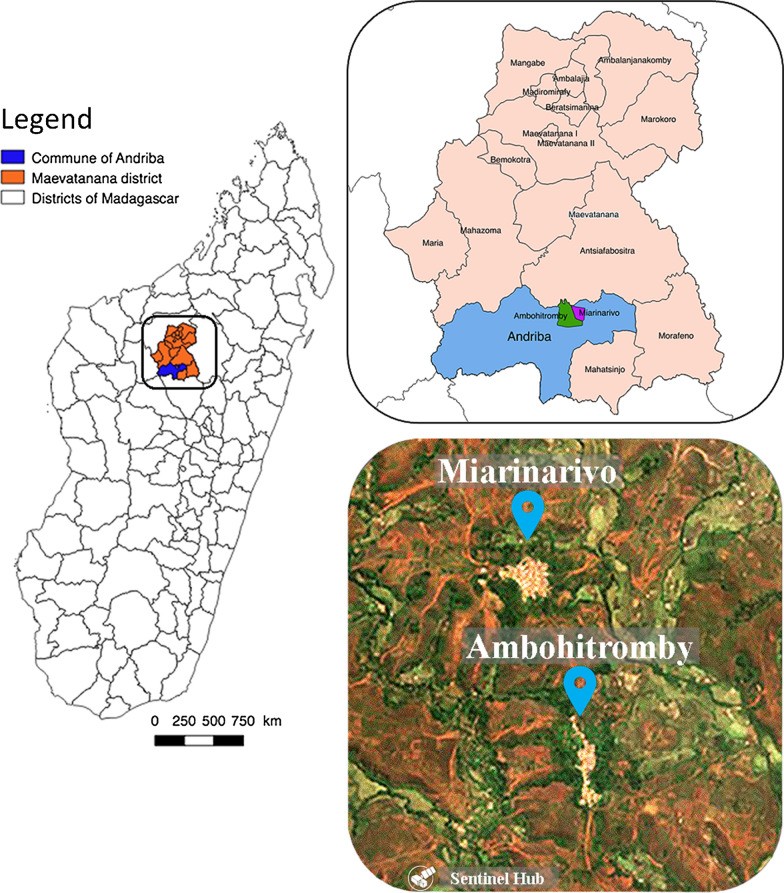
Malaria is still a heavy public health concern in Madagascar. Few studies combining parasitology and entomology have been conducted despite the need for accurate information to design effective vector control measures. In a Malagasy region of moderate to intense transmission of both Plasmodium falciparum and P. vivax, parasitology and entomology have been combined to survey malaria transmission in two nearby villages.
Community-based surveys were conducted in the villages of Ambohitromby and Miarinarivo at three time points (T1, T2 and T3) during a single malaria transmission season. Human malaria prevalence was determined by rapid diagnostic tests (RDTs), microscopy and real-time PCR. Mosquitoes were collected by human landing catches and pyrethrum spray catches and the presence of Plasmodium sporozoites was assessed by TaqMan assay.
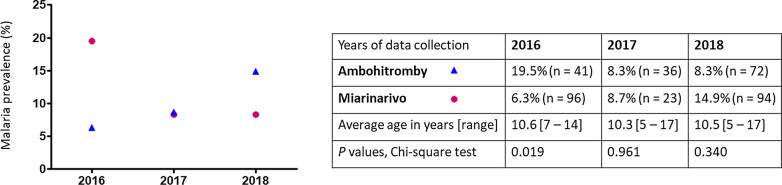
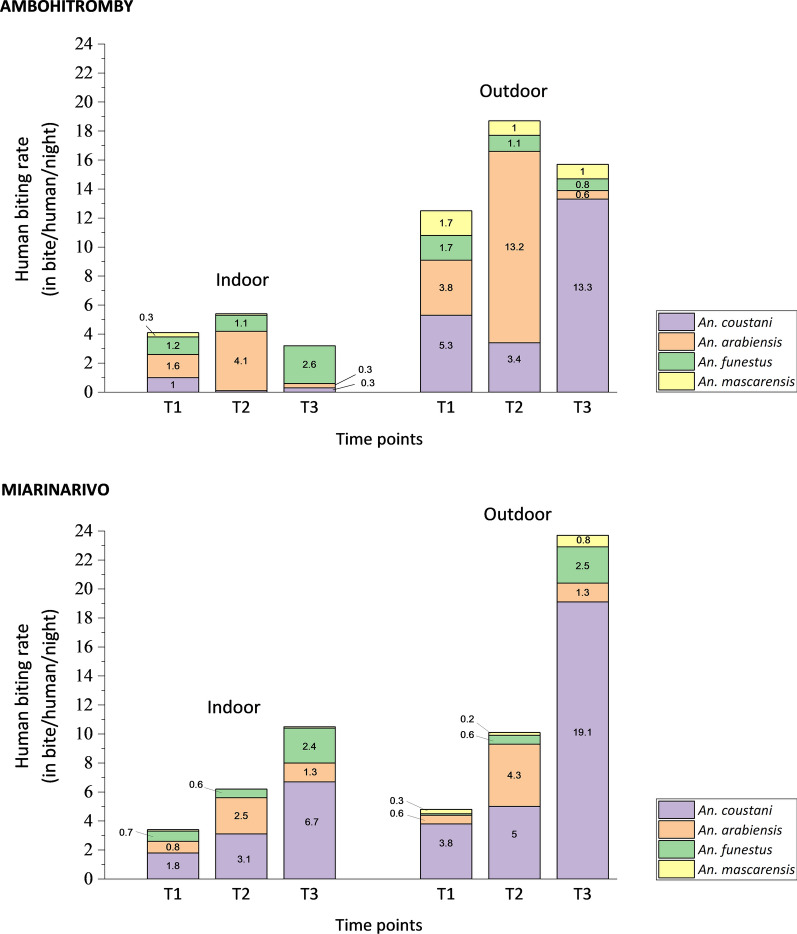
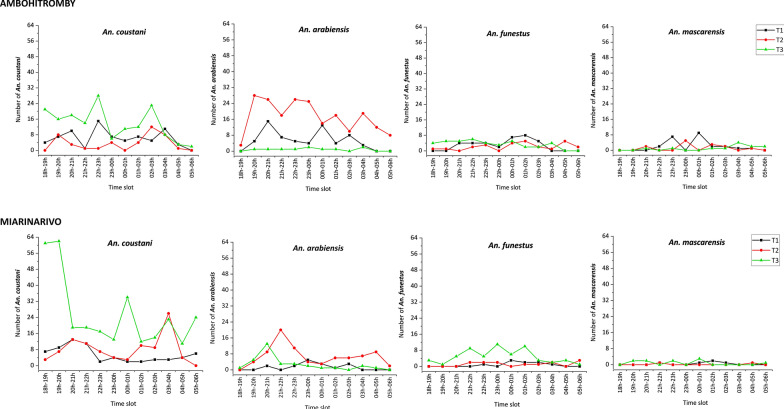
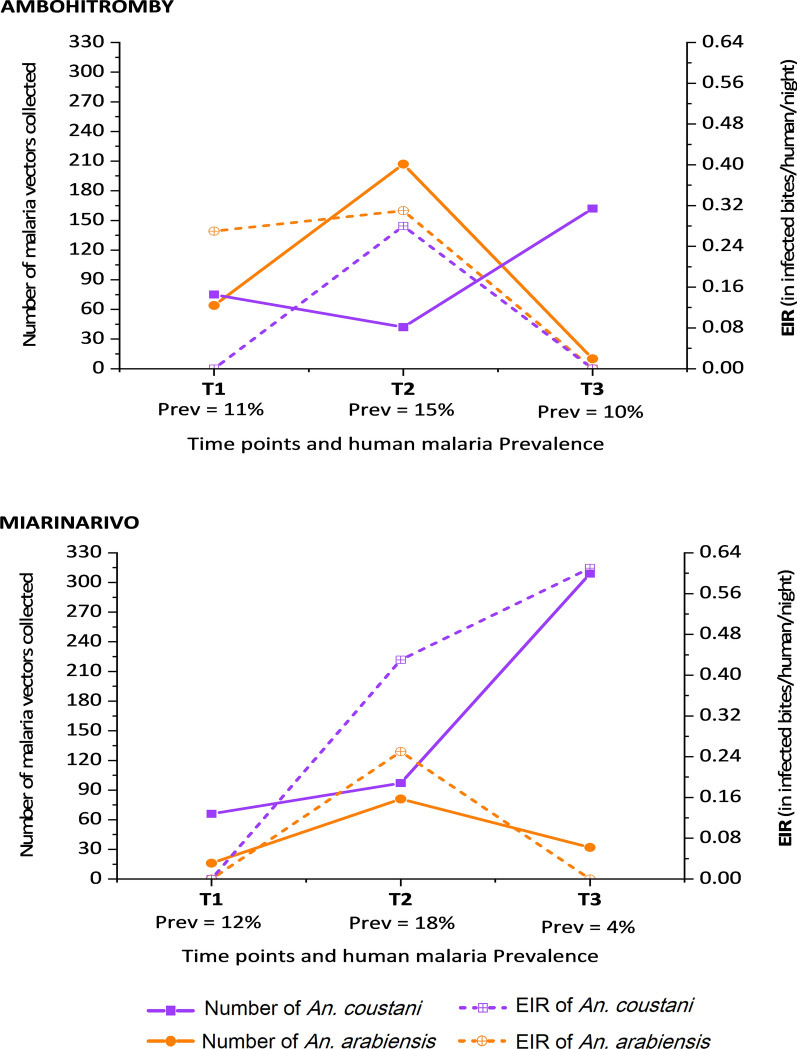
Malaria prevalence was not significantly different between villages, with an average of 8.0% by RDT, 4.8% by microscopy and 11.9% by PCR. This was mainly due to P. falciparum and to a lesser extent to P. vivax. However, there was a significantly higher prevalence rate as determined by PCR at T2 ([Formula: see text] = 7.46, P = 0.025). Likewise, mosquitoes were significantly more abundant at T2 ([Formula: see text] = 64.8, P < 0.001), especially in Ambohitromby. At T1 and T3 mosquito abundance was higher in Miarinarivo than in Ambohitromby ([Formula: see text] = 14.92, P < 0.001). Of 1550 Anopheles mosquitoes tested, 28 (1.8%) were found carrying Plasmodium sporozoites. The entomological inoculation rate revealed that Anopheles coustani played a major contribution in malaria transmission in Miarinarivo, being responsible of 61.2 infective bites per human (ib/h) during the whole six months of the survey, whereas, it was An. arabiensis, with 36 ib/h, that played that role in Ambohitromby.
Despite a similar malaria prevalence in two nearby villages, the entomological survey showed a different contribution of An. coustani and An. arabiensis to malaria transmission in each village. Importantly, the suspected secondary malaria vector An. coustani, was found playing the major role in malaria transmission in one village. This highlights the importance of combining parasitology and entomology surveys for better targeting local malaria vectors. Such study should contribute to the malaria pre-elimination goal established under the 2018-2022 National Malaria Strategic Plan.
疟疾仍然是马达加斯加的一个严重公共卫生问题。尽管需要准确的信息来设计有效的病媒控制措施,但仍很少有结合寄生虫学和昆虫学的研究。在马达加斯加一个疟原虫和间日疟原虫传播程度为中度至高强度的地区,寄生虫学和昆虫学结合起来,对两个附近村庄的疟疾传播进行了调查。
在一个疟疾传播季节的三个时间点(T1、T2 和 T3),在安博希特罗姆比和米亚里纳里沃两个村庄进行了基于社区的调查。通过快速诊断检测(RDT)、显微镜检查和实时 PCR 来确定人类疟疾的流行率。通过人体降落捕获和除虫菊喷雾捕获收集蚊子,并通过 TaqMan 检测评估疟原虫孢子虫的存在。
两个村庄的疟疾流行率没有显著差异,RDT 检测的平均流行率为 8.0%,显微镜检测的平均流行率为 4.8%,PCR 检测的平均流行率为 11.9%。这主要是由于恶性疟原虫,其次是间日疟原虫。然而,PCR 检测的结果在 T2 时显著更高([公式:见正文] = 7.46,P = 0.025)。同样,蚊子在 T2 时也明显更丰富([公式:见正文] = 64.8,P < 0.001),特别是在安博希特罗姆比。在 T1 和 T3,米亚里纳里沃的蚊子数量高于安博希特罗姆比([公式:见正文] = 14.92,P < 0.001)。在检测的 1550 只疟蚊中,有 28 只(1.8%)携带疟原虫孢子虫。昆虫学接种率表明,库氏按蚊在米亚里纳里沃的疟疾传播中起了主要作用,在整个六个月的调查期间,每 100 人有 61.2 个感染性叮咬(ib/h),而在安博希特罗姆比,起作用的是 36 ib/h 的阿蚊。
尽管两个附近村庄的疟疾流行率相似,但昆虫学调查显示,库蚊和阿蚊在每个村庄的疟疾传播中贡献不同。重要的是,被怀疑是次要疟疾传播媒介的库蚊在一个村庄中发挥了主要作用。这凸显了寄生虫学和昆虫学调查相结合以更好地针对当地疟疾媒介的重要性。此类研究应有助于实现 2018-2022 年国家疟疾战略计划下制定的消除疟疾前目标。