Dept Parasitology, Institute of Tropical Medicine Antwerp, Nationalestraat 155, B-2000 Antwerpen, Belgium.
Malar J. 2010 Dec 23;9:373. doi: 10.1186/1475-2875-9-373.
In Vietnam, malaria is becoming progressively restricted to specific foci where human and vector characteristics alter the known malaria epidemiology, urging for alternative or adapted control strategies. Long-lasting insecticidal hammocks (LLIH) were designed and introduced in Ninh Thuan province, south-central Vietnam, to control malaria in the specific context of forest malaria. An entomological study in this specific forested environment was conducted to assess the behavioural patterns of forest and village vectors and to assess the spatio-temporal risk factors of malaria transmission in the province.
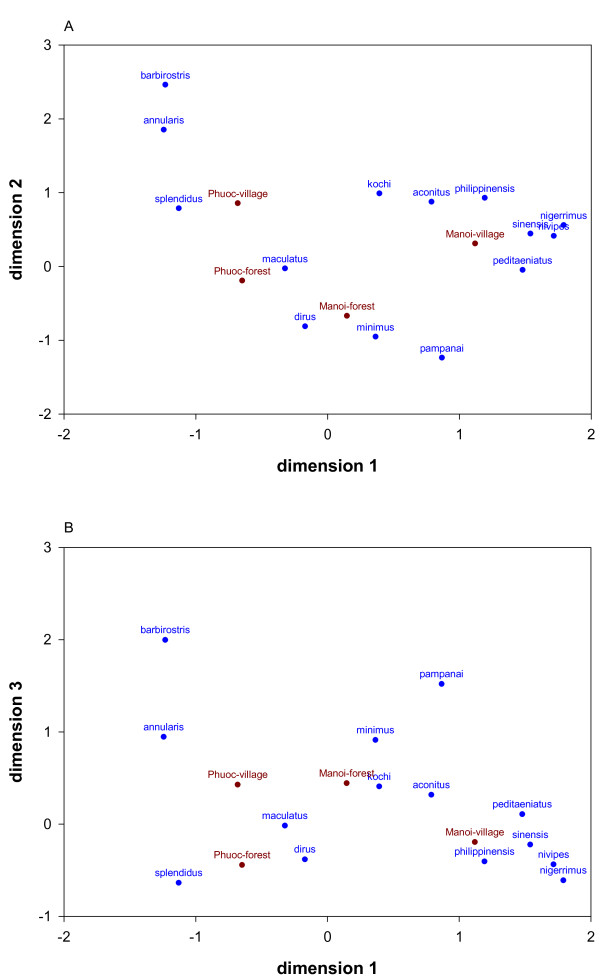
Five entomological surveys were conducted in three villages in Ma Noi commune and in five villages in Phuoc Binh commune in Ninh Thuan Province, south-central Vietnam. Collections were made inside the village, at the plot near the slash-and-burn fields in the forest and on the way to the forest. All collected mosquito species were subjected to enzyme-linked immunosorbent assay (ELISA) to detect Plasmodium in the head-thoracic portion of individual mosquitoes after morphological identification. Collection data were analysed by use of correspondence and multivariate analyses.
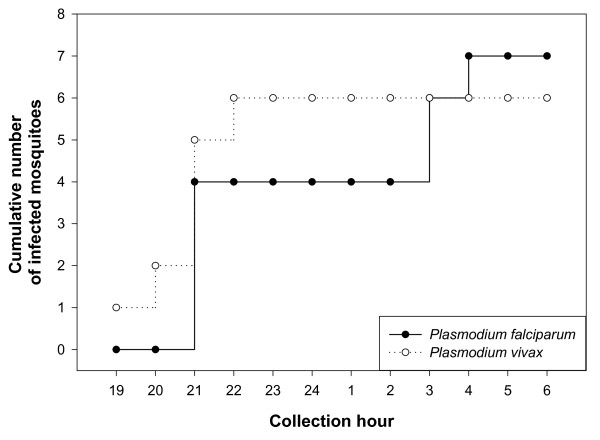
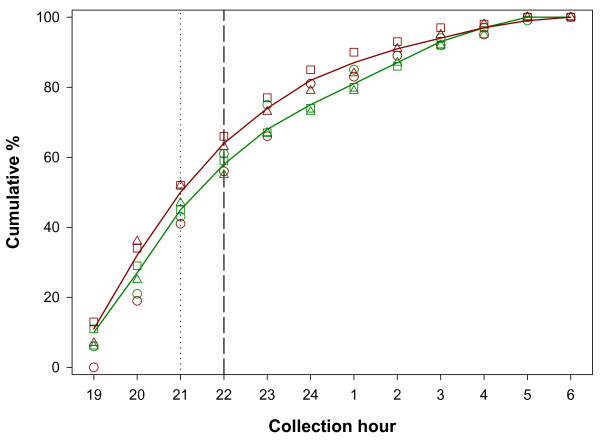
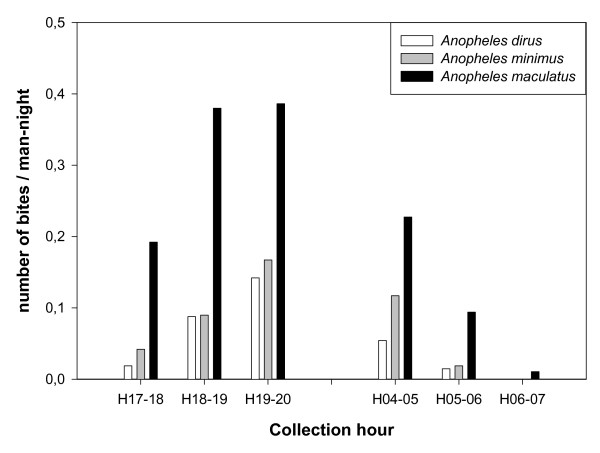
The mosquito density in the study area was low with on average 3.7 anopheline bites per man-night and 17.4 culicine bites per man-night. Plasmodium-infected mosquitoes were only found in the forest and on the way to the forest. Malaria transmission in the forested malaria foci was spread over the entire night, from dusk to dawn, but was most intense in the early evening as nine of the 13 Plasmodium positive bites occurred before 21H. The annual entomological inoculation rate of Plasmodium falciparum was 2.2 infective bites per person-year to which Anopheles dirus s.s. and Anopheles minimus s.s. contributed. The Plasmodium vivax annual entomological inoculation rate was 2.5 infective bites per person-year with Anopheles sawadwongporni, Anopheles dirus s.s. and Anopheles pampanai as vectors.
The vector behaviour and spatio-temporal patterns of malaria transmission in Southeast Asia impose new challenges when changing objectives from control to elimination of malaria and make it necessary to focus not only on the known main vector species. Moreover, effective tools to prevent malaria transmission in the early evening and in the early morning, when the treated bed net cannot be used, need to be developed.
在越南,疟疾逐渐局限于特定的疫源地,人类和病媒的特征改变了已知的疟疾流行病学特征,因此需要替代或调整控制策略。长效驱虫蚊帐(LLIH)是专为控制森林疟疾而在越南中南部的宁顺省设计和引入的。在这个特定的森林环境中进行了一项昆虫学研究,以评估森林和村庄病媒的行为模式,并评估该省疟疾传播的时空风险因素。
在越南中南部宁顺省马诺伊公社的三个村庄和富平公社的五个村庄进行了五次昆虫学调查。在村内、靠近森林烧垦地的地段以及前往森林的路上进行了采集。对所有采集到的蚊子种类进行酶联免疫吸附试验(ELISA),以检测个体蚊子头胸部中的疟原虫,在形态学鉴定后进行检测。使用对应分析和多元分析对采集数据进行分析。
研究区域的蚊子密度较低,平均每 100 人夜有 3.7 只按蚊叮咬和 17.4 只库蚊叮咬。只有在森林中和前往森林的路上才发现感染疟原虫的蚊子。森林疟疾疫源地的疟疾传播持续整个夜晚,从黄昏到黎明,但傍晚时分最为强烈,因为 13 次疟原虫阳性叮咬中有 9 次发生在 21 点之前。恶性疟原虫的年昆虫接种率为每人每年 2.2 次感染性叮咬,其中按蚊指名亚种和微小按蚊亚种各占一半。间日疟原虫的年昆虫接种率为每人每年 2.5 次感染性叮咬,媒介包括斯氏按蚊、按蚊指名亚种和帕彭按蚊。
东南亚病媒的行为和疟疾传播的时空模式给从控制疟疾向消除疟疾转变的目标带来了新的挑战,这使得不仅要关注已知的主要病媒种类,而且要关注其他病媒。此外,需要开发有效的工具来预防傍晚和清晨(即无法使用处理过的蚊帐时)的疟疾传播。