van Klij Pim, Reiman Michael P, Waarsing Jan H, Reijman Max, Bramer Wichor M, Verhaar Jan A N, Agricola Rintje
Department of Orthopaedic Surgery, Erasmus MC, University Medical Center Rotterdam, the Netherlands.
Department of Orthopaedic Surgery, Duke University School of Medicine, Durham, North Carolina, USA.
Orthop J Sports Med. 2020 Aug 10;8(8):2325967120938312. doi: 10.1177/2325967120938312. eCollection 2020 Aug.
The alpha angle is the most often used measure to classify cam morphology. There is currently no agreement on which alpha angle threshold value to use.
To systematically investigate the different alpha angle threshold values used for defining cam morphology in studies aiming to identify this threshold and to determine whether data are consistent enough to suggest an alpha angle threshold to classify cam morphology.
Systematic review; Level of evidence, 3.
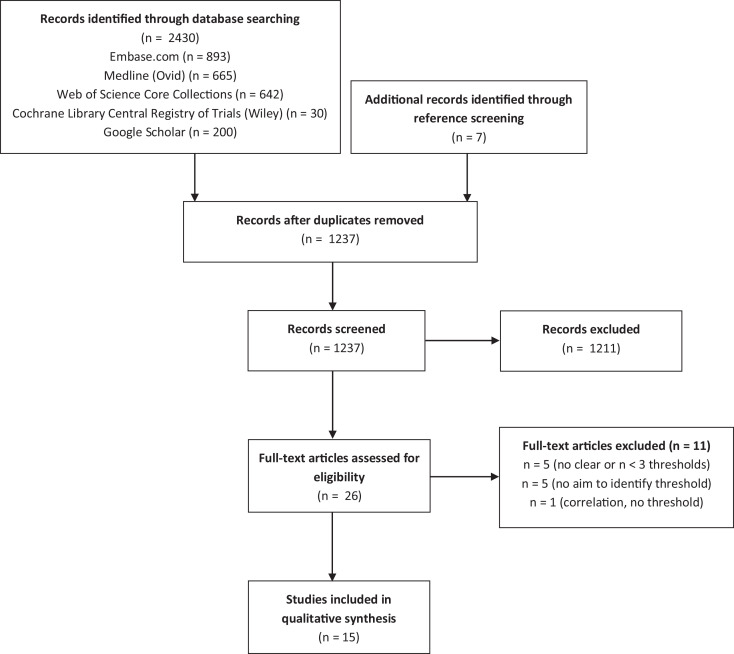
The Embase, Medline (Ovid), Web of Science, Cochrane Central, and Google Scholar databases were searched from database inception to February 28, 2019. Studies aiming at identifying an alpha angle threshold to classify cam morphology were eligible for inclusion.
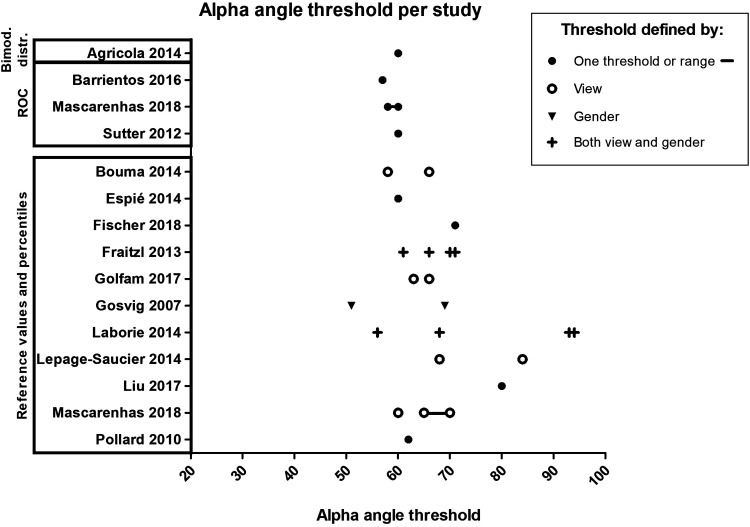
We included 4 case-control studies, 10 cohort studies, and 1 finite-element study from 2437 identified publications. Studies (n = 3) using receiver operating characteristic (ROC) curve analysis to distinguish asymptomatic people from patients with femoroacetabular impingement syndrome consistently observed alpha angle thresholds between 57° and 60°. A 60° threshold was also found to best discriminate between hips with and without cam morphology in a large cohort study based on a bimodal distribution of the alpha angle. Studies (n = 8) using the upper limit of the 95% reference interval as threshold proposed a wide overall threshold range between 58° and 93°. When stratified by sex, thresholds between 63° and 93° in male patients and between 58° and 94° in female patients were reported.
Based on the available evidence, mostly based on studies using ROC curve analysis, an alpha angle threshold of ≥60° is currently the most appropriate to classify cam morphology. Further research is required to fully validate this threshold.
α角是用于分类凸轮形态最常用的测量指标。目前对于使用何种α角阈值尚无共识。
系统研究在旨在确定该阈值的研究中用于定义凸轮形态的不同α角阈值,并确定数据是否足够一致以提出一个用于分类凸轮形态的α角阈值。
系统评价;证据等级,3级。
检索了Embase、Medline(Ovid)、Web of Science、Cochrane Central和Google Scholar数据库,检索时间从数据库建立至2019年2月28日。旨在确定用于分类凸轮形态的α角阈值的研究符合纳入标准。
我们从2437篇已识别的出版物中纳入了4项病例对照研究、10项队列研究和1项有限元研究。使用受试者操作特征(ROC)曲线分析来区分无症状者与股骨髋臼撞击综合征患者的研究(n = 3)一致观察到α角阈值在57°至60°之间。在一项基于α角双峰分布的大型队列研究中,还发现60°的阈值最能区分有和没有凸轮形态的髋关节。使用95%参考区间上限作为阈值的研究(n = 8)提出了一个宽泛的总体阈值范围,在58°至93°之间。按性别分层时,男性患者的阈值在63°至93°之间,女性患者的阈值在58°至94°之间。
基于现有证据,主要是基于使用ROC曲线分析的研究,目前α角阈值≥60°最适合用于分类凸轮形态。需要进一步研究来充分验证该阈值。