Faculty of Land and Food Systems, The University of British Columbia, Vancouver, British Columbia, Canada.
Department of Forest and Conservation Sciences, Faculty of Forestry, The University of British Columbia, Vancouver, British Columbia, Canada.
PLoS One. 2020 Aug 26;15(8):e0238055. doi: 10.1371/journal.pone.0238055. eCollection 2020.
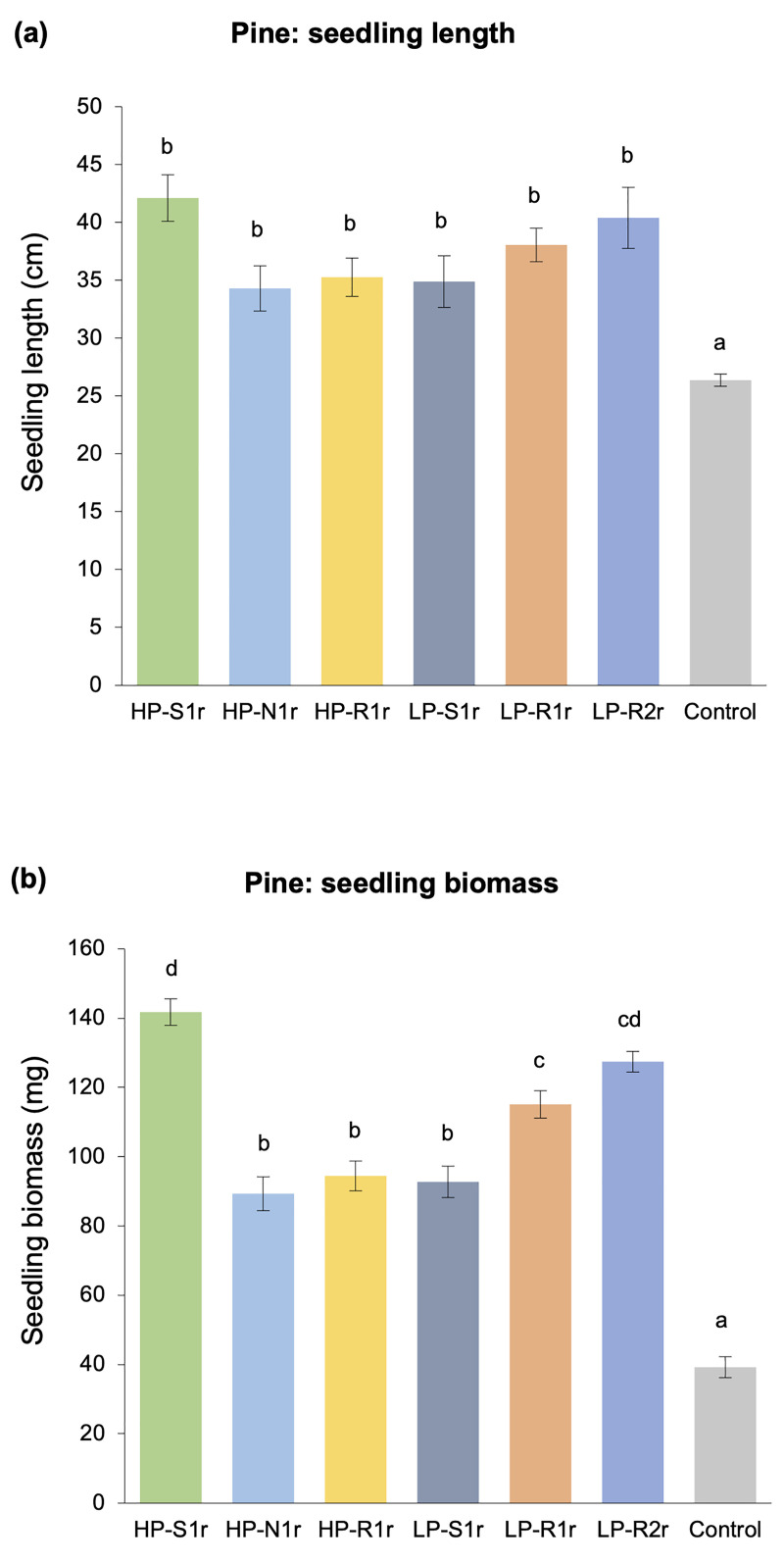
Lodgepole pine, a prominent Pinaceae tree species native to western North America, is well-known for its ability to thrive in highly disturbed and degraded areas. One such area is the Sub-Boreal Pine-Spruce xeric-cold (SBPSxc) region in British Columbia, Canada, which is characterized by weakly-developed, parched soils that lack an organic forest floor and essential plant-available nutrients. We hypothesized that plant growth-promoting bacteria could play a significant role in sustaining the growth of lodgepole pine trees in the SBPSxc region. Testing this hypothesis, we evaluated plant growth-promoting abilities of six endophytic bacterial strains previously isolated from lodgepole pine trees growing in this region. These bacterial strains significantly enhanced the length and biomass of their natural host (lodgepole pine) as well as a foreign host (hybrid white spruce) in a 540-day long greenhouse trial. This growth stimulation could be linked to the diverse plant growth-promoting (PGP) abilities detected in these strains using in vitro assays for inorganic/organic phosphate-solubilization, siderophore production IAA production, ACC deaminase activity, lytic enzymes (chitinase, β-1,3-glucanase, protease, and cellulase) activity, ammonia production and catalase activity. ACC deaminase activity was also detected in vivo for all strains using ethylene-sensitive plants-canola and tomato. Notably, strains belonging to the Burkholderiaceae family (HP-S1r, LP-R1r and LP-R2r) showed the greatest potential in all PGP assays and enhanced pine and spruce seedling length and biomass by up to 1.5-fold and 4-fold, respectively. Therefore, such bacterial strains with multifarious PGP abilities could be crucial for survival and growth of lodgepole pine trees in the SBPSxc region and could potentially be utilized as bioinoculant for Pinaceae trees in highly disturbed and nutrient-poor ecosystems.
道格拉斯冷杉,一种原产于北美洲西部的著名松科树种,以其在高度干扰和退化地区茁壮成长的能力而闻名。不列颠哥伦比亚省的亚北极松-云杉干旱寒冷(SBPSxc)地区就是这样一个区域,其特点是土壤发育不良、干燥,缺乏有机林分和基本的植物可用养分。我们假设植物促生菌可以在 SBPSxc 地区维持花旗松的生长中发挥重要作用。为了验证这一假设,我们评估了之前从该地区生长的花旗松中分离出的六种内生细菌菌株的促生长能力。在为期 540 天的温室试验中,这些细菌菌株显著增加了其自然宿主(花旗松)和外来宿主(杂种白云杉)的长度和生物量。这种生长刺激可能与这些菌株在体外检测到的多种植物促生长(PGP)能力有关,包括无机/有机磷酸盐溶解、铁载体生产、IAA 生产、ACC 脱氨酶活性、溶菌酶(几丁质酶、β-1,3-葡聚糖酶、蛋白酶和纤维素酶)活性、氨生产和过氧化氢酶活性。所有菌株在体内也通过乙烯敏感植物-油菜和番茄检测到 ACC 脱氨酶活性。值得注意的是,属于伯克霍尔德氏菌科(HP-S1r、LP-R1r 和 LP-R2r)的菌株在所有 PGP 试验中表现出最大的潜力,分别将松树苗和云杉苗的长度和生物量增加了 1.5 倍和 4 倍。因此,具有多种 PGP 能力的此类细菌菌株可能对 SBPSxc 地区花旗松的生存和生长至关重要,并可能有潜力作为高度干扰和养分贫乏生态系统中 Pinaceae 树木的生物接种剂。