Human Performance Laboratory, Department of Kinesiology, University of Connecticut, Storrs, CT 06269, USA.
Department of Nutritional Sciences, University of Connecticut, Storrs, CT 06269, USA.
Nutrients. 2020 Aug 24;12(9):2554. doi: 10.3390/nu12092554.
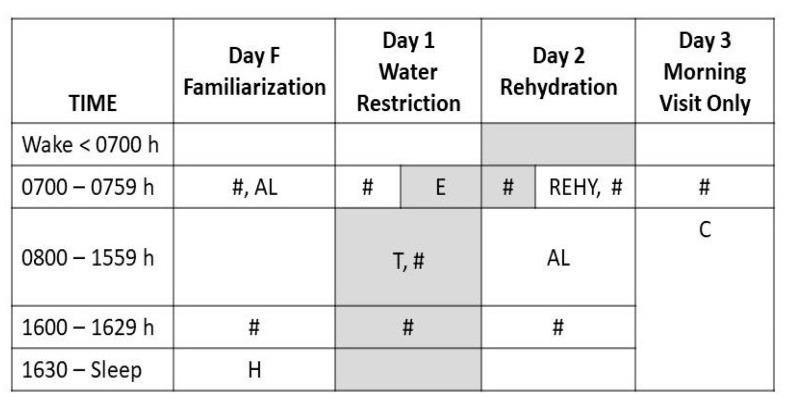
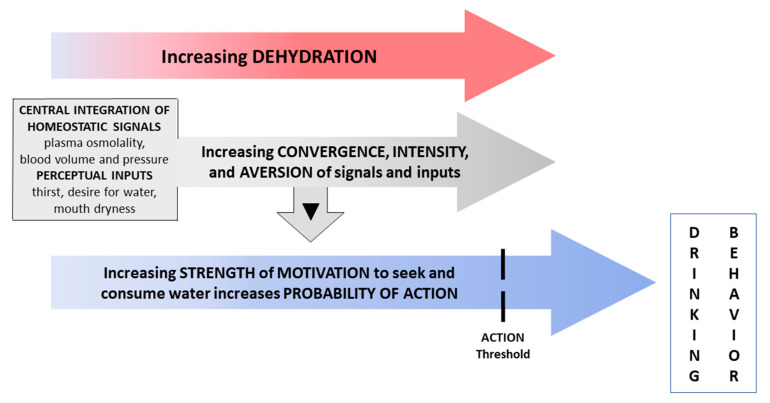
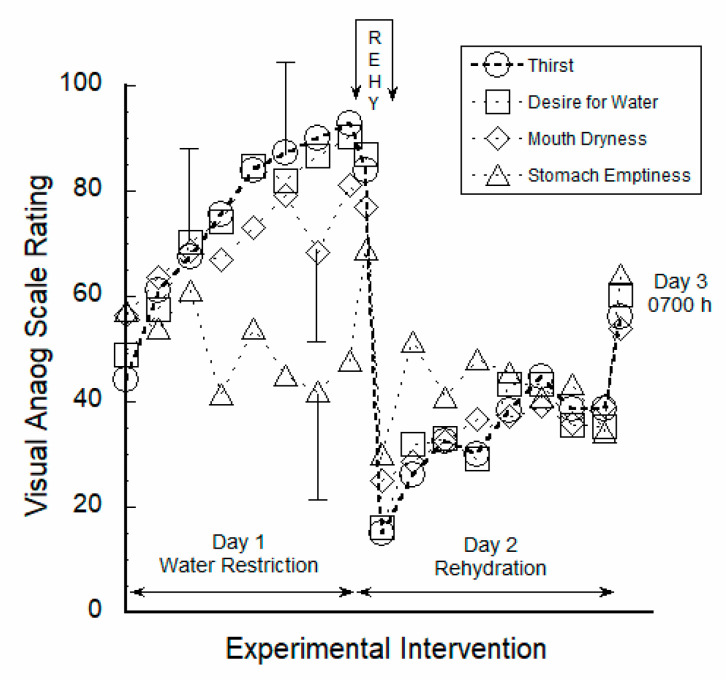
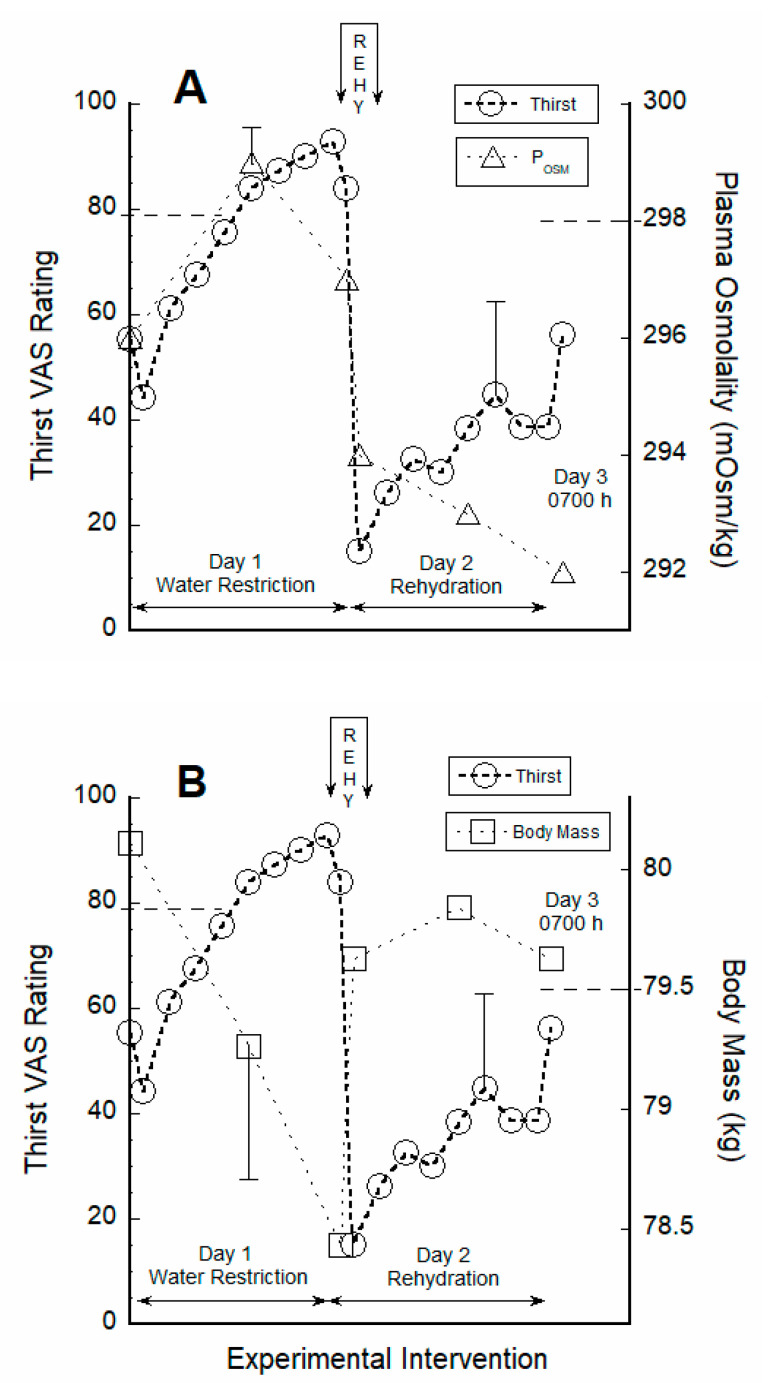
Current models of afferent inputs to the brain, which influence body water volume and concentration via thirst and drinking behavior, have not adequately described the interactions of subconscious homeostatic regulatory responses with conscious perceptions. The purpose of this investigation was to observe the interactions of hydration change indices (i.e., plasma osmolality, body mass loss) with perceptual ratings (i.e., thirst, mouth dryness, stomach emptiness) in 18 free-living, healthy adult men (age, 23 ± 3 y; body mass, 80.09 ± 9.69 kg) who participated in a 24-h water restriction period (Days 1-2), a monitored 30-min oral rehydration session (REHY, Day 2), and a 24-h ad libitum rehydration period (Days 2-3) while conducting usual daily activities. Laboratory and field measurements spanned three mornings and included subjective perceptions (visual analog scale ratings, VAS), water intake, dietary intake, and hydration biomarkers associated with dehydration and rehydration. Results indicated that total water intake was 0.31 L/24 h on Day 1 versus 2.60 L/24 h on Day 2 (of which 1.46 L/30 min was consumed during REHY). The increase of plasma osmolality on Day 1 (297 ± 4 to 299 ± 5 mOsm/kg) concurrent with a body mass loss of 1.67 kg (2.12%) paralleled increasing VAS ratings of thirst, desire for water, and mouth dryness but not stomach emptiness. Interestingly, plasma osmolality dissociated from all perceptual ratings on Day 3, suggesting that morning thirst was predominantly non-osmotic (i.e., perceptual). These findings clarified the complex, dynamic interactions of subconscious regulatory responses with conscious perceptions during dehydration, rehydration, and reestablished euhydration.
目前的大脑传入输入模型通过口渴和饮水行为影响身体的水合状态和浓度,但尚未充分描述潜意识稳态调节反应与意识感知之间的相互作用。本研究旨在观察水合状态变化指标(即血浆渗透压、体重减轻)与感知评分(即口渴、口干、胃部空虚)在 18 名自由生活、健康成年男性(年龄 23 ± 3 岁;体重 80.09 ± 9.69 kg)中的相互作用,他们参与了 24 小时的水限制期(第 1-2 天)、监测 30 分钟的口服补液期(REHY,第 2 天)和 24 小时的自由补液期(第 2-3 天),同时进行日常活动。实验室和现场测量跨越三个早晨,包括主观感知(视觉模拟评分,VAS)、水摄入量、饮食摄入量以及与脱水和补液相关的水合生物标志物。结果表明,第 1 天的总水摄入量为 0.31 L/24 h,而第 2 天为 2.60 L/24 h(其中 1.46 L/30 min 在 REHY 期间消耗)。第 1 天血浆渗透压的升高(297 ± 4 至 299 ± 5 mOsm/kg)伴随着 1.67 kg 的体重减轻(2.12%),与口渴、对水的渴望和口干的 VAS 评分增加相平行,但与胃部空虚无关。有趣的是,第 3 天血浆渗透压与所有感知评分分离,表明早晨的口渴主要是非渗透的(即感知性的)。这些发现阐明了在脱水、补液和重新建立水合状态期间潜意识调节反应与意识感知之间的复杂、动态相互作用。