Biomedical Signals and Systems (BSS), University of Twente, 7500 AE Enschede, The Netherlands.
Vascular Neurology and Neurorehabilitation, Department of Neurology, University Hospital Zurich, University of Zurich, 8091 Zurich, Switzerland.
Sensors (Basel). 2020 Aug 24;20(17):4770. doi: 10.3390/s20174770.
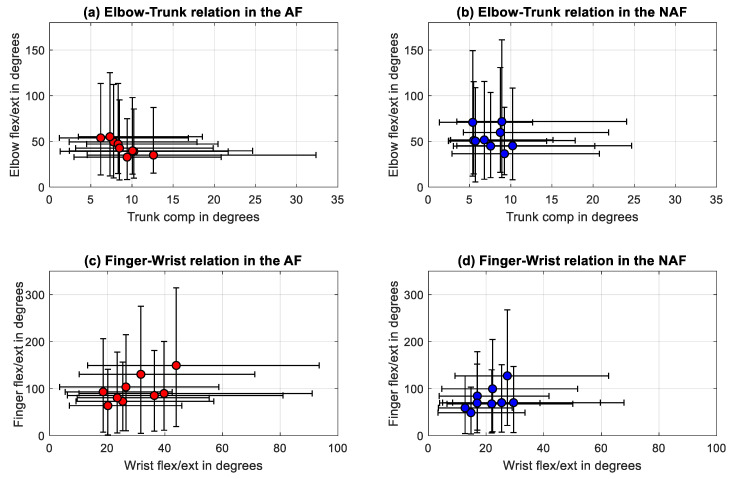
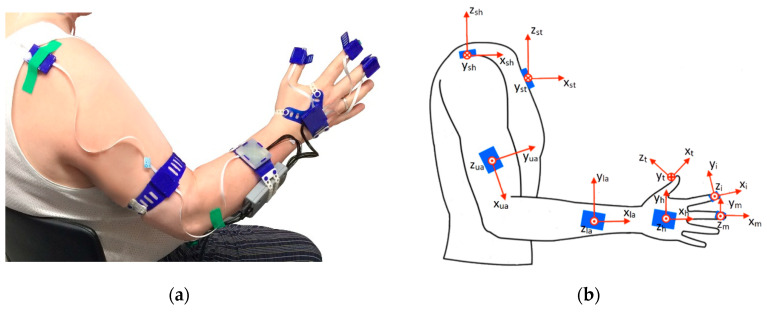
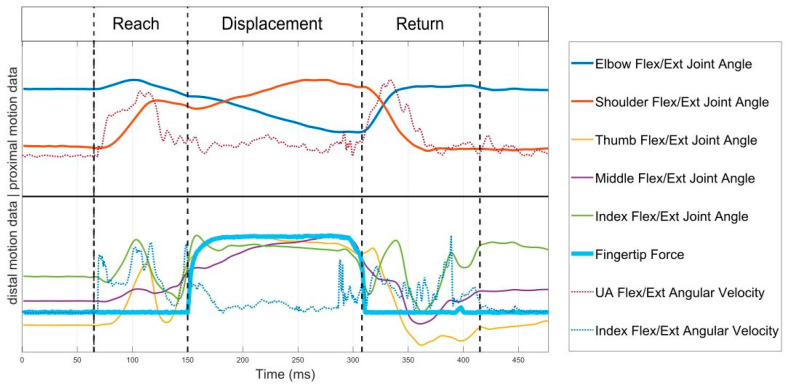
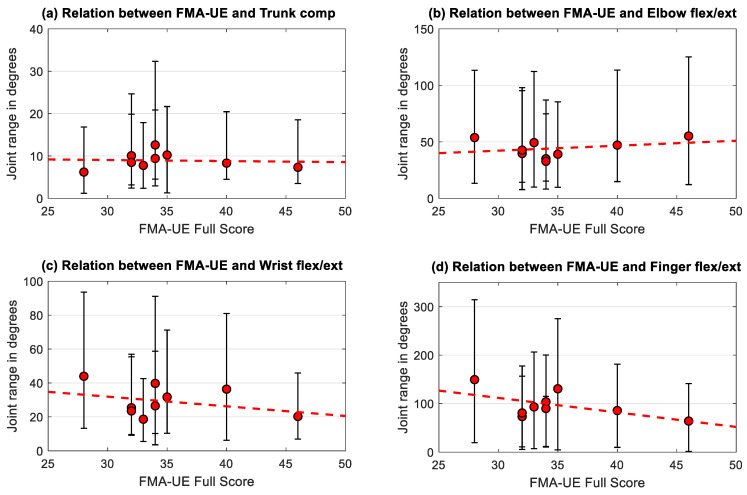
Precise and objective assessments of upper limb movement quality after strokes in functional task conditions are an important prerequisite to improve understanding of the pathophysiology of movement deficits and to prove the effectiveness of interventions. Herein, a wearable inertial sensing system was used to capture movements from the fingers to the trunk in 10 chronic stroke subjects when performing reach-to-grasp activities with the affected and non-affected upper limb. It was investigated whether the factors, tested arm, object weight, and target height, affect the expressions of range of motion in trunk compensation and flexion-extension of the elbow, wrist, and finger during object displacement. The relationship between these metrics and clinically measured impairment was explored. Nine subjects were included in the analysis, as one had to be excluded due to defective data. The tested arm and target height showed strong effects on all metrics, while an increased object weight showed effects on trunk compensation. High inter- and intrasubject variability was found in all metrics without clear relationships to clinical measures. Relating all metrics to each other resulted in significant negative correlations between trunk compensation and elbow flexion-extension in the affected arm. The findings support the clinical usability of sensor-based motion analysis.
在功能性任务条件下,对脑卒中后上肢运动质量进行精确和客观的评估,是提高对运动缺陷病理生理学理解和证明干预措施有效性的重要前提。本文使用可穿戴惯性传感系统,在 10 名慢性脑卒中患者进行患侧和非患侧上肢抓握活动时,从手指到躯干捕捉运动。研究了因素(测试臂、物体重量和目标高度)是否会影响躯干补偿和肘部、腕部和手指屈伸的运动范围在物体位移过程中的表达。还探讨了这些指标与临床测量损伤之间的关系。9 名受试者被纳入分析,1 名因数据缺陷而被排除。测试臂和目标高度对所有指标都有强烈影响,而物体重量增加对躯干补偿有影响。所有指标的个体内和个体间变异性都很高,且与临床测量值没有明确关系。将所有指标相互关联的结果表明,在患侧手臂中,躯干补偿与肘部屈伸之间存在显著的负相关。这些发现支持基于传感器的运动分析的临床可用性。