Pharmacology Teaching and Research Department, School of Basic Medicine, Guizhou University of Traditional Chinese Medicine, Dongqing Road, University Town, Huaxi District, Guiyang, People's Republic of China.
Heilongjiang Key Laboratory for Animal Disease Control and Pharmaceutical Development. Faculty of Basic Veterinary Science, College of Veterinary Medicine, Northeast Agricultural University, 600 Changjiang Road, Xiangfang District, Harbin, Heilongjiang, 150030, People's Republic of China.
BMC Vet Res. 2020 Aug 26;16(1):309. doi: 10.1186/s12917-020-02522-0.
Apramycin is used exclusively for the treatment of Escherichia coli (E.coli) infections in swine around the world since the early 1980s. Recently, many research papers have demonstrated that apramycin has significant in vitro activity against multidrug-resistant E.coli isolated in hospitals. Therefore, ensuring the proper use of apramycin in veterinary clinics is of great significance of public health. The objectives of this study were to develop a wild-type cutoff for apramycin against E.coli using a statistical method recommended by Clinical and Laboratory Standards Institute (CLSI) and to investigate the prevalence of resistance genes that confer resistance to apramycin in E. coli.
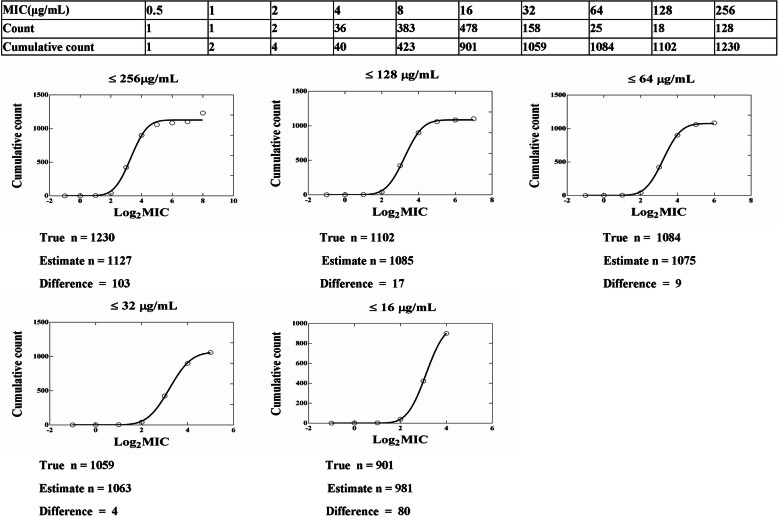
Apramycin susceptibility testing of 1230 E.coli clinical isolates from swine were determinded by broth microdilution testing according to the CLSI document M07-A9. A total number of 310 E.coli strains from different minimum inhibitory concentration (MIC) subsets (0.5-256 μg/mL) were selected for the detection of resistance genes (aac(3)-IV; npmA; apmA) in E. coli by PCR. The percentage of E. coli isolates at each MIC (0.5, 1, 2, 4, 8, 16, 32, 64, 128, and 256 μg/mL) was 0.08, 0.08, 0.16, 2.93, 31.14, 38.86, 12.85, 2.03, 1.46, and 10.41%. The MIC and MIC were 16 and 64 μg/mL. All the 310 E.coli isolates were negative for npmA and apmA gene, and only the aac(3)-IV gene was detected in this study.
The wild-type cutoff for apramycin against E.coli was defined as 32 μg/mL. The prevelance of aac(3)-IV gene mainly concentrated in these MIC subsets 'MIC ≥ 64 μg/ mL', which indicates that the wild-type cutoff established in our study is reliable. The wild-type cutoff offers interpretion criteria of apramycin susceptibility testing of E.coli.
自 20 世纪 80 年代初以来,大观霉素一直被全世界用于治疗猪大肠杆菌(E.coli)感染。最近,许多研究论文表明,大观霉素对医院分离的多药耐药大肠杆菌具有显著的体外活性。因此,确保兽医诊所合理使用大观霉素对公共卫生具有重要意义。本研究的目的是使用临床和实验室标准协会(CLSI)推荐的统计方法制定针对大肠杆菌的大观霉素野生型截断值,并研究导致大肠杆菌对大观霉素耐药的耐药基因的流行情况。
根据 CLSI 文件 M07-A9 进行肉汤微量稀释试验,对来自猪的 1230 株大肠杆菌临床分离株进行了大观霉素药敏试验。从不同最小抑菌浓度(MIC)亚组(0.5-256μg/mL)中选择了 310 株大肠杆菌菌株,通过 PCR 检测大肠杆菌中的耐药基因(aac(3)-IV;npmA;apmA)。在每个 MIC(0.5、1、2、4、8、16、32、64、128 和 256μg/mL)的大肠杆菌分离株的比例分别为 0.08、0.08、0.16、2.93、31.14、38.86、12.85、2.03、1.46 和 10.41%。MIC 和 MIC 分别为 16 和 64μg/mL。本研究中所有 310 株大肠杆菌分离株均为 npmA 和 apmA 基因阴性,仅检测到 aac(3)-IV 基因。
针对大肠杆菌的大观霉素野生型截断值定义为 32μg/mL。aac(3)-IV 基因的流行主要集中在这些 MIC 亚组(MIC≥64μg/mL)中,这表明本研究中建立的野生型截断值是可靠的。野生型截断值为大肠杆菌大观霉素药敏试验提供了解释标准。