De-Leon Hilla, Pederiva Francesco
Phys Fluids (1994). 2020 Aug 1;32(8):087113. doi: 10.1063/5.0020565.
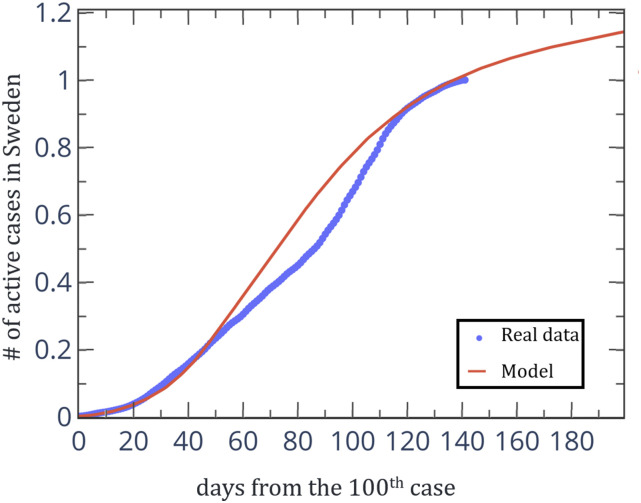
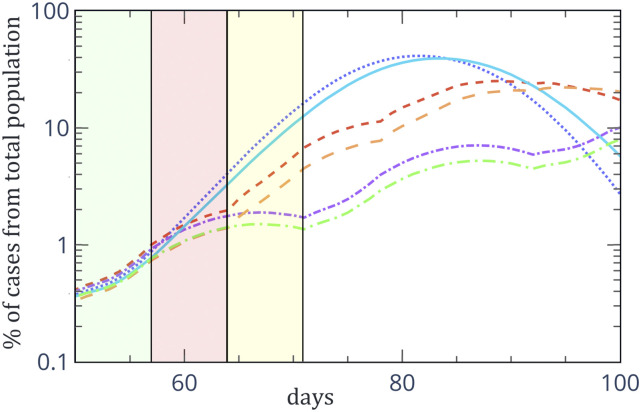
By the end of July 2020, the COVID-19 pandemic had infected more than 17 × 10 people and had spread to almost all countries worldwide. In response, many countries all over the world have used different methods to reduce the infection rate, such as case isolation, closure of schools and universities, banning public events, and forcing social distancing, including local and national lockdowns. In our work, we use a Monte Carlo based algorithm to predict the virus infection rate for different population densities using the most recent epidemic data. We test the spread of the coronavirus using three different lockdown models and eight various combinations of constraints, which allow us to examine the efficiency of each model and constraint. In this paper, we have tested three different time-cyclic patterns of no-restriction/lockdown patterns. This model's main prediction is that a cyclic schedule of no-restrictions/lockdowns that contains at least ten days of lockdown for each time cycle can help control the virus infection. In particular, this model reduces the infection rate when accompanied by social distancing and complete isolation of symptomatic patients.
到2020年7月底,新冠疫情已感染超过17×10人,并蔓延至全球几乎所有国家。作为应对措施,世界上许多国家采用了不同方法来降低感染率,如病例隔离、关闭中小学和大学、禁止公共活动以及强制保持社交距离,包括地方和国家层面的封锁。在我们的工作中,我们使用一种基于蒙特卡洛的算法,利用最新的疫情数据预测不同人口密度下的病毒感染率。我们使用三种不同的封锁模型和八种不同的约束组合来测试新冠病毒的传播情况,这使我们能够检验每个模型和约束的效率。在本文中,我们测试了三种不同的无限制/封锁模式的时间循环模式。该模型的主要预测是,每个时间周期包含至少十天封锁期的无限制/封锁循环时间表有助于控制病毒感染。特别是,当伴有社交距离和对有症状患者的完全隔离时,该模型可降低感染率。