Bittihn Philip, Hupe Lukas, Isensee Jonas, Golestanian Ramin
Max Planck Institute for Dynamics and Self-Organization, Göttingen, Germany.
Institute for the Dynamics of Complex Systems, Göttingen University, Göttingen, Germany.
EClinicalMedicine. 2021 Feb;32:100718. doi: 10.1016/j.eclinm.2020.100718. Epub 2021 Jan 7.
Many countries worldwide are faced with the choice between the (re)surgence of COVID-19 and endangering the economic and mental well-being of their citizens. While infection numbers are monitored and measures adjusted, a systematic strategy for balancing contact restrictions and socioeconomic life in the absence of a vaccine is currently lacking.
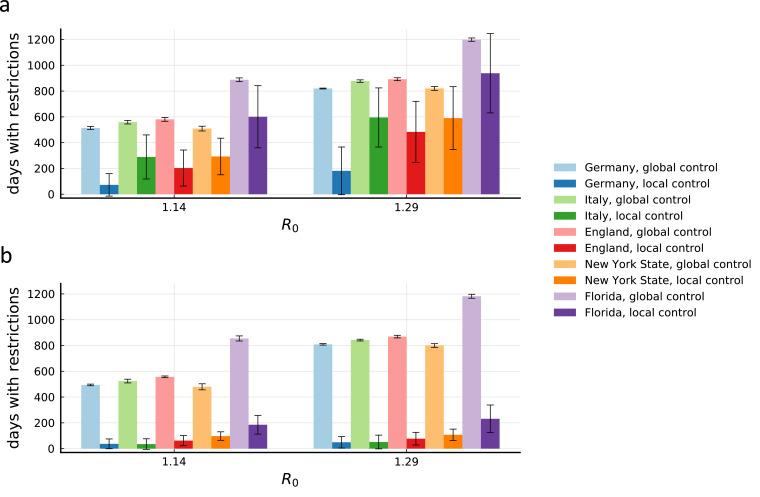
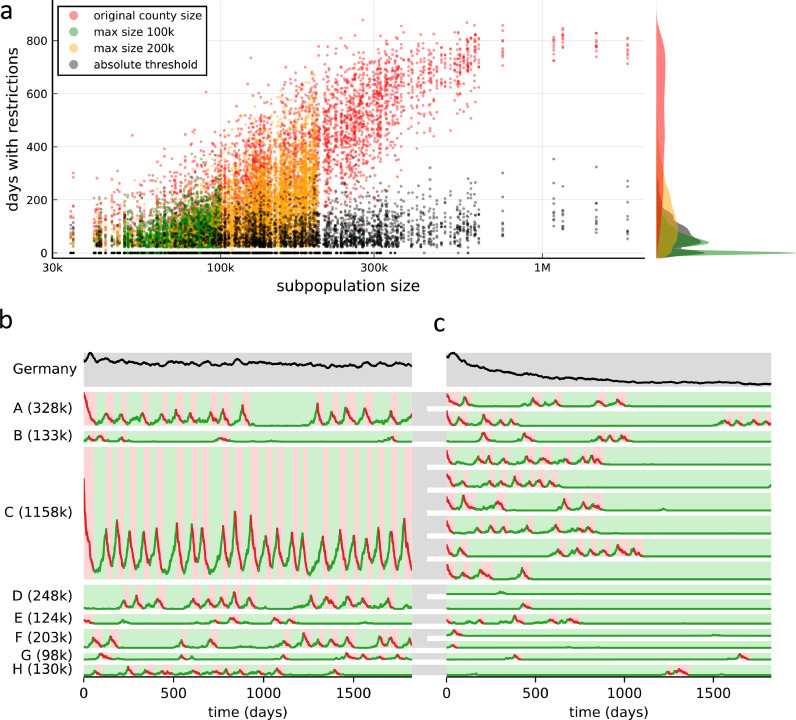
In a mathematical model, we determine the efficacy of regional containment strategies, where contact restrictions are triggered locally in individual regions upon crossing critical infection number thresholds. Our stochastic meta-population model distinguishes between contacts within a region and cross-regional contacts. We use current data on the spread of COVID-19 in Germany, Italy, England, New York State and Florida, including the effects of their individual national lockdowns, and county population sizes obtained from census data to define individual regions. As a performance measure, we determine the number of days citizens will experience contact restrictions over the next 5 years ('restriction time') and compare it to an equivalent national lockdown strategy. To extract crucial parameters, we vary the proportion of cross-regional contacts (between 0% and 100%), the thresholds for initiating local measures (between 5 and 20 active infections per 100,000 inhabitants) as well as their duration after infection numbers have returned below the threshold (between 7 and 28 days). We compare performance across the five different countries and test how further subdivision of large counties into independently controlled regions of up to 100,000 or 200,000 inhabitants affects the results.
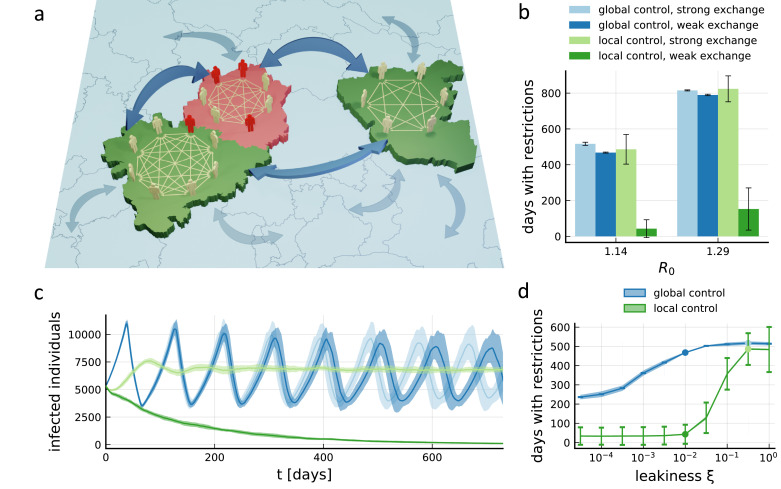
Our numerical simulations show a substantially reduced restriction time for regional containment, if the effective reproduction number of SARS-CoV-2 without restrictions, , is only slightly larger than 1 and the proportion of cross-regional contacts (the so-called ) is low. In Germany, specifically, for =1.14, a leakiness of 1% is sufficiently low to reduce the mean restriction time from 468 days (s.d. 3 days) for the national containment strategy to 43 days (s.d. 3 days across simulations) for the regional strategy, when local measures are initiated at 10 infections per 100,000 inhabitants in the past 7 days. For =1.28, the allowed leakiness for minimal restriction time reduces to approximately 0.3%. The dependence of the restriction time on the leakiness is threshold-like only for regional containment, due to cooperative effects. It rises to levels similar to the national containment strategy for a leakiness 10% (517 days national vs. 486 days regional for leakiness 32% and =1.14). We find a strong correlation between the population size of each region and the experienced restriction time. For countries with large counties, this can result in only a mild reduction in restriction time for regional containment, which can only be partly compensated by lower thresholds for initiating local measures and increasing their duration. In contrast, further subdividing large counties into smaller units can ensure a strong reduction of the restriction time for the regional strategy.
The leakiness, i.e. the proportion of cross-regional contacts, and the regional structure itself were crucial parameters for the performance of the regional strategy. Therefore, regional strategies could offer an adaptive way to contain the epidemic with fewer overall restrictions, if cross-regional infections can be kept below the critical level, which could be achieved without affecting local socioeconomic freedom. Maintaining general hygiene and contact tracing, testing should be intensified to ensure regional measures can be initiated at low infection thresholds, preventing the spread of the disease to other regions before local elimination. While such tight control could lead to more restrictions in the short run, restrictions necessary for long-term containment could be reduced by up to a factor of 10. Our open-source simulation code is freely available and can be readily adapted to other countries.
This work was supported by the Max Planck Society.
全球许多国家都面临着新冠疫情死灰复燃与危及本国公民经济和心理健康之间的抉择。虽然感染数据受到监测且防控措施不断调整,但目前仍缺乏在没有疫苗的情况下平衡接触限制与社会经济生活的系统性策略。
在一个数学模型中,我们确定了区域防控策略的效果,即当个别地区的感染数超过临界阈值时,在当地触发接触限制。我们的随机元种群模型区分了区域内接触和跨区域接触。我们使用德国、意大利、英国、纽约州和佛罗里达州当前新冠疫情传播的数据,包括各自国家封锁措施的影响,以及从人口普查数据中获取的县人口规模来定义各个区域。作为一项性能指标,我们确定公民在未来5年将经历接触限制的天数(“限制时间”),并将其与等效的全国封锁策略进行比较。为了提取关键参数,我们改变跨区域接触的比例(0%至100%)、启动当地措施的阈值(每10万居民中有5至20例活跃感染)以及感染数降至阈值以下后的持续时间(7至28天)。我们比较了五个不同国家的防控效果,并测试了将大县进一步细分为人口最多达10万或20万的独立控制区域如何影响结果。
我们的数值模拟表明,如果在没有限制措施的情况下,新冠病毒的有效繁殖数R0仅略大于1,且跨区域接触的比例(所谓的“泄漏率”)较低,那么区域防控策略的限制时间将大幅减少。具体而言,在德国,对于R0 = 1.14,1%的泄漏率足够低,可将全国防控策略的平均限制时间从468天(标准差3天)降至区域防控策略的43天(模拟中的标准差3天),前提是在过去7天内每10万居民中有10例感染时启动当地措施。对于R0 = 1.28,将限制时间降至最低所需的允许泄漏率降至约0.3%。由于协同效应,限制时间对泄漏率的依赖仅在区域防控中呈阈值状。当泄漏率超过10%时,限制时间升至与全国防控策略相似的水平(对于泄漏率32%和R0 = 1.14,全国为517天,区域为486天)。我们发现每个区域的人口规模与经历的限制时间之间存在很强的相关性。对于有大县的国家,这可能导致区域防控的限制时间仅略有减少,这只能通过降低启动当地措施的阈值并延长其持续时间来部分弥补。相比之下,将大县进一步细分为较小单位可确保区域防控策略的限制时间大幅减少。
泄漏率,即跨区域接触的比例,以及区域结构本身是区域防控策略效果的关键参数。因此,如果能将跨区域感染控制在临界水平以下,区域防控策略可以提供一种适应性的方式,以较少的总体限制来控制疫情,这可以在不影响当地社会经济自由的情况下实现。在保持一般卫生和接触者追踪的同时,应加强检测,以确保能在低感染阈值时启动区域防控措施,防止疾病在当地消除之前传播到其他区域。虽然这种严格控制在短期内可能导致更多限制,但长期防控所需的限制可减少多达十分之九。我们的开源模拟代码可免费获取,并可轻松适用于其他国家。
这项工作得到了马克斯·普朗克学会的支持。