Ji Min-Tao, Nie Jing, Nie Xue-Fei, Hu Wen-Tao, Pei Hai-Long, Wan Jian-Mei, Wang Ai-Qing, Zhou Guang-Ming, Zhang Zeng-Li, Chang Lei, Li Bing-Yan
Department of Nutrition and Food Hygiene, Soochow University of Public Health, Suzhou, China.
State Key Laboratory of Radiation Medicine and Protection, School of Radiation Medicine and Protection, Collaborative Innovation Centre of Radiological Medicine of Jiangsu Higher Education Institutions, Soochow University, Suzhou, China.
Front Pharmacol. 2020 Aug 7;11:945. doi: 10.3389/fphar.2020.00945. eCollection 2020.
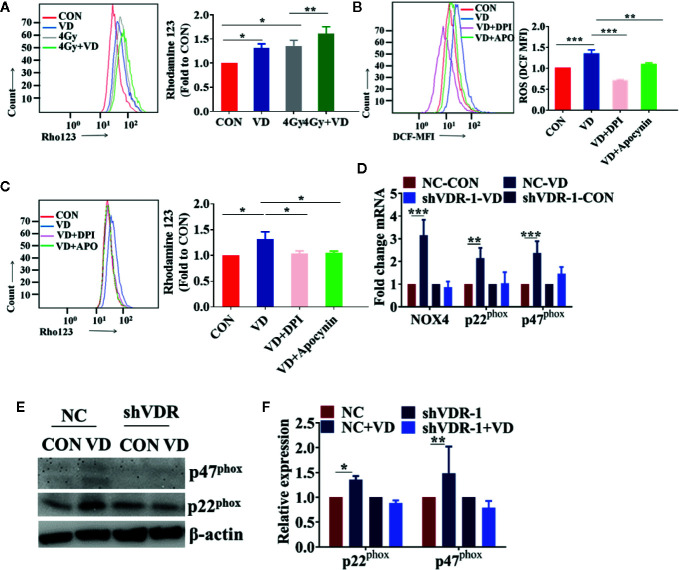
The radioresistance of tumors affect the outcome of radiotherapy. Accumulating data suggest that 1α,25(OH)D is a potential anti-oncogenic molecule in various cancers. In the present study, we investigated the radiosensitive effects and underlying mechanisms of 1α,25(OH)D and . We found that 1α,25(OH)D enhanced the radiosensitivity of lung cancer and ovarian cancer cells by promoting the NADPH oxidase-ROS-apoptosis axis. Compared to the group that only received radiation, the survival fraction and self-renewal capacity of cancer cells treated with a combination of 1α,25(OH)D and radiation were decreased. Both apoptosis and ROS were significantly increased in the combination group compared with the radiation only group. Moreover, N-acetyl-L-cysteine, a scavenger of intracellular ROS, reversed the apoptosis and ROS induced by 1α,25(OH)D, indicating that 1α,25(OH)D enhanced the radiosensitivity of cancer cells by promoting ROS-induced apoptosis. Moreover, our results demonstrated that 1α,25(OH)D promoted the ROS level activating NADPH oxidase complexes, NOX4, p22, and p47. In addition, knockdown of the vitamin D receptor (VDR) abolished the radiosensitization of 1α,25(OH)D, which confirmed that 1α,25(OH)D radiosensitized tumor cells that depend on VDR. Similarly, our study also evidenced that vitamin D enhanced the radiosensitivity of cancer cells and extended the overall survival of mice with tumors. In summary, these results demonstrate that 1α,25(OH)D enhances the radiosensitivity depending on VDR and activates the NADPH oxidase-ROS-apoptosis axis. Our findings suggest that 1α,25(OH)D in combination with radiation enhances lung and ovarian cell radiosensitivity, potentially providing a novel combination therapeutic strategy.
肿瘤的放射抗性会影响放射治疗的效果。越来越多的数据表明,1α,25(OH)D在多种癌症中是一种潜在的抗癌分子。在本研究中,我们调查了1α,25(OH)D的放射增敏作用及其潜在机制。我们发现,1α,25(OH)D通过促进NADPH氧化酶-ROS-凋亡轴增强肺癌和卵巢癌细胞的放射敏感性。与仅接受放疗的组相比,用1α,25(OH)D和放疗联合处理的癌细胞的存活分数和自我更新能力降低。与仅放疗组相比,联合组的细胞凋亡和ROS均显著增加。此外,细胞内ROS清除剂N-乙酰-L-半胱氨酸可逆转1α,25(OH)D诱导的细胞凋亡和ROS,这表明1α,25(OH)D通过促进ROS诱导的细胞凋亡增强癌细胞的放射敏感性。此外,我们的结果表明,1α,25(OH)D通过激活NADPH氧化酶复合物NOX4、p22和p47来提高ROS水平。此外,维生素D受体(VDR)的敲低消除了1α,25(OH)D的放射增敏作用,这证实了1α,25(OH)D使依赖VDR的肿瘤细胞对放疗敏感。同样,我们的研究还证明维生素D可增强癌细胞的放射敏感性并延长荷瘤小鼠的总生存期。总之,这些结果表明,1α,25(OH)D依赖VDR增强放射敏感性并激活NADPH氧化酶-ROS-凋亡轴。我们的研究结果表明,1α,25(OH)D与放疗联合可增强肺和卵巢细胞的放射敏感性,可能提供一种新的联合治疗策略。