• 文献检索
  • 文档翻译
  • 深度研究
  • 学术资讯
  • Suppr Zotero 插件Zotero 插件
  • 邀请有礼
  • 套餐&价格
  • 历史记录
应用&插件
Suppr Zotero 插件Zotero 插件浏览器插件Mac 客户端Windows 客户端微信小程序
定价
高级版会员购买积分包购买API积分包
服务
文献检索文档翻译深度研究API 文档MCP 服务
关于我们
关于 Suppr公司介绍联系我们用户协议隐私条款
关注我们

Suppr 超能文献

核心技术专利:CN118964589B侵权必究
粤ICP备2023148730 号-1Suppr @ 2026

文献检索

告别复杂PubMed语法,用中文像聊天一样搜索,搜遍4000万医学文献。AI智能推荐,让科研检索更轻松。

立即免费搜索

文件翻译

保留排版,准确专业,支持PDF/Word/PPT等文件格式,支持 12+语言互译。

免费翻译文档

深度研究

AI帮你快速写综述,25分钟生成高质量综述,智能提取关键信息,辅助科研写作。

立即免费体验

使用K-mer分析工作流程对基于下一代测序的临床微生物学检测进行分析性能验证

Analytical Performance Validation of Next-Generation Sequencing Based Clinical Microbiology Assays Using a K-mer Analysis Workflow.

作者信息

Lepuschitz Sarah, Weinmaier Thomas, Mrazek Katharina, Beisken Stephan, Weinberger Johannes, Posch Andreas E

机构信息

Ares Genetics GmbH, Vienna, Austria.

出版信息

Front Microbiol. 2020 Aug 5;11:1883. doi: 10.3389/fmicb.2020.01883. eCollection 2020.

DOI:10.3389/fmicb.2020.01883
PMID:32849463
原文链接:https://pmc.ncbi.nlm.nih.gov/articles/PMC7422695/
Abstract

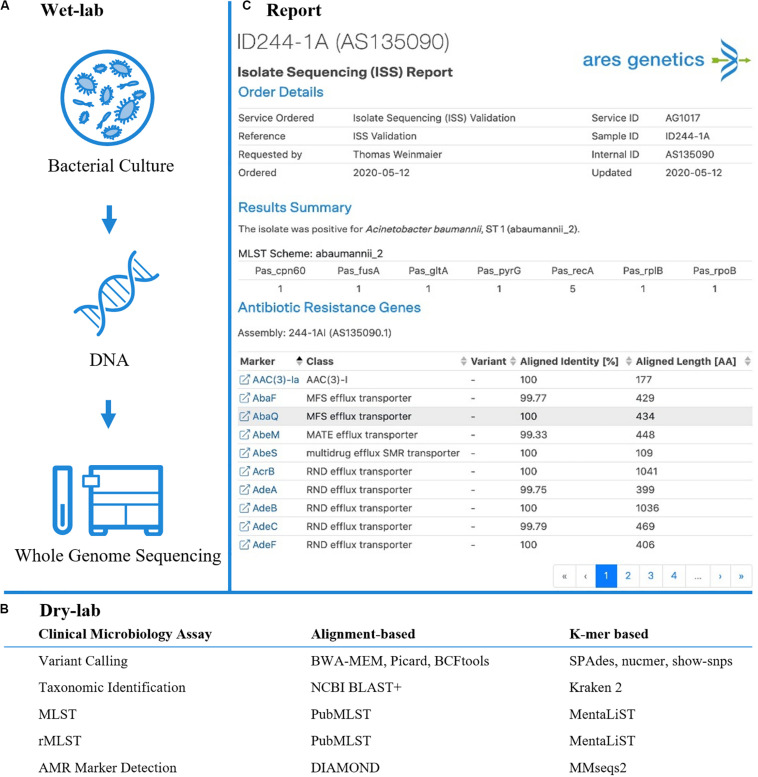
Next-generation sequencing (NGS) enables clinical microbiology assays such as molecular typing of bacterial isolates which is now routinely applied for infection control and epidemiology. Additionally, feasibility for NGS-based identification of antimicrobial resistance (AMR) markers as well as genetic prediction of antibiotic susceptibility testing results has been demonstrated. Various bioinformatics approaches enabling NGS-based clinical microbiology assays exist, but standardized, computationally efficient and scalable sample-to-results workflows including validated quality control parameters are still lacking. Bioinformatics analysis workflows based on k-mers have been shown to allow for fast and efficient analysis of large genomics data sets as obtained from microbial sequencing applications. We here demonstrate applicability of k-mer based clinical microbiology assays for whole-genome sequencing (WGS) including variant calling, taxonomic identification, bacterial typing as well as AMR marker detection. The wet-lab and dry-lab workflows were developed and validated in line with Clinical Laboratory Improvement Act (CLIA) guidelines for laboratory-developed tests (LDTs) on multi-drug resistant ESKAPE pathogens. The developed k-mer based workflow demonstrated ≥99.39% repeatability, ≥99.09% reproducibility and ≥99.76% accuracy for variant calling and applied assays as determined by intra-day and inter-day triplicate measurements. The limit of detection (LOD) across assays was found to be at 20× sequencing depth and 15× for AMR marker detection. Thorough benchmarking of the k-mer based workflow revealed analytical performance criteria are comparable to state-of-the-art alignment based workflows across clinical microbiology assays. Diagnostic sensitivity and specificity for multilocus sequence typing (MLST) and phylogenetic analysis were 100% for both approaches. For AMR marker detection, sensitivity and specificity were 95.29 and 99.78% for the k-mer based workflow as compared to 95.17 and 99.77% for the alignment-based approach. Summarizing, results illustrate that k-mer based analysis workflows enable a broad range of clinical microbiology assays, potentially not only for WGS-based typing and AMR gene detection but also genetic prediction of antibiotic susceptibility testing results.

摘要

下一代测序(NGS)推动了临床微生物学检测的发展,例如细菌分离株的分子分型,目前已常规应用于感染控制和流行病学研究。此外,基于NGS识别抗菌药物耐药性(AMR)标记以及对抗生素敏感性测试结果进行遗传预测的可行性也已得到证实。虽然存在多种支持基于NGS的临床微生物学检测的生物信息学方法,但仍缺乏标准化、计算高效且可扩展的从样本到结果的工作流程,包括经过验证的质量控制参数。基于k-mer的生物信息学分析工作流程已被证明能够快速有效地分析从微生物测序应用中获得的大型基因组数据集。我们在此展示了基于k-mer的临床微生物学检测在全基因组测序(WGS)中的适用性,包括变异检测、分类鉴定、细菌分型以及AMR标记检测。湿实验室和干实验室工作流程是根据临床实验室改进法案(CLIA)关于实验室开发检测(LDT)的指南,针对多重耐药的ESKAPE病原体开发并验证的。通过日内和日间一式三份测量确定,所开发的基于k-mer的工作流程在变异检测和应用检测方面表现出≥99.39%的重复性、≥99.09%的再现性和≥99.76%的准确性。发现各检测方法的检测限在20×测序深度,AMR标记检测的检测限为15×。对基于k-mer的工作流程进行的全面基准测试表明,其分析性能标准与临床微生物学检测中基于比对的先进工作流程相当。两种方法对多位点序列分型(MLST)和系统发育分析的诊断敏感性和特异性均为100%。对于AMR标记检测,基于k-mer的工作流程的敏感性和特异性分别为95.29%和99.78%,而基于比对的方法的敏感性和特异性分别为95.17%和99.77%。综上所述,结果表明基于k-mer的分析工作流程能够实现广泛的临床微生物学检测,不仅可能用于基于WGS的分型和AMR基因检测,还能用于抗生素敏感性测试结果的遗传预测。
https://cdn.ncbi.nlm.nih.gov/pmc/blobs/53fc/7422695/954d77a2639a/fmicb-11-01883-g001.jpg

相似文献

1
Analytical Performance Validation of Next-Generation Sequencing Based Clinical Microbiology Assays Using a K-mer Analysis Workflow.使用K-mer分析工作流程对基于下一代测序的临床微生物学检测进行分析性能验证
Front Microbiol. 2020 Aug 5;11:1883. doi: 10.3389/fmicb.2020.01883. eCollection 2020.
2
Validation and Implementation of Clinical Laboratory Improvements Act-Compliant Whole-Genome Sequencing in the Public Health Microbiology Laboratory.公共卫生微生物实验室中符合《临床实验室改进法案》的全基因组测序的验证与实施
J Clin Microbiol. 2017 Aug;55(8):2502-2520. doi: 10.1128/JCM.00361-17. Epub 2017 Jun 7.
3
Validation of a Bioinformatics Workflow for Routine Analysis of Whole-Genome Sequencing Data and Related Challenges for Pathogen Typing in a European National Reference Center: as a Proof-of-Concept.用于全基因组测序数据常规分析的生物信息学工作流程的验证以及欧洲国家参考中心病原体分型的相关挑战:作为概念验证
Front Microbiol. 2019 Mar 6;10:362. doi: 10.3389/fmicb.2019.00362. eCollection 2019.
4
Practical issues in implementing whole-genome-sequencing in routine diagnostic microbiology.在常规诊断微生物学中实施全基因组测序的实际问题。
Clin Microbiol Infect. 2018 Apr;24(4):355-360. doi: 10.1016/j.cmi.2017.11.001. Epub 2017 Nov 5.
5
A Bioinformatics Whole-Genome Sequencing Workflow for Clinical Mycobacterium tuberculosis Complex Isolate Analysis, Validated Using a Reference Collection Extensively Characterized with Conventional Methods and Approaches.一种临床结核分枝杆菌复合群分离物分析的生物信息学全基因组测序工作流程,使用经过广泛传统方法和方法表征的参考集进行了验证。
J Clin Microbiol. 2021 May 19;59(6). doi: 10.1128/JCM.00202-21.
6
Benchmarking workflows to assess performance and suitability of germline variant calling pipelines in clinical diagnostic assays.评估用于临床诊断检测的种系变异calling 管道性能和适用性的基准测试工作流程。
BMC Bioinformatics. 2021 Feb 24;22(1):85. doi: 10.1186/s12859-020-03934-3.
7
Comparative Analysis of Short- and Long-Read Sequencing of Vancomycin-Resistant Enterococci for Application to Molecular Epidemiology.万古霉素耐药肠球菌的短读长测序和长读长测序的比较分析及其在分子流行病学中的应用。
Front Cell Infect Microbiol. 2022 Apr 6;12:857801. doi: 10.3389/fcimb.2022.857801. eCollection 2022.
8
Evaluation of Metagenomic and Targeted Next-Generation Sequencing Workflows for Detection of Respiratory Pathogens from Bronchoalveolar Lavage Fluid Specimens.宏基因组和靶向下一代测序工作流程评估用于检测支气管肺泡灌洗液标本中的呼吸道病原体。
J Clin Microbiol. 2022 Jul 20;60(7):e0052622. doi: 10.1128/jcm.00526-22. Epub 2022 Jun 13.
9
Systematic Evaluation of Whole Genome Sequence-Based Predictions of Serotype and Antimicrobial Resistance.基于全基因组序列的血清型和抗菌药物耐药性预测的系统评价
Front Microbiol. 2020 Apr 3;11:549. doi: 10.3389/fmicb.2020.00549. eCollection 2020.
10
Culture-Free Detection of Antibiotic Resistance Markers from Native Patient Samples by Hybridization Capture Sequencing.通过杂交捕获测序从患者原始样本中进行无培养的抗生素耐药性标志物检测。
Microorganisms. 2021 Aug 5;9(8):1672. doi: 10.3390/microorganisms9081672.

引用本文的文献

1
Genomics for antimicrobial resistance-progress and future directions.抗微生物药物耐药性的基因组学——进展与未来方向
Antimicrob Agents Chemother. 2025 May 7;69(5):e0108224. doi: 10.1128/aac.01082-24. Epub 2025 Apr 14.
2
PanKA: Leveraging population pangenome to predict antibiotic resistance.PanKA:利用群体泛基因组预测抗生素耐药性。
iScience. 2024 Aug 2;27(9):110623. doi: 10.1016/j.isci.2024.110623. eCollection 2024 Sep 20.
3
Implementing laboratory automation for next-generation sequencing: benefits and challenges for library preparation.

本文引用的文献

1
Species Identification and Antibiotic Resistance Prediction by Analysis of Whole-Genome Sequence Data by Use of ARESdb: an Analysis of Isolates from the Unyvero Lower Respiratory Tract Infection Trial.利用 ARESdb 通过全基因组序列数据分析进行物种鉴定和抗生素耐药性预测:来自 Unyvero 下呼吸道感染试验的分离株分析。
J Clin Microbiol. 2020 Jun 24;58(7). doi: 10.1128/JCM.00273-20.
2
Improved metagenomic analysis with Kraken 2.Kraken 2 提升宏基因组分析。
Genome Biol. 2019 Nov 28;20(1):257. doi: 10.1186/s13059-019-1891-0.
3
Large-scale sequence comparisons with .
实现下一代测序的实验室自动化:文库制备的优势和挑战。
Front Public Health. 2023 Jul 13;11:1195581. doi: 10.3389/fpubh.2023.1195581. eCollection 2023.
4
Fast and Accurate Identification of by High Resolution Mass Spectrometry.通过高分辨率质谱法快速准确鉴定……(原文by后内容缺失)
J Fungi (Basel). 2023 Feb 16;9(2):267. doi: 10.3390/jof9020267.
5
Metagenomic Antimicrobial Susceptibility Testing from Simulated Native Patient Samples.来自模拟天然患者样本的宏基因组抗菌药敏试验。
Antibiotics (Basel). 2023 Feb 9;12(2):366. doi: 10.3390/antibiotics12020366.
6
Validation and Application of Long-Read Whole-Genome Sequencing for Antimicrobial Resistance Gene Detection and Antimicrobial Susceptibility Testing.长读全基因组测序在耐药基因检测和药敏试验中的验证和应用。
Antimicrob Agents Chemother. 2023 Jan 24;67(1):e0107222. doi: 10.1128/aac.01072-22. Epub 2022 Dec 19.
7
Next-Generation Sequencing Applications for the Study of Fungal Pathogens.用于真菌病原体研究的下一代测序应用
Microorganisms. 2022 Sep 21;10(10):1882. doi: 10.3390/microorganisms10101882.
8
Assessing putative bias in prediction of anti-microbial resistance from real-world genotyping data under explicit causal assumptions.在明确的因果假设下,评估从真实世界的基因分型数据中预测抗微生物耐药性的潜在偏差。
Artif Intell Med. 2022 Aug;130:102326. doi: 10.1016/j.artmed.2022.102326. Epub 2022 Jun 3.
9
Genomic Characterization of spp. and spp. Strains Isolated From Powdered Infant Formula in Chile.从智利婴儿配方奶粉中分离出的[具体菌种1]和[具体菌种2]菌株的基因组特征分析
Front Microbiol. 2022 Jun 2;13:884721. doi: 10.3389/fmicb.2022.884721. eCollection 2022.
10
Proceedings of the Clinical Microbiology Open 2018 and 2019 - a Discussion about Emerging Trends, Challenges, and the Future of Clinical Microbiology.2018 年和 2019 年临床微生物学开放论坛会议记录——关于临床微生物学新兴趋势、挑战和未来的讨论。
J Clin Microbiol. 2022 Jul 20;60(7):e0009222. doi: 10.1128/jcm.00092-22. Epub 2022 May 31.
与……进行大规模序列比较
F1000Res. 2019 Jul 4;8:1006. doi: 10.12688/f1000research.19675.1. eCollection 2019.
4
Clinical Resistome Screening of 1,110 Isolates Efficiently Recovers Diagnostically Relevant Antibiotic Resistance Biomarkers and Potential Novel Resistance Mechanisms.对1110株分离株进行临床耐药基因组筛选可有效发现具有诊断意义的抗生素耐药生物标志物和潜在的新型耐药机制。
Front Microbiol. 2019 Aug 13;10:1671. doi: 10.3389/fmicb.2019.01671. eCollection 2019.
5
Validating the AMRFinder Tool and Resistance Gene Database by Using Antimicrobial Resistance Genotype-Phenotype Correlations in a Collection of Isolates.通过在分离株集合中使用抗生素耐药基因型-表型相关性来验证 AMRFinder 工具和耐药基因数据库。
Antimicrob Agents Chemother. 2019 Oct 22;63(11). doi: 10.1128/AAC.00483-19. Print 2019 Nov.
6
Whole-Genome Sequencing of Chlamydia trachomatis Directly from Human Samples.直接从人类样本中进行沙眼衣原体的全基因组测序。
Methods Mol Biol. 2019;2042:45-67. doi: 10.1007/978-1-4939-9694-0_6.
7
Validation of a Bioinformatics Workflow for Routine Analysis of Whole-Genome Sequencing Data and Related Challenges for Pathogen Typing in a European National Reference Center: as a Proof-of-Concept.用于全基因组测序数据常规分析的生物信息学工作流程的验证以及欧洲国家参考中心病原体分型的相关挑战:作为概念验证
Front Microbiol. 2019 Mar 6;10:362. doi: 10.3389/fmicb.2019.00362. eCollection 2019.
8
KrakenUniq: confident and fast metagenomics classification using unique k-mer counts.KrakenUniq:基于独特的 k-mer 计数实现自信且快速的宏基因组分类。
Genome Biol. 2018 Nov 16;19(1):198. doi: 10.1186/s13059-018-1568-0.
9
Genome-Based Prediction of Bacterial Antibiotic Resistance.基于基因组的细菌抗生素耐药性预测。
J Clin Microbiol. 2019 Feb 27;57(3). doi: 10.1128/JCM.01405-18. Print 2019 Mar.
10
Applying Rapid Whole-Genome Sequencing To Predict Phenotypic Antimicrobial Susceptibility Testing Results among Carbapenem-Resistant Klebsiella pneumoniae Clinical Isolates.应用快速全基因组测序预测碳青霉烯类耐药肺炎克雷伯菌临床分离株的表型抗菌药物敏感性试验结果。
Antimicrob Agents Chemother. 2018 Dec 21;63(1). doi: 10.1128/AAC.01923-18. Print 2019 Jan.