Premi Sanjay
Department of Tumor Biology, Moffitt Cancer Center & Research Institute, Tampa, FL, United States.
Front Oncol. 2020 Aug 6;10:1305. doi: 10.3389/fonc.2020.01305. eCollection 2020.
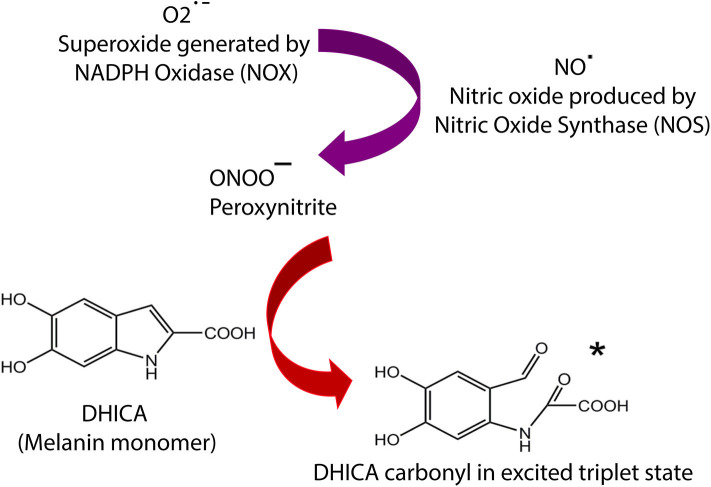
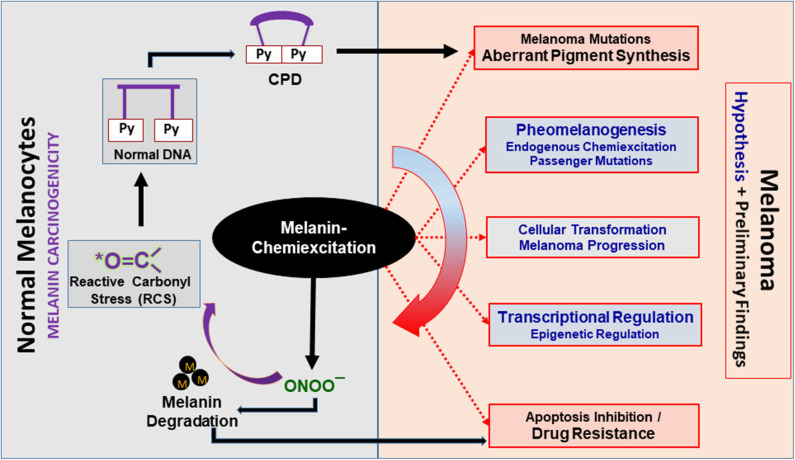
Melanoma is the deadliest type of skin cancer. Human melanomas often show hyperactivity of nitric oxide synthase (NOS) and NADPH oxidase (NOX), which, respectively, generate nitric oxide (NO ) and superoxide (O ). The NO and O react instantly with each other to generate peroxynitrite (ONOO) which is the driver of melanin chemiexcitation. Melanoma precursors, the melanocytes, are specialized skin cells that synthesize melanin, a potent shield against sunlight's ultraviolet (UV) radiation. However, melanin chemiexcitation paradoxically demonstrates the melanomagenic properties of melanin. In a loop, the NOS activity regulates melanin synthesis, and melanin is utilized by the chemiexcitation pathway to generate carcinogenic melanin-carbonyls in an excited triplet state. These carbonyl compounds induce UV-specific DNA damage without UV. Additionally, the carbonyl compounds are highly reactive and can make melanomagenic adducts with proteins, DNA and other biomolecules. Here we review the role of the melanin chemiexcitation pathway in melanoma initiation, progression, and drug resistance. We conclude by hypothesizing a non-classical, positive loop in melanoma where melanin chemiexcitation generates carcinogenic reactive carbonyl species (RCS) and DNA damage in normal melanocytes. In parallel, NOS and NOX regulate melanin synthesis generating raw material for chemiexcitation, and the resulting RCS and reactive nitrogen species (RNS) regulate cellular proteome and transcriptome in favor of melanoma progression, metastasis, and resistance against targeted therapies.
黑色素瘤是最致命的皮肤癌类型。人类黑色素瘤通常表现出一氧化氮合酶(NOS)和烟酰胺腺嘌呤二核苷酸磷酸氧化酶(NOX)的活性过高,它们分别产生一氧化氮(NO )和超氧化物(O )。NO 和O 会立即相互反应生成过氧亚硝酸盐(ONOO),而过氧亚硝酸盐是黑色素化学激发的驱动因素。黑色素瘤的前体细胞,即黑素细胞,是专门合成黑色素的皮肤细胞,黑色素是抵御阳光紫外线辐射的有效屏障。然而,黑色素化学激发却反常地显示出黑色素的致黑色素瘤特性。在一个循环中,NOS活性调节黑色素的合成,而黑色素则被化学激发途径利用,以产生处于激发三重态的致癌性黑色素羰基化合物。这些羰基化合物在没有紫外线的情况下会导致特定于紫外线的DNA损伤。此外,羰基化合物具有高反应性,可与蛋白质、DNA和其他生物分子形成致黑色素瘤加合物。在这里,我们综述了黑色素化学激发途径在黑色素瘤起始、进展和耐药性中的作用。我们通过假设黑色素瘤中存在一个非经典的正反馈环来得出结论,在这个环中,黑色素化学激发在正常黑素细胞中产生致癌性反应性羰基物种(RCS)和DNA损伤。同时,NOS和NOX调节黑色素的合成,为化学激发生成原料,而产生的RCS和反应性氮物种(RNS)调节细胞蛋白质组和转录组,有利于黑色素瘤的进展、转移和对靶向治疗的耐药性。