Health Economics and Epidemiology Research Office, Department of Internal Medicine, School of Clinical Medicine, Faculty of Health Sciences, University of the Witwatersrand, Johannesburg, South Africa.
Department of Global Health, Boston University School of Public Health, Boston, Massachusetts, United States of America.
PLoS Med. 2020 Aug 27;17(8):e1003226. doi: 10.1371/journal.pmed.1003226. eCollection 2020 Aug.
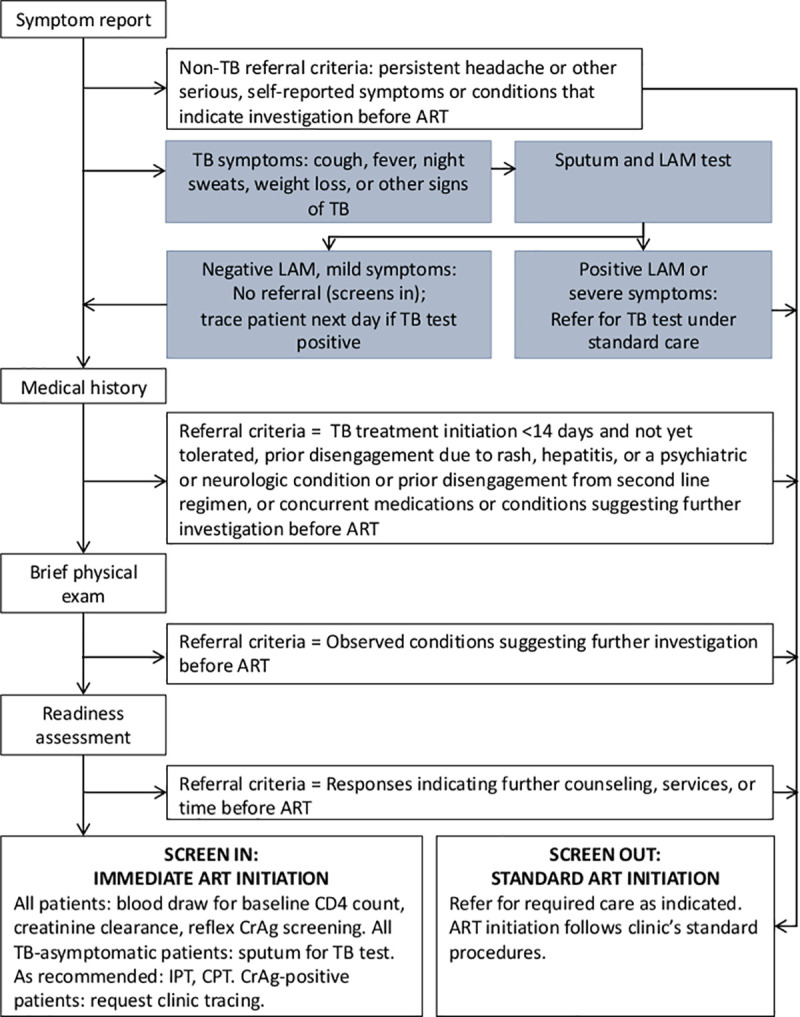
Many countries encourage same-day initiation of antiretroviral therapy (ART), but evidence on eligibility for same-day initiation, how best to implement it, and its impact on outcomes remains scarce. Building on the Simplified Algorithm for Treatment Eligibility (SLATE) I trial, in which nearly half of participants were ineligible for same-day initiation mainly because of TB symptoms, the study evaluated the revised SLATE II algorithm, which allowed same-day initiation for patients with mild TB symptoms and other less serious reasons for delay.
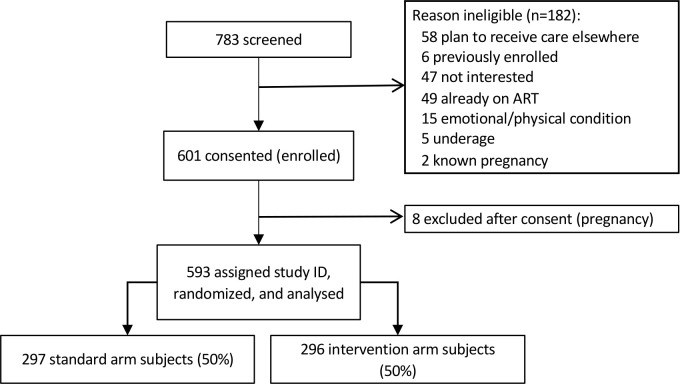
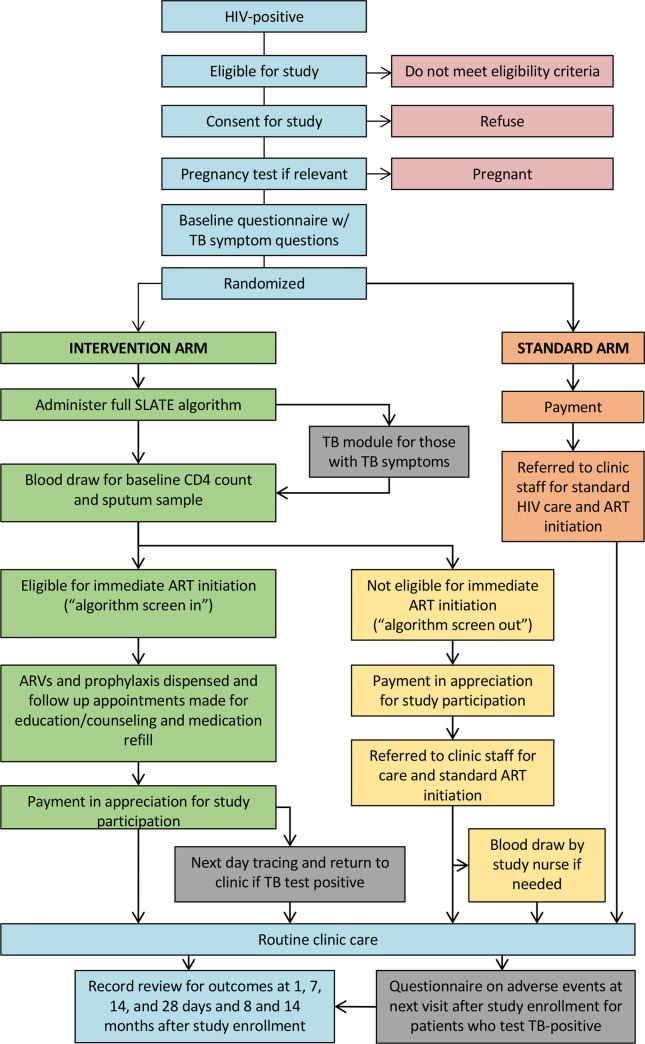
SLATE II was a nonblinded, 1:1 individually randomized pragmatic trial at three primary healthcare clinics in Johannesburg, South Africa. It randomized adult patients presenting for an HIV test or any HIV care but not yet on ART. Intervention arm patients were assessed with a symptom screen, medical history, brief physical examination, and readiness questionnaire to distinguish between patients eligible for immediate ART dispensing and those requiring further care before initiation. Standard arm patients received usual care. Follow-up was by review of routine clinic records. Primary outcomes were (1) ART initiation in ≤7 days and (2) ART initiation in ≤28 days and retention in care at 8 months (composite outcome). From 14 March to 18 September 2018, 593 adult HIV+, nonpregnant patients were enrolled (median interquartile range [IQR] age 35 [29-43]; 63% (n = 373) female; median CD4 count 293 [133-487]). Half of study patients (n = 295) presented with TB symptoms, whereas only 13 (4%) standard arm and 7 (2%) intervention arm patients tested positive for TB disease. Among 140 intervention arm patients with TB symptoms, 72% were eligible for same-day initiation. Initiation was higher in the intervention (n = 296) versus standard arm (n = 297) by 7 days (91% versus 68%; risk difference [RD] 23% [95% confidence interval (CI) 17%-29%]) and 28 days (94% versus 82%; RD 12% [7%-17%]) after enrollment. In total, 87% of intervention and 38% of standard arm patients initiated on the same day. By 8 months after study enrollment, 74% (220/296) of intervention and 59% (175/297) of standard arm patients had both initiated ART in ≤28 days and been retained in care (RD 15% [7%-23%]). Among the 41% of participants with viral load results available, suppression was 90% in the standard arm and 92% in the intervention arm among patients initiated in ≤28 days. No ART-associated adverse events were reported after initiation; two intervention and four standard arm patients were reported to have died during passive follow-up. Limitations of the study included limited geographic generalizability, exclusion of patients too sick to consent, fluctuations in procedures in the standard arm over the course of the study, high fidelity to the trial protocol by study staff, and the possibility of overestimating loss to follow-up due to data constraints.
More than 85% of patients presenting for HIV testing or care, including those newly diagnosed, were eligible and ready for same-day initiation under the SLATE II algorithm. The algorithm increased initiation within 7 days without appearing to compromise retention and viral suppression at 8 months, offering a practical and acceptable approach that can be widely and immediately utilized by existing providers.
Clinicaltrials.gov NCT03315013, registered 19 October 2017. First participant enrolled 14 March 2018.
许多国家鼓励在同一天启动抗逆转录病毒疗法(ART),但关于符合条件的人当天即可启动治疗、如何最好地实施以及对结果的影响等方面的证据仍然很少。在简化治疗资格算法(SLATE)试验的基础上,该试验中近一半的参与者因结核病症状而不符合当天启动治疗的条件,本研究评估了经过修订的 SLATE II 算法,该算法允许对有轻微结核病症状和其他较不严重的延迟原因的患者当天启动治疗。
SLATE II 是一项在南非约翰内斯堡的三家初级保健诊所进行的非盲、1:1 个体随机实用试验。它对前来进行 HIV 检测或任何 HIV 护理但尚未接受 ART 的成年患者进行随机分组。干预组的患者接受症状筛查、病史、简短的身体检查和准备情况问卷,以区分有条件立即开始 ART 配药的患者和需要进一步护理才能开始治疗的患者。标准组的患者接受常规护理。通过查看常规诊所记录进行随访。主要结局是(1)≤7 天内开始 ART 和(2)≤28 天内开始 ART 并在 8 个月时保持在护理中(复合结局)。从 2018 年 3 月 14 日至 9 月 18 日,共有 593 名成年 HIV+、非孕妇患者入组(中位数年龄为 35 [29-43]岁;63%[n=373]为女性;中位数 CD4 计数为 293 [133-487]个细胞/μL)。一半的研究患者(n=295)出现结核病症状,而只有 13 名(4%)标准组和 7 名(2%)干预组患者的结核病检测呈阳性。在 140 名有结核病症状的干预组患者中,有 72%符合当天启动治疗的条件。干预组(n=296)比标准组(n=297)在第 7 天(91%比 68%;风险差异[RD]23%[95%置信区间[CI]17%-29%])和第 28 天(94%比 82%;RD 12%[7%-17%])启动治疗的比例更高。总的来说,87%的干预组和 38%的标准组患者在同一天开始治疗。在研究入组后 8 个月时,干预组有 74%(220/296)和标准组有 59%(175/297)的患者在≤28 天内开始 ART 并保持在护理中(RD 15%[7%-23%])。在可获得病毒载量结果的 41%的参与者中,标准组和干预组在≤28 天内开始治疗的患者中,病毒抑制率分别为 90%和 92%。在开始治疗后没有报告任何与 ART 相关的不良事件;两名干预组和四名标准组患者在被动随访期间报告死亡。研究的局限性包括地理范围的推广性有限、排除了无法同意的病重患者、标准组在研究过程中的程序波动、研究人员对试验方案的高度遵守以及由于数据限制而高估失访的可能性。
在 SLATE II 算法下,包括新诊断患者在内的接受 HIV 检测或护理的患者中,超过 85%的患者有条件并准备好当天启动治疗。该算法提高了 7 天内开始治疗的比例,同时在 8 个月时保持了保留和病毒抑制,提供了一种实用且可接受的方法,现有的提供者可以广泛和立即采用。
Clinicaltrials.gov NCT03315013,2017 年 10 月 19 日注册。第一名参与者于 2018 年 3 月 14 日入组。