Department of Cardiac and Vascular Diseases, Jagiellonian University Collegium Medicum, John Paul II Hospital, Prądnicka Street 80, Kraków, 31-202, Poland.
Jagiellonian University Collegium Medicum, Students' Scientific Group at the Department of Cardiac and Vascular Diseases, John Paul II Hospital, Krakow, Poland.
ESC Heart Fail. 2020 Oct;7(5):2455-2467. doi: 10.1002/ehf2.12809. Epub 2020 Aug 27.
The aims of this paper were to investigate the analytical performance of the nine prognostic scales commonly used in heart failure (HF), in patients with dilated cardiomyopathy (DCM), and to develop a unique prognostic model tailored to DCM patients.
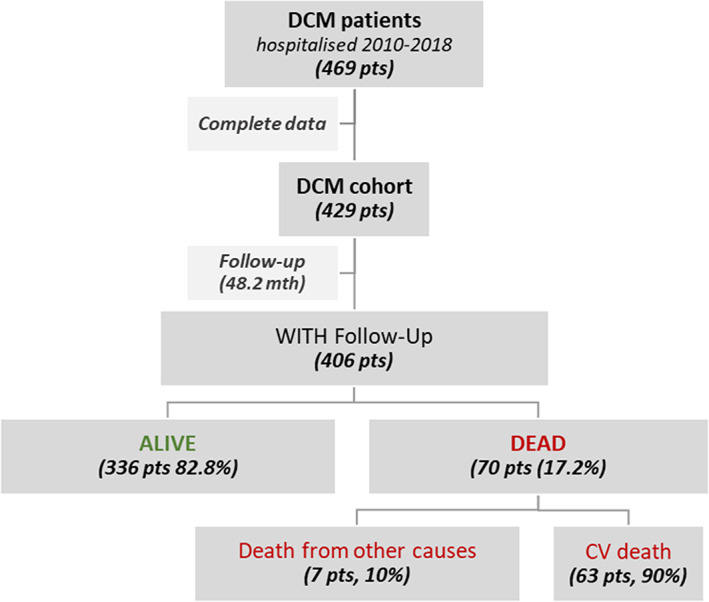
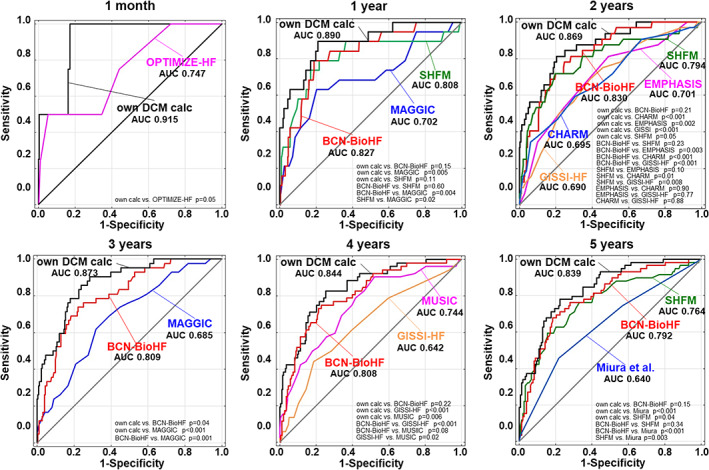
The hospital and outpatient records of 406 DCM patients were retrospectively analysed. The information on patient status was gathered after 48.2 ± 32.0 months. Tests were carried out to ascertain the prognostic accuracy in DCM using some of the most frequently applied HF prognostic scales (Barcelona Bio-Heart Failure, Candesartan in Heart Failure-Assessment of Reduction in Mortality and Morbidity, Studio della Streptochinasi nell'Infarto Miocardico-Heart Failure, Eplerenone in Mild Patients Hospitalization and Survival Study in Heart Failure, Meta-Analysis Global Group in Chronic Heart Failure, MUerte Subita en Insuficiencia Cardiaca, Organized Program to Initiate Lifesaving Treatment in Hospitalized Patients With Heart Failure, Seattle Heart Failure Model) and one dedicated to DCM, that of Miura et al. At follow-up, 70 DCM patients (17.2%) died. Most analysed scores substantially overestimated the mortality risk, especially in survivors. The prognostic accuracy of the scales were suboptimal, varying between 60% and 80%, with the best performance from Barcelona Bio-Heart Failure and Seattle Heart Failure Model for 1-5 year mortality [areas under the receiver operating curve 0.792-0.890 (95% confidence interval 0.725-0.918) and 0.764-0.808 (95% confidence interval 0.682-0.934), respectively].Based on our accumulated data, a self-developed DCM prognostic model was constructed. The model consists of age, gender, body mass index, symptoms duration, New York Heart Association class, diabetes mellitus, prior stroke, abnormal liver function, dyslipidaemia, left bundle branch block, left ventricle end-diastolic diameter, ejection fraction, N terminal pro brain natriuretic peptide, haemoglobin, estimated glomerular filtration rate, and pharmacological and resynchronisation therapy. This newly created prognostic model outperformed the analysed HF scales.
An analysis of various HF prognostic models found them to be suboptimal for DCM patients. A self-developed DCM prognostic model showed improved performance over the nine other models studied. However, further validation of the prognostic model in different DCM populations is required.
本文旨在探讨常用于心力衰竭(HF)的 9 种预后评分在扩张型心肌病(DCM)患者中的分析性能,并为 DCM 患者开发一种独特的预后模型。
回顾性分析了 406 例 DCM 患者的住院和门诊记录。在 48.2±32.0 个月后收集患者状态信息。使用一些最常用于 HF 预后评分的测试(巴塞罗那生物心力衰竭、坎地沙坦心力衰竭评估降低死亡率和发病率、心肌梗死后链激酶研究-心力衰竭、依普利酮在轻度心力衰竭住院患者中的住院和生存研究、Meta-Analysis Global Group in Chronic Heart Failure、突发心力衰竭死亡、有组织的计划开始对住院心力衰竭患者进行救生治疗、西雅图心力衰竭模型)和一个专门针对 DCM 的评分(Miura 等人)来评估 DCM 的预后准确性。随访期间,70 例 DCM 患者(17.2%)死亡。大多数分析的评分大大高估了死亡率风险,尤其是在幸存者中。这些评分的预后准确性不理想,在 60%到 80%之间,巴塞罗那生物心力衰竭和西雅图心力衰竭模型对 1-5 年死亡率的预测效果最好[受试者工作特征曲线下面积分别为 0.792-0.890(95%置信区间 0.725-0.918)和 0.764-0.808(95%置信区间 0.682-0.934)]。基于我们积累的数据,构建了一个自我开发的 DCM 预后模型。该模型由年龄、性别、体重指数、症状持续时间、纽约心脏协会(NYHA)分级、糖尿病、既往中风、肝功能异常、血脂异常、左束支传导阻滞、左心室舒张末期直径、射血分数、N 末端脑钠肽前体、血红蛋白、估计肾小球滤过率、药物治疗和心脏再同步化治疗组成。这个新创建的预后模型比分析的 HF 评分表现更好。
对各种 HF 预后模型的分析发现,它们对 DCM 患者的预后评估效果不佳。自我开发的 DCM 预后模型的表现优于研究的其他 9 种模型。然而,需要在不同的 DCM 人群中进一步验证该预后模型。