Department of Sociology, Social Work and Anthropology, Utah State University, Logan, UT, 84322, USA.
Sci Rep. 2020 Aug 27;10(1):13416. doi: 10.1038/s41598-020-70046-6.
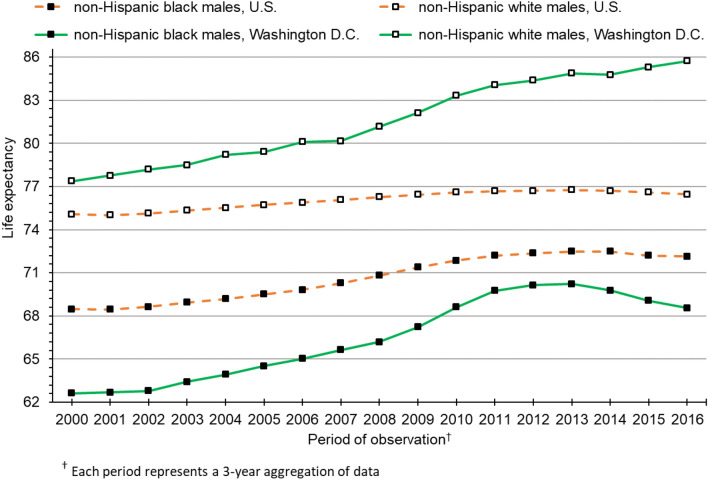
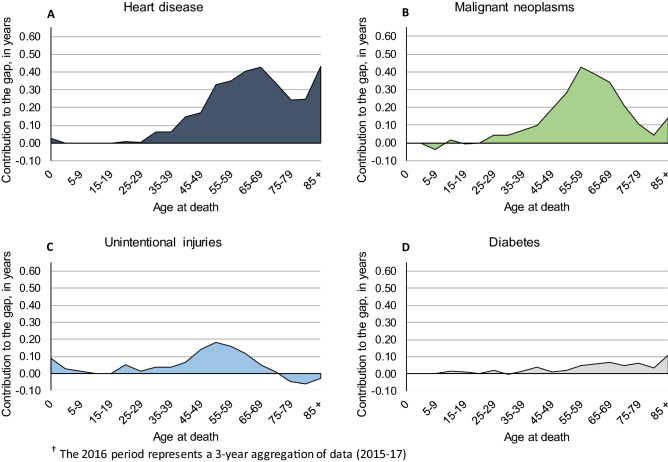
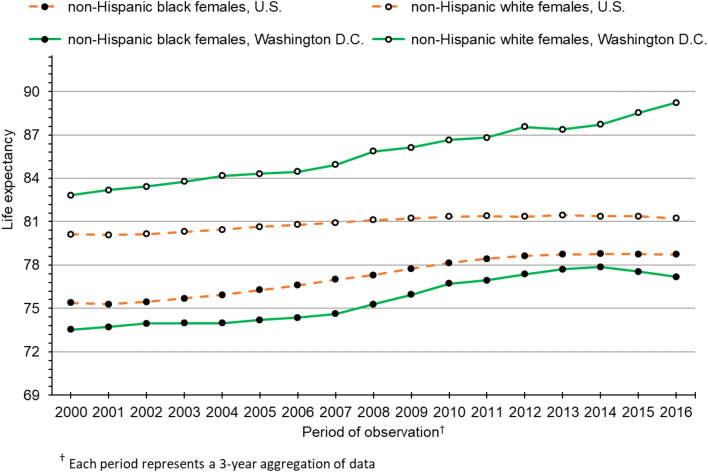
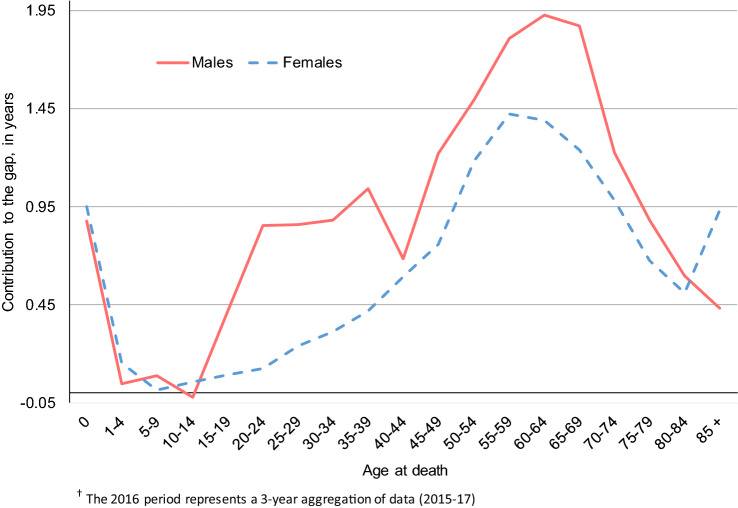
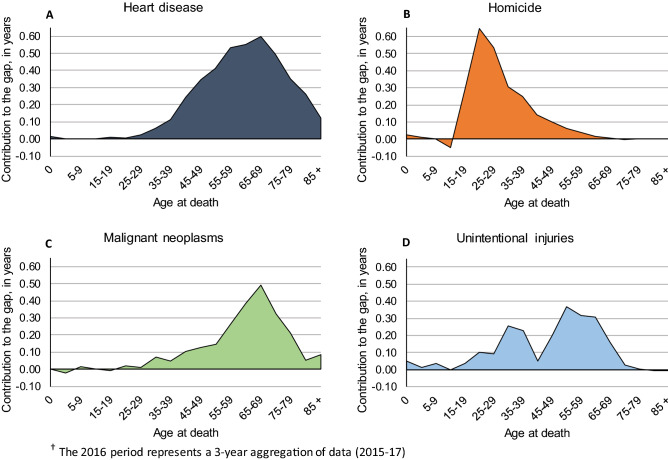
Although the black-white gap in life expectancy has been shrinking in the U.S., national improvement conceals ongoing disparities. Nowhere is this more evident than Washington D.C., where the black-white gap has persistently exceeded 10 years. Using 1999-2017 mortality data from the National Center for Health Statistics, we employed demographic techniques to pursue three aims: first, we created period life tables to examine longevity trends in Washington D.C.; second, we decomposed black-white life expectancy differences into 23 causes of death in three time periods (2000, 2008, 2016); third, we assessed age-specific contributions for each cause of death. Findings revealed that heart disease (4.14 years), homicide (2.43 years), and cancer (2.30 years) contributed most to the 17.23-year gap among males in 2016. Heart disease and cancer contributed most at ages 55-69; homicide contributed most at ages 20-29. Among females in 2016, heart disease (3.24 years), cancer (2.36 years), and unintentional injuries (0.85 years) contributed most to the 12.06-year gap. Heart disease and cancer contributed most at ages 55-69, and unintentional injuries at ages 50-59. Our investigation provides detailed evidence about contributors to the black-white longevity gap in Washington D.C., which can aid in the development of targeted public health interventions.
尽管美国的预期寿命的黑白差距一直在缩小,但国家层面的改善掩盖了持续存在的差距。在华盛顿特区,这种差距最为明显,黑白差距持续超过 10 年。我们使用国家卫生统计中心 1999-2017 年的死亡率数据,采用人口统计学技术来实现三个目标:首先,我们创建了时期生命表,以研究华盛顿特区的长寿趋势;其次,我们将黑人和白人的预期寿命差异分解为三个时期(2000 年、2008 年和 2016 年)的 23 种死因;最后,我们评估了每种死因在特定年龄的贡献。研究结果表明,心脏病(4.14 年)、凶杀(2.43 年)和癌症(2.30 年)是导致 2016 年男性 17.23 年差距的主要原因。心脏病和癌症在 55-69 岁年龄组的贡献最大;凶杀在 20-29 岁年龄组的贡献最大。在 2016 年的女性中,心脏病(3.24 年)、癌症(2.36 年)和意外伤害(0.85 年)是导致 12.06 年差距的主要原因。心脏病和癌症在 55-69 岁年龄组的贡献最大,意外伤害在 50-59 岁年龄组的贡献最大。我们的调查提供了关于华盛顿特区黑白长寿差距的详细原因,这有助于制定有针对性的公共卫生干预措施。