Health Policy and Systems Division, School of Public Health and Family Medicine, Faculty of Health Sciences, University of Cape Town, Cape Town, South Africa.
Int J Health Policy Manag. 2021 Jul 1;10(7):414-429. doi: 10.34172/ijhpm.2020.159.
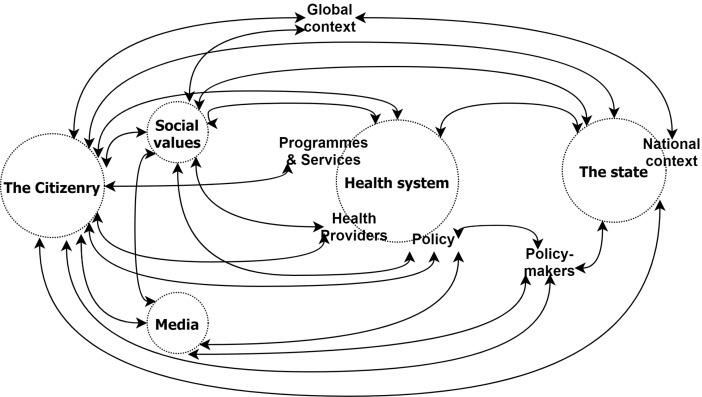
Health systems are complex social systems, and values constitute a central dimension of their complexity. Values are commonly understood as key drivers of health system change, operating across all health systems components and functions. Moreover, health systems are understood to influence and generate social values, presenting an opportunity to harness health systems to build stronger, more cohesive societies. However, there is little investigation (theoretical, conceptual, or empirical) on social values in health policy and systems research (HPSR), particularly regarding the capacity of health systems to influence and generate social values. This study develops an explanatory theory for the 'social value of health systems.'
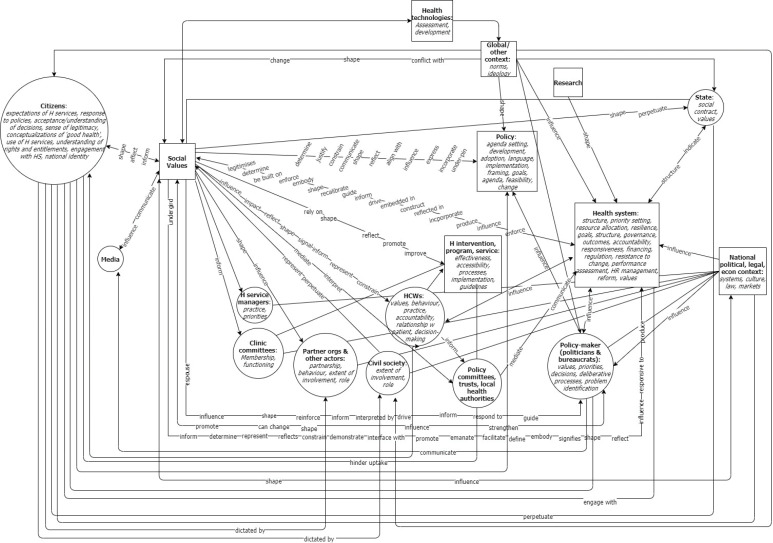
We present the results of an interpretive synthesis of HPSR literature on social values, drawing on a qualitative systematic review, focusing on claims about the relationship between 'health systems' and 'social values.' We combined relational claims extracted from the literature under a common framework in order to generate new explanatory theory.
We identify four mechanisms by which health systems are considered to contribute social value to society: Health systems can: (1) offer a unifying national ideal and build social cohesion, (2) influence and legitimise popular attitudes about rights and entitlements with regard to healthcare and inform citizen's understanding of state responsibilities, (3) strengthen trust in the state and legitimise state authority, and (4) communicate the extent to which the state values various population groups.
We conclude that, using a systems-thinking and complex adaptive systems perspective, the above mechanisms can be explained as emergent properties of the dynamic network of values-based connections operating within health systems. We also demonstrate that this theory accounts for how HPSR authors write about the relationship between health systems and social values. Finally, we offer lessons for researchers and policy-makers seeking to bring about values-based change in health systems.
卫生系统是复杂的社会系统,而价值观是其复杂性的一个核心维度。价值观通常被理解为推动卫生系统变革的关键因素,作用于卫生系统的所有组成部分和功能。此外,卫生系统被认为会影响和产生社会价值观,从而提供了一个利用卫生系统建设更强大、更具凝聚力的社会的机会。然而,在卫生政策和系统研究(HPSR)中,对社会价值观的研究(理论、概念或实证)很少,特别是关于卫生系统影响和产生社会价值观的能力。本研究为“卫生系统的社会价值”发展了一个解释性理论。
我们展示了对 HPSR 文献中关于社会价值观的解释性综合的结果,该综合利用了定性系统评价,重点关注关于“卫生系统”和“社会价值观”之间关系的主张。我们将文献中提取的关系主张纳入一个共同框架下,以生成新的解释性理论。
我们确定了卫生系统被认为对社会贡献社会价值的四个机制:卫生系统可以:(1)提供一个统一的国家理想,建立社会凝聚力;(2)影响和使人们对医疗保健的权利和权益的态度合法化,并使公民了解国家的责任;(3)增强对国家的信任,并使国家权威合法化;(4)传达国家对各人群的重视程度。
我们得出结论,从系统思维和复杂适应系统的角度来看,上述机制可以解释为在卫生系统内运作的基于价值观的连接的动态网络中的涌现属性。我们还表明,该理论解释了 HPSR 作者如何撰写卫生系统与社会价值观之间的关系。最后,我们为寻求在卫生系统中实现基于价值观的变革的研究人员和政策制定者提供了一些经验教训。