School of Mechanical Engineering, Xi'an Jiaotong University, Xi'an, China.
Shaanxi Key Laboratory of Intelligent Robot, Xi'an Jiaotong University, Xi'an, China.
Med Biol Eng Comput. 2020 Nov;58(11):2685-2698. doi: 10.1007/s11517-020-02236-3. Epub 2020 Aug 29.
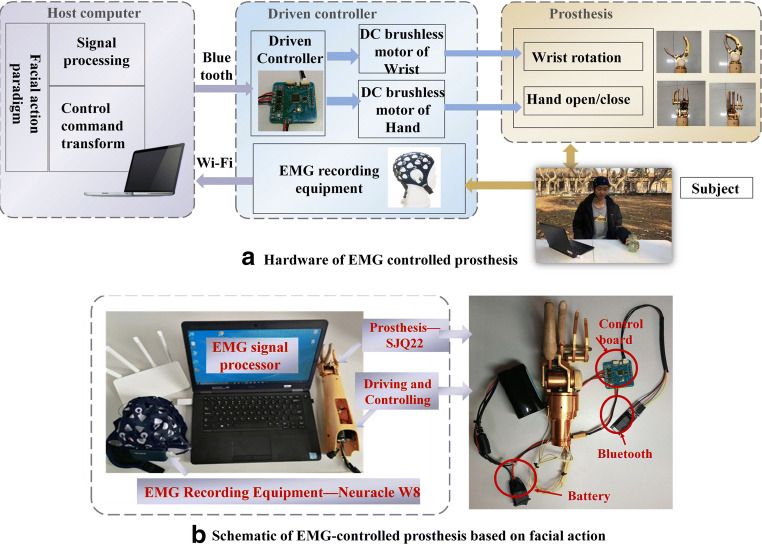
Individuals with severe tetraplegia frequently require to control their complex assistive devices using body movement with the remaining activity above the neck. Electromyography (EMG) signals from the contractions of facial muscles enable people to produce multiple command signals by conveying information about attempted movements. In this study, a novel EMG-controlled system based on facial actions was developed. The mechanism of different facial actions was processed using an EMG control model. Four asymmetric and symmetry actions were defined to control a two-degree-of-freedom (2-DOF) prosthesis. Both indoor and outdoor experiments were conducted to validate the feasibility of EMG-controlled prostheses based on facial action. The experimental results indicated that the new paradigm presented in this paper yields high performance and efficient control for prosthesis applications. Graphical abstract Individuals with severe tetraplegia frequently require to control their complex assistive devices using body movement with the remaining activity above the neck. Electromyography (EMG) signals from the contractions of facial muscles enable people to produce multiple command signals by conveying information about attempted movements. In this study, a novel EMG-controlled system based on facial actions was developed. The mechanism of different facial actions was processed using an EMG control model. Four asymmetric and symmetry actions were defined to control a two-degree-of-freedom (2-DOF) prosthesis. Both indoor and outdoor experiments were conducted to validate the feasibility of EMG-controlled prostheses based on facial action. The experimental results indicated that the new paradigm presented in this paper yields high performance and efficient control for prosthesis applications.
严重四肢瘫痪的个体经常需要使用颈部以上剩余活动来控制复杂的辅助设备,通过面部肌肉收缩产生的肌电图 (EMG) 信号,人们可以通过传达有关尝试运动的信息来产生多个命令信号。在这项研究中,开发了一种基于面部动作的新型 EMG 控制系统。使用 EMG 控制模型处理不同面部动作的机制。定义了四个不对称和对称动作来控制两自由度(2-DOF)假体。进行了室内和室外实验,以验证基于面部动作的 EMG 控制假体的可行性。实验结果表明,本文提出的新范例为假体应用提供了高性能和高效控制。