School of Cancer & Pharmaceutical Sciences, Faculty of Life Sciences & Medicine, King's College London, London, UK.
Public Health England Screening, Screening Quality Assurance Service, Birmingham, UK.
J Med Screen. 2021 Sep;28(3):325-332. doi: 10.1177/0969141320953446. Epub 2020 Aug 30.
English cervical screening programme guidelines changed between 2009 and 2012. We explore the impact on the age and intervals at which women receive a cytology test.
Eligible women were controls from a population-based case-control study in England. Tests taken between 1980 and 2017 were extracted from the call/recall database. Using the Kaplan-Meier estimator by birth cohort and age at (or time since) last test, we explore proportions tested since or prior to a given age, years since previous test, and interval following a negative test.
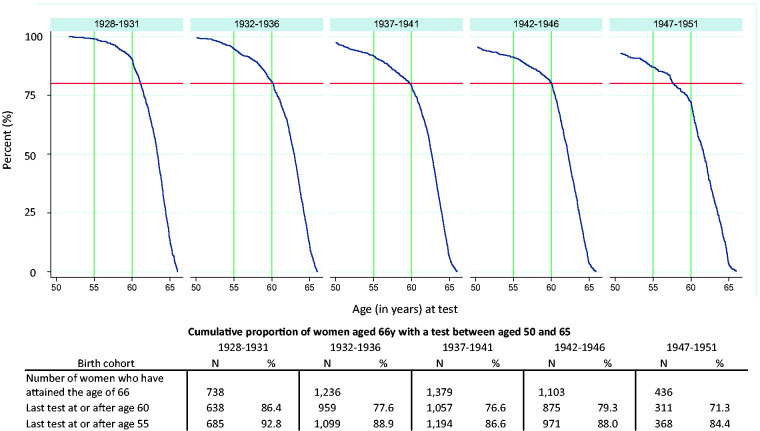
Screening histories from 46,037 women were included. Proportion tested by age 26 has increased from 55% among birth cohorts 1978-1979 to 67% among those born 1990-1991, despite more recent cohorts only having received one invitation (instead of two) prior to age 26. The proportion of women tested at aged 28 with a test three years earlier increased by 20% (from 36% in 1997-2006 to 56% in 2012-2017) whereas the proportion tested at ages 23-27 without a prior test increased from 34% to 80%. The age at last test prior to exiting the programme has decreased: among those born 1928-1931 86% had a test aged 60-65, but only 71% of those born 1947-1951.
Clear programme guidance alongside quality assurance has improved the cervical screening programme by standardising the age and intervals at which women are screened.
2009 年至 2012 年间,英国宫颈筛查项目指南发生了变化。我们探讨了这对女性接受细胞学检查的年龄和间隔的影响。
合格的女性是来自英格兰基于人群的病例对照研究的对照者。从呼叫/召回数据库中提取了 1980 年至 2017 年间进行的检测。按出生队列和上次检测时的年龄(或距上次检测的时间)使用 Kaplan-Meier 估计器,我们探讨了在特定年龄之前或之后接受检测的比例、上次检测后的年数以及阴性检测后的间隔。
共纳入了 46037 名女性的筛查史。尽管最近的队列在 26 岁之前只收到一次邀请(而不是两次),但出生队列 1978-1979 年的 26 岁前接受检测的比例从 55%增加到了 1990-1991 年的 67%。28 岁时进行的检查比例增加了 20%(从 1997-2006 年的 36%增加到 2012-2017 年的 56%),而未经前次检查在 23-27 岁之间进行检查的比例从 34%增加到 80%。退出项目前最后一次检测的年龄已经下降:出生于 1928-1931 年的人中有 86%在 60-65 岁时接受了检测,但出生于 1947-1951 年的人中只有 71%接受了检测。
明确的项目指导和质量保证通过标准化女性接受筛查的年龄和间隔,改善了宫颈筛查项目。