550512International Isocyanate Institute, Inc. (III), Boonton, NJ, USA.
Toxicol Ind Health. 2020 Nov;36(11):876-884. doi: 10.1177/0748233720947202. Epub 2020 Aug 31.
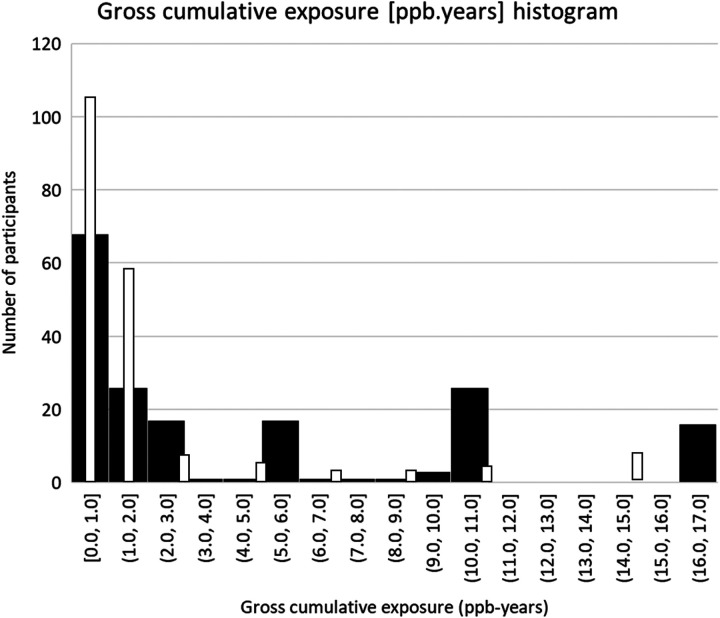
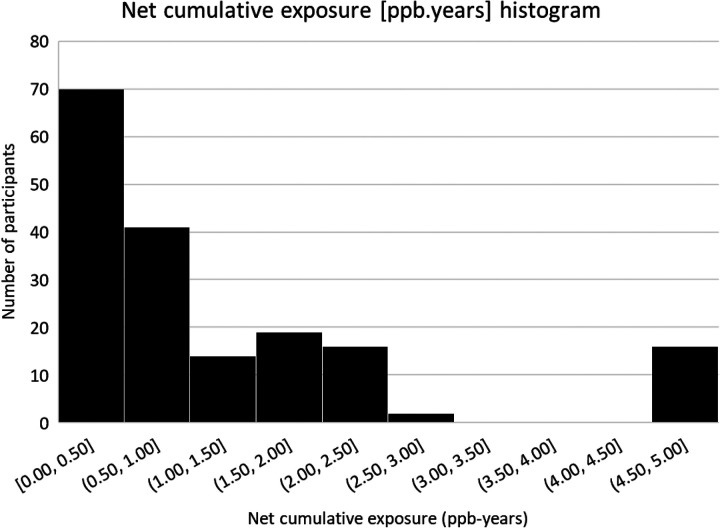
The anonymized data of an epidemiology study on incidence of toluene diisocyanate (TDI)-related occupational asthma in three US-based TDI production facilities have been reanalyzed to identify where to best focus exposure reduction efforts in industrial practice to reduce the risk of sensitization to TDI. Since the induction of sensitization has sometimes been attributed to cumulative exposure, this relationship was examined first. Gross cumulative exposure values (i.e. not taking into account whether respiratory protection was used or not) and net cumulative exposure values (i.e. accounting for the use of respiratory protection) per participant were calculated based on the duration of their study participation and the average time-weighted average value of the exposure group to which they belonged. These two sets of cumulative exposure data were compared with asthma incidence using logistic regression. Incidence was zero among workers who rarely come into contact with open plant systems (e.g. during maintenance or spills). Notwithstanding, no statistically significant relationship between asthma incidence and either gross or net cumulative exposure could be determined. This is shown to be consistent with the results of several other epidemiology studies on TDI-related occupational asthma. In conclusion, cumulative exposure values are not a good indicator of the risk of developing TDI-related occupational asthma.
对三所美国 TDI 生产工厂中甲苯二异氰酸酯(TDI)相关职业性哮喘发病率的流行病学研究的匿名数据进行了重新分析,以确定在工业实践中应在哪里集中精力减少暴露,从而降低对 TDI 致敏的风险。由于致敏的诱导有时归因于累积暴露,因此首先检查了这种关系。根据参与者的研究参与时间和所属暴露组的平均时间加权平均值,计算了每位参与者的总累积暴露值(即不考虑是否使用呼吸保护)和净累积暴露值(即考虑使用呼吸保护)。使用逻辑回归将这两组累积暴露数据与哮喘发病率进行了比较。在很少接触开放式工厂系统(例如在维护或溢出期间)的工人中,发病率为零。尽管如此,仍无法确定哮喘发病率与总或净累积暴露之间存在统计学上的显著关系。这与其他几项关于 TDI 相关职业性哮喘的流行病学研究结果一致。总之,累积暴露值不是发展 TDI 相关职业性哮喘风险的良好指标。